
Introduction
A business owner gets a term sheet. An investor wants in, or a competitor wants to buy the company outright. The seller's instinct is to hand over last year's financial statements and call it done.
That's a mistake that costs deals — or worse, closes them at the wrong price.
Standard bookkeeping and even a routine audit weren't built to answer the questions a buyer or investor actually has:
- Are these earnings sustainable?
- Is working capital adequate?
- What's hiding in the indirect cost pools?
That's where accounting due diligence comes in, and it's frequently confused with a basic audit.
This article breaks down what accounting due diligence actually involves, how it differs from an audit, the three core types of diligence, the "Four P's" framework buyers use, and how the process unfolds from first document request to final report.
Key Takeaways
- Accounting due diligence is a transaction-specific investigation, not a compliance checkbox like an audit.
- 2–3 years of financial history, interim data, and forecast assumptions are the usual review scope.
- Financial, legal, and commercial diligence anchor most deal reviews.
- Government contractors face extra scrutiny around indirect rates and DCAA-compliant accounting systems.
- Staying "due diligence ready" year-round beats scrambling once a deal is on the table.
What Is Accounting Due Diligence?
Before a deal closes, buyers need more than a clean-looking P&L. They need proof the numbers hold up under scrutiny.
Accounting due diligence is the investigation and verification of a company's financial records, systems, and underlying data, performed before a transaction closes. KPMG frames it as a systematic analysis of a target's data that surfaces risks and opportunities in assets, liabilities, financial position, and results: the picture a buyer needs before signing anything (KPMG).
In practice, this means digging into:
- Historical financial statements — usually spanning multiple years, not one
- Working capital trends — composition, drivers, and whether the purchase-agreement figure reflects reality
- Quality of earnings — normalizing one-time items to find what profit is actually repeatable
- **Accounting systems and internal controls** — can the numbers be trusted in the first place
- Forecast assumptions — is management's growth story grounded in anything real
Why It Matters for Deal Terms
Diligence does more than confirm the numbers. It uncovers hidden liabilities, stress-tests valuation assumptions, and shapes the deal itself: purchase price adjustments, indemnities, warranties, and escrow terms all shift based on what turns up.
Who Performs It
Accounting due diligence is typically led by M&A professionals, CPAs, corporate finance specialists, or an investor's internal corporate development team. Many companies outsource this work to specialized advisory firms rather than building the capability in-house, especially on complex deals where the buyer's finance team lacks transaction experience.
Timelines vary with deal size and the target's recordkeeping quality. Clean books and organized records move faster than scattered spreadsheets and undocumented processes, which is why readiness matters long before a deal is on the table.
Bookkeeping records transactions as they happen. Due diligence tests whether those records tell the truth, survive buyer scrutiny, and support the valuation on the table.
Below: what the review covers, how findings change deal terms, and who typically runs the work.
Due Diligence vs. Audit: Is FDD Just a Glorified Audit?
An audit and financial due diligence (FDD) are not the same exercise. Treating them as interchangeable is one of the most common mistakes in deal work.
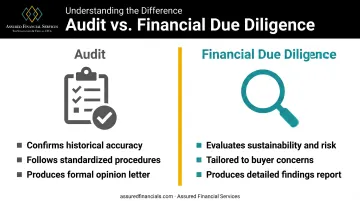
An audit exists to give assurance that management has presented a true and fair view of the company's financial performance for a given period. FDD asks a different question entirely: are the underlying economic earnings sustainable, and what does the buyer need to know before writing a check (MLR CPAs and Advisors)?
Key Differences
| Factor | Audit | Accounting Due Diligence |
|---|---|---|
| Purpose | Confirms historical accuracy and compliance | Evaluates sustainability, risk, and deal fit |
| Scope | Follows standardized audit procedures | Tailored to buyer-specific concerns |
| Time period | Primarily historical financial statements | Historical trends plus forecasts and interim data |
| Flexibility | Rule-bound, consistent methodology | Customized to the specific transaction |
| Deliverable | Formal opinion letter | Detailed findings report with recommendations |
Two differences show up most clearly in practice:
- Regulatory posture: Audit procedures follow defined rules. FDD is shaped around buyer-specific risks such as customer concentration, indirect rate structures for a government contractor, or cross-border tax exposure.
- Deliverable: Sell-side FDD produces an independent report built around concerns a prospective buyer is likely to raise, not a generic compliance opinion.
FDD is not a glorified audit. It is a broader, deal-specific analysis meant to support a decision: proceed, walk away, or renegotiate—not merely to certify that last year's numbers were fairly presented.
The Three Main Types of Due Diligence
Due diligence can branch into many specialties depending on the deal — tax, operational, HR, technology, cybersecurity. But most transactions rest on three foundational reviews.
Financial (Accounting) Due Diligence
Financial due diligence verifies financial statements, cash flow patterns, and earnings quality. This workstream tests whether the numbers being sold to you actually hold up.
Legal Due Diligence
Legal due diligence reviews contracts, pending or threatened litigation, regulatory compliance, and corporate structure. It answers a simple question: is there anything in the paperwork that could blow up after closing?
Commercial Due Diligence
Commercial due diligence assesses market position, customer concentration, growth potential, and competitive landscape (Investopedia). This is where a buyer figures out if the company's growth story is believable.
Tax and operational diligence often get folded into the financial and commercial reviews rather than run as standalone workstreams. On more complex deals—especially cross-border transactions or government contracts—they frequently get pulled out and treated separately.
The Four P's of Due Diligence
Beyond the balance sheet, many buyers and investors organize their evaluation around a simple mental model: the Four P's.
- People — Leadership team quality, key employee retention risk, organizational culture
- Product — Differentiation, quality, and long-term sustainability of what the company actually sells
- Prospects — Market growth potential, competitive positioning, pipeline strength
- Paper — The financial statements, contracts, and compliance documentation underneath everything else
Analysts often group the same ground into two buckets (Investopedia). Hard due diligence is the quantitative review of financial statements and data. Soft due diligence covers management quality, customer loyalty, and employee motivation.
Paper and Prospects lean hard. People and Product lean soft. A deal that looks flawless on paper but rests on one irreplaceable founder is still a risky deal. The Four P's exist to catch that gap.
How the Accounting Due Diligence Process Works
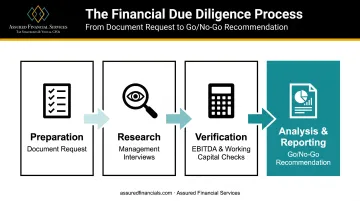
Accounting due diligence typically unfolds in four stages once a letter of intent is signed.
Preparation: Confirming strategic fit, assembling the diligence team, and building a document request checklist covering financial statements, tax filings, contracts, and organizational records.
Research: Gathering and reviewing the requested documents, then conducting management interviews to understand the story behind the numbers—not just the figures themselves.
Verification: Cross-checking figures against source documents, testing for irregularities, and calculating adjusted EBITDA, net working capital, and net debt. This is the analytical core of the process.
Analysis & Reporting: Compiling findings into a report that supports a go/no-go recommendation and flags deal-term adjustments such as a price reduction, escrow holdback, or specific indemnity language.
Findings from this process feed directly into risk mitigation planning, pricing mechanisms, and the final structure of the purchase agreement.
Timeline benchmark: There is no fixed number of weeks that fits every deal. Duration depends on target complexity:
- Clean, audit-ready books and a single legal entity usually move through diligence quickly
- Messy records, multiple subsidiaries, or government contract obligations slow the work considerably
Who Needs Accounting Due Diligence & How to Prepare
Three groups typically need accounting due diligence:
- Buyers evaluating an acquisition target
- Sellers preparing for a sale, often called sell-side due diligence, run before a buyer ever sees the books
- Businesses undergoing capital raises, ownership changes, or contract transitions
Preparation should start well before a deal is on the table:
- Gather three years of financial statements, tax returns, and supporting schedules
- Document revenue recognition policies, customer concentration, and working capital trends
- Resolve known accounting issues and reconcile related-party balances
- Confirm cost allocations and your chart of accounts can withstand third-party review
The Added Complexity for Government Contractors
For government contractors, those same steps carry extra weight. Ownership changes or contract novations can trigger DCAA and FAR-driven review of indirect rate structures and accounting systems.
Fringe, overhead, and G&A pools need to be defensible, and direct-versus-indirect classifications need to hold up. The accounting system itself must meet standards like SF1408, not only when a deal is on the table but continuously.
Continuous readiness is the practical answer, and that is the model Assured Financial Services is built around. AFS pairs fractional and virtual CFO support with GovCon accounting expertise so diligence fundamentals stay in place year-round:
- Designing and monitoring fringe, overhead, G&A, and material-handling pools for FAR compliance
- Configuring accounting systems in Deltek Costpoint, Unanet, or QuickBooks Online, matched to the contractor's size and contract mix
- Maintaining job-costing structures, labor-charging controls, and internal controls that hold up under a DCAA floor check
- Providing cash-flow monitoring, working capital oversight, and financial reporting through its Fractional CFO service, the same fundamentals a buyer's diligence team will test first
Because AFS keeps an in-house, U.S.-based team with security-cleared staff, it can also support ownership transitions involving sensitive or classified program work, something most general accounting firms are not equipped to handle.

The smoothest transactions belong to businesses that kept their books clean all along, not those that scrambled the month before closing.
Frequently Asked Questions
What is accounting due diligence?
Accounting due diligence is a detailed, transaction-focused review of a company's financial records performed to verify accuracy and uncover risk before a deal closes. It goes beyond compliance to inform pricing and deal terms.
What are the three main types of due diligence?
Financial, legal, and commercial due diligence form the three foundational pillars most transactions rely on. Tax and operational reviews are often folded into these depending on deal complexity.
Is FDD a glorified audit?
No. FDD is broader and more strategic, covering multiple years, forecasts, and deal-specific risk analysis rather than a single compliance opinion. An audit certifies the past; FDD evaluates the deal.
What are the four P's of due diligence?
People, Product, Prospects, and Paper — a framework used to evaluate a target's leadership, offering, growth potential, and financial documentation beyond raw numbers.
How long does the accounting due diligence process take?
Timelines vary widely based on deal size, industry, and recordkeeping quality. Companies with clean, organized books move through the process considerably faster than those with disorganized records.
Who typically performs accounting due diligence?
CPAs, M&A advisory teams, or specialized financial advisory firms — such as Assured Financial Services (AFS) — typically lead the process, either as an outsourced engagement or through internal corporate development teams.