Introduction
Search "tax law specialist" and you'll likely land on a law school's career page or a bar association's certification portal. Neither tells you what you actually need to know.
If you're a business owner facing an IRS audit notice, cross-border income, or government contract compliance, those results don't help. You need to know which credential solves your specific issue before you spend a dollar.
"Tax law specialist" is almost never a formal title. It's a phrase anyone can slap on a website. There's exactly one narrow exception, and it's rarer than most people realize.
This guide breaks down what the term actually means, the real credentials behind it (EA, CPA, tax attorney, board-certified specialist), what each one costs, and how to pick the right fit for your situation.
Key Takeaways
- "Tax law specialist" is usually a marketing label, not a licensed credential, in nearly every state
- True Board-Certified Tax Law Specialist status exists in only a few states and takes years of exams plus peer review
- IRS Enrolled Agents have unlimited representation rights before the IRS in all 50 states
- Tax attorneys are essential for litigation and criminal defense, not routine compliance work
- Most businesses need year-round tax planning, not a once-a-year filing relationship
What Is a Tax Law Specialist?
In most states, "tax law specialist" describes a focus area, not a license. Nothing stops a general practitioner or accountant from putting that phrase on a business card. There's no exam requirement and no oversight body checking whether the claim is accurate.
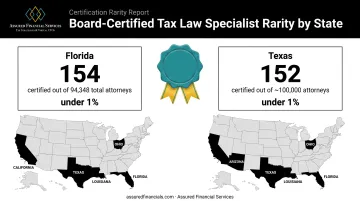
The one real exception is narrow. A small number of state bars run formal Board-Certified Tax Law Specialist programs, including:
- California (Certified Specialist in Taxation Law)
- Texas (Board Certified in Tax Law)
- Florida (Board Certified in Tax Law)
- Arizona, Ohio, and Louisiana (similar tax-specific certifications)
These programs require years of documented tax-law experience, a written exam, peer review, and periodic recertification. Florida's standard, for example, calls for at least 500 tax-law hours annually across three years plus 90 hours of continuing education.
Just How Rare Is This Credential?
Genuinely rare. Florida's official registry listed 154 Board Certified Tax Law lawyers against roughly 94,348 total eligible members statewide, putting certified specialists at well under 1% of practicing attorneys. Texas shows a nearly identical pattern, with about 152 certified specialists out of nearly 100,000 active attorneys.
Outside this narrow legal designation, "specialist" simply describes someone's focus, whether that's an attorney, a CPA, or an Enrolled Agent. The credential behind the label matters far more than the word itself.
Types of Tax Law Professionals (and Which One You Actually Need)
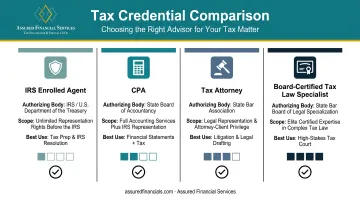
Four distinct credentials get grouped under the "tax specialist" umbrella. Each has a different scope, and picking the wrong one wastes money or leaves you underprotected.
IRS Enrolled Agent (EA)
An Enrolled Agent is a federally licensed tax practitioner authorized directly by the U.S. Department of the Treasury. It's the highest credential the IRS itself awards, earned through a three-part exam or prior IRS experience. EAs also complete 72 hours of continuing education every three years.
According to the IRS, EAs hold unlimited representation rights before the IRS in all 50 states—audits, collections, appeals, and any tax matter, for any taxpayer. That's not a state license with geographic limits. It's federal authority.
Choose an EA for tax preparation, planning, and IRS resolution when you need federal representation without law-firm overhead. Assured Financial Services is led by an IRS Enrolled Agent, so clients get that representation on routine compliance and planning work.
Certified Public Accountant (CPA)
CPAs are licensed by state boards of accountancy after passing the Uniform CPA Exam and meeting state-specific experience requirements. Their core training centers on financial reporting and tax preparation.
CPAs can represent clients before the IRS with the same unlimited scope as EAs. What they can't do is practice law. A CPA license doesn't authorize legal advice, contract drafting, or courtroom representation.
A CPA is often the better fit when you also need audited or reviewed financials, broader accounting oversight, or a practitioner steeped in financial reporting—not only tax controversy.
Tax Attorney
Tax attorneys are admitted to practice law by a state bar, typically after earning a J.D. and passing the bar exam. This makes them the right choice for:
- Tax Court litigation
- Criminal tax defense
- Complex legal drafting, such as trust structuring and entity formation
The tradeoff is cost. Attorney-client privilege and courtroom standing come at a premium hourly rate. For a business whose issue is compliance-driven rather than an actual legal dispute, that premium often buys protection you don't need yet.
Board-Certified Tax Law Specialist
This is the legal-only designation covered earlier, granted by a state bar's Board of Legal Specialization after years of documented experience and a specialty exam. It's an attorney credential layered on top of a law license, not a separate practice right.
It matters most when litigation is already on the horizon. For planning, compliance, or IRS resolution work, an EA or CPA typically covers the need without the added legal-specialty premium.
Quick pick: which one you actually need
- Tax prep, planning, or IRS resolution → EA or CPA
- Financial statements plus tax → CPA
- Litigation, criminal tax, or legal drafting → Tax attorney
- High-stakes tax court specialty → Board-certified tax law specialist
What Does a Tax Law Specialist Actually Do?
Regardless of which credential you hire, the work generally falls into four buckets:
- Tax planning and strategy — entity structure, income timing, deduction planning
- Compliance and filing — federal, state, and specialty returns
- Audit representation — responding to IRS or state audit notices
- Dispute resolution — offers in compromise, installment agreements, penalty abatement
Most of this work happens far from a courtroom. Litigation is a small slice of total tax cases; the daily reality for most businesses is proactive planning and steady compliance.
Certain niches demand deeper specialization:
- Cross-border tax — FBAR and FATCA reporting, foreign entity filings (Forms 5471 and 5472), and multi-jurisdiction planning
- Government contractor (GovCon) work — DCAA-compliant accounting systems, indirect rate structuring, and Incurred Cost Submissions
Most general preparers simply haven't touched these areas.
AFS builds its cross-border practice around exactly this kind of detail. FBAR filing, for instance, kicks in once foreign account balances exceed $10,000 at any point during the year under FinCEN's reporting rule. Miss the filing and the penalties aren't trivial.
On the GovCon side, AFS handles chart-of-accounts design, job costing, indirect rate pools, and platform setup on Deltek Costpoint, Unanet, or QuickBooks Online. That work is configuration-dependent, not something any accounting software solves on its own.
When Do You Actually Need One?
Certain triggers signal it's time to bring in specialized help instead of relying on a general preparer:
- An IRS audit notice arrives — correspondence, office, or field audits all carry deadlines and documentation requirements
- Back taxes or wage garnishment begin — collections escalate quickly once the IRS starts levying accounts
- You expand into cross-border business — foreign income, accounts, or entities create new reporting obligations overnight
- Revenue growth outpaces DIY filing — at a certain size, a filing mistake carries real financial risk, not just an inconvenience
Government contractors face a trigger point most other businesses never encounter. Pursuing a first cost-type contract or preparing for a DCAA pre-award survey requires a compliant accounting system before the contract even starts. Waiting until after the award notice arrives is usually too late.
A year-round advisory relationship does more than a once-a-year filing engagement. It surfaces most of these triggers early—while you still have time, options, and leverage.
How Much Does a Tax Law Specialist Cost?
Fees scale with credential type and complexity, not a flat industry rate. Attorneys generally command the highest hourly rates because litigation risk and legal training carry a premium that EAs and CPAs don't factor into their pricing.
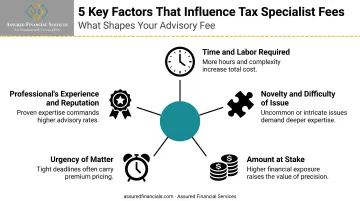
In the U.S., simple compliance or return work often falls in a lower band, while IRS representation, offers in compromise, and cross-border structuring run higher—sometimes several hundred dollars per hour for attorney-led matters. A few factors drive the actual number, consistent with American Bar Association fee-setting guidance:
- Time, labor, and required skill level
- Novelty and difficulty of the tax issue
- Amount of money at stake
- Urgency of the matter
- The professional's experience and reputation
Simple compliance work costs far less than IRS representation or cross-border structuring. A straightforward business return is a fraction of the cost of negotiating an offer in compromise or unwinding a multi-entity foreign structure.
Because pricing hinges on your facts, scope the cost before you commit. Assured Financial Services (AFS) offers a free 30-minute consultation with no minimum engagement, so you can see what the work involves before signing anything.
How to Choose the Right Tax Law Specialist
Website claims aren't verification. Check credentials directly:
- EA status — verify through the IRS's own enrolled agent lookup
- CPA license — confirm via your state board of accountancy or NASBA's CPAverify database
- Attorney bar status — check the state bar's official directory
- Board certification — confirm through the certifying bar's specialization registry, not the general bar record
Watch for marketing gimmicks. Self-proclaimed "expert" status, vague claims of "IRS experience," and awards like "Super Lawyers" carry no formal credentialing weight. None of these require an exam, peer review, or ongoing education.
Ask directly whether the specialist handles your actual niche. GovCon compliance, cross-border reporting, and IRS resolution each require distinct expertise. General tax prep dressed up as specialization won't hold up when DCAA shows up for a pre-award survey or the IRS opens a foreign account inquiry.
How they work with you matters as much as what they know. A proactive, year-round advisory setup—with quarterly reviews and ongoing strategy—catches problems earlier than a once-a-year filing service ever could.
Assured Financial Services (AFS) runs a principal-led, in-house, U.S.-based model built around that kind of ongoing relationship, which matters most for businesses with genuine complexity. Start with a direct consultation to confirm fit before signing anything.
Frequently Asked Questions
How much does a tax law specialist cost in the US?
Costs vary by credential type and complexity, from flat-fee compliance work to significantly higher hourly rates for attorney-led litigation. Most reputable firms offer a free initial consultation to scope cost before you commit, including Assured Financial Services.
What is the difference between a tax attorney and a tax specialist?
"Tax specialist" is a general descriptor anyone can use, while "tax attorney" refers to a specific licensed legal role requiring bar admission. EAs and CPAs can also specialize deeply in tax without holding a law degree.
Is an IRS Enrolled Agent as qualified as a tax attorney?
For IRS matters, yes. EAs hold the highest credential the IRS awards, with unlimited representation rights nationwide. Attorneys become necessary only for court litigation or criminal tax defense.
What is a Board-Certified Tax Law Specialist?
A Board-Certified Tax Law Specialist is a rare legal designation granted by a handful of state bars after a rigorous exam, peer review, and years of documented tax-law experience. It is distinct from the general marketing use of "specialist."
Do I need a tax attorney to deal with the IRS?
Not usually. EAs and CPAs can represent taxpayers before the IRS for audits, collections, and most disputes. An attorney becomes necessary mainly for Tax Court litigation or criminal cases.
Can an Enrolled Agent represent me in every state?
Yes. EAs hold a federal license, not a state one, so they can represent taxpayers before the IRS in all 50 states regardless of where the EA is physically located.