The market has grown fast enough to attract both. The global virtual CFO market was valued at $7.8 billion in 2024 and is projected to reach $17.9 billion by 2030, a 12.5% annual growth rate, according to a 2025 report from Strategic Market Research. More providers means more noise to sort through.
Hiring the wrong one costs months of runway and leaves cash flow visibility, compliance, and capital-raising readiness no better than before. This guide covers what a fractional CFO actually does, and the factors worth checking before you sign anything.
TL;DR
- A fractional CFO delivers executive-level financial strategy part-time or on contract, not bookkeeping or controller-level work
- Vet real CFO tenure, industry fluency, engagement scope, and pricing clarity—not just a polished title
- Get forecasting, cash management, compliance, and capital strategy without a six-figure full-time salary
- Reassess fit as complexity grows—hiring is ongoing, not a one-time transaction
What Is a Fractional CFO?
A fractional CFO is a part-time or contract-based financial executive who delivers the same strategic leadership as a full-time CFO, at a fraction of the cost and time commitment.
That said, the label gets used loosely. Three distinct models get lumped under the same "fractional CFO" umbrella, and knowing which one you're actually hiring matters.
| Model | What It Means | Typical Time Pattern |
|---|---|---|
| Fractional CFO | Ongoing part-time strategic leadership, a few hours per week or month | Recurring, long-term |
| Interim CFO | Full-time but temporary, usually covering a leadership gap or transition | Defined period, often 3-12 months |
| Virtual CFO | CFO-level or operational finance work delivered remotely | Varies, part-time or full-time |
Assured Financial Services blends the first and third models.
Its Fractional CFO service covers strategy:
- Long-range planning and capital decisions
- KPI development and pricing
- Investor reporting
Its Virtual CFO service handles the operational side:
- Bookkeeping oversight and cash-flow forecasting
- Accounts payable and receivable
- Payroll coordination
Many clients use both, since strategic questions and day-to-day financial management tend to surface together.
Core Components of a Fractional CFO Engagement
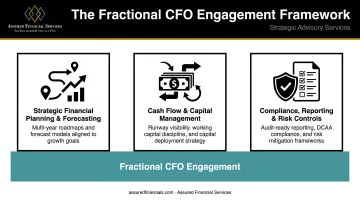
A fractional CFO's job goes well beyond reviewing last month's numbers. Here's what the role actually covers day-to-day, beyond basic bookkeeping or tax prep.
Strategic Financial Planning & Forecasting
This is forward-looking work: building a growth roadmap, modeling cash runway, and stress-testing different scenarios before they happen, not just summarizing what already occurred. A fractional CFO should be able to explain how long your cash lasts under three different growth assumptions, not just what you spent last quarter.
Cash Flow & Capital Management
Ongoing monitoring and forecasting keep leadership from getting blindsided by a tight month. This extends to banking and lending relationships too, positioning the business for a credit line or loan before it's needed, rather than scrambling for one during a cash crunch. Ongoing monitoring and forecasting keep leadership from getting blindsided by a tight month. This extends to banking and lending relationships too, positioning the business for a credit line or loan before it's needed, rather than scrambling for one during a cash crunch.
In practice, that means a rolling cash view, working-capital discipline, and a capital plan that matches your growth timeline—so you approach lenders from strength, not urgency.
Compliance, Reporting & Risk Controls
Internal controls, management reporting, and audit readiness sit in this bucket. For regulated industries, the work gets technical fast.
Government contractors, for example, need accounting systems that meet DCAA standards under SF 1408 criteria before they can win cost-reimbursement contracts, per DCAA's own pre-award accounting system checklist. A fractional CFO without that specific background can miss requirements that trigger payment withholding or a failed audit.
Benefits of Hiring a Fractional CFO
Bringing on a fractional CFO changes more than your org chart. Done well, it shows up in the numbers:
- Gives leadership cash flow visibility weeks before problems become emergencies
- Cuts tax exposure with year-round planning instead of an April scramble
- Strengthens investor and lender confidence with clear KPI reporting and financial narratives
- Builds systems and processes that hold up when revenue doubles
- Delivers CFO-level judgment without a full-time salary and benefits package
You get that impact from the right part-time hire—not a full-time seat on the org chart.
What to Consider When Hiring the Best Fractional CFO in 2026
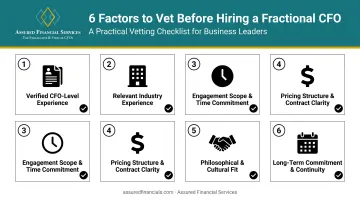
Price shouldn't be the deciding factor, and neither should a polished LinkedIn profile. These six factors help match a candidate's real capabilities to your company's stage and complexity.
Because the fractional CFO space has no licensing requirement or governing body, due diligence isn't optional. Anyone can print business cards that say CFO. Verifying what's behind the title is the actual work of hiring one.
Factor 1: Verified CFO-Level Experience
A title on a resume doesn't confirm anything. Ask how long this person actually held a CFO seat, versus a controller or VP of Finance role rebranded later. Check the revenue scale of companies they served and whether they answered to a board or a lender.
KPI to check: years spent in a true CFO seat, not years spent adjacent to one.
Factor 2: Relevant Industry Experience
Sector fluency eliminates ramp-up time. A CFO who already understands government contracting compliance, cross-border tax exposure, or SaaS metrics starts contributing in week one instead of week twelve.
Metric to ask for: how quickly they can point to measurable impact within the first 90 days. A vague answer is a signal on its own.
Factor 3: Engagement Scope & Time Commitment
Match allocated hours to actual need. A business needing light advisory support shouldn't pay for an embedded strategic partner, and a company mid-raise shouldn't settle for two hours a month.
KPI: hours committed per week or month, tied to specific deliverables agreed on before work starts.
Factor 4: Pricing Structure & Contract Clarity
Understand the billing model before signing anything. Fractional CFO pricing typically runs $150 to $500 per hour, $3,000 to $10,000 per month for a retainer, or $10,000 to $35,000-plus for project-based work like fundraising support, depending on experience and scope.
KPI: cost as a percentage of an equivalent full-time CFO salary. Once a fractional arrangement approaches 70-80% of full-time cost, the math stops making sense.
Factor 5: Philosophical & Cultural Fit
Growth-versus-profitability philosophy matters more than most owners expect going in. A CFO focused on aggressive expansion clashes fast with a founder prioritizing lean profitability. The role also requires someone willing to push back on leadership, not just agree with it.
Misalignment tends to show up as decision-making friction and unusually short engagement lifespans.
KPI: shared stance on growth vs. profitability, plus clear examples of pushing back on leadership decisions.
Factor 6: Long-Term Commitment & Continuity
Some fractional CFOs treat the work as a placeholder while job-hunting for a full-time role. That creates instability right when a business needs consistency most.
KPI: average client tenure, and whether fractional work is the candidate's stated primary, long-term focus rather than a stopgap.
How Assured Financial Services Can Help
Assured Financial Services provides CFO-level leadership through a principal-led, in-house partnership. Based in Bowie, Maryland, the firm works with government contractors, cross-border businesses, and established SMBs generating $5 million or more in annual revenue.
Here's what separates AFS from a typical fractional CFO marketplace or independent contractor:
- Work directly with the founder on every engagement (15+ years in corporate finance and federal GovCon), not a junior associate
- Pair tax strategy with CFO leadership through an IRS Enrolled Agent with unlimited practice rights in all 50 states
- Keep sensitive GovCon and cross-border work with security-cleared, U.S.-based staff—no offshore outsourcing
- Start with a free 30-minute consultation to see whether Fractional CFO, Virtual CFO, or both fit, with no minimum engagement
For government contractors, support also covers Deltek Costpoint, Unanet, or QuickBooks Online implementations, plus DCAA pre-award readiness built around SF 1408 criteria.
If you want a clear read on fit before you commit, start with that free 30-minute consultation.
Conclusion
The right fractional CFO is the one whose experience and philosophy match your business's stage and complexity—not the most credentialed résumé or the lowest rate on the market.
Hiring is only step one. Review the engagement against the KPIs you set at the start—don't treat the hire as a one-time decision.
A CFO who fit at $3 million in revenue may not fit at $15 million with three government contracts and a pending acquisition.
In 2026, more businesses are dropping once-a-year, reactive engagements for proactive, year-round financial partnerships. Complexity doesn't wait for tax season—and neither should the financial leadership managing it. Choose for fit, then keep measuring whether that fit still holds.
Frequently Asked Questions
At what size does a company need a CFO?
$5 million or more in annual revenue is a common reference point, but complexity matters more than revenue alone. Rapid growth, fundraising, or an upcoming acquisition can push that timeline earlier.
How much should a CFO get paid?
Full-time CFO salaries in the U.S. typically range from $195,000 to $320,000 annually, depending on experience and company size. Fractional CFO pay follows a different model—hours or scope, not a full-time salary.
How much does a virtual CFO cost?
Pricing usually falls between $150 and $500 per hour, $3,000 to $10,000 per month on retainer, or $10,000 to $35,000-plus for project work such as fundraising support, depending on experience and scope.
Is a CFO higher than a CEO?
No. The CEO is the highest-ranking executive, and the CFO reports to them, though both hold significant leadership authority within their respective domains.
What's the difference between a fractional and an interim CFO?
A fractional CFO provides ongoing, part-time support on a recurring basis. An interim CFO is typically full-time but temporary, brought in to cover a leadership gap or manage a transition like an acquisition.
How do I know if a fractional CFO is qualified?
Verify their LinkedIn career history, check references directly, and confirm they held genuine CFO-level roles at companies of comparable size and complexity to yours, not just controller or VP of Finance titles.