Many business owners at this stage share the same headache: forecasting is guesswork, board decks get built the night before, and nobody can explain the difference between a fringe rate and an overhead rate. A generalist bookkeeper can't fix that. Neither can a CPA who spends the year buried in tax returns.
That's where a contract CFO comes in. Instead of paying six figures for a full-time executive, you get senior financial leadership on a schedule that fits your business — hourly, retainer, or project-based.
This guide breaks down what contract CFO services actually are, what they cost, how they compare to a CPA or CEO, and the specific signs it's time to bring one on board.
Key Takeaways
- A contract CFO provides senior financial leadership part-time, on retainer, or per project — without full-time executive pay
- Pricing swings widely by scope and complexity, but stays well below a full-time CFO's total compensation package
- A CFO, CPA, and CEO aren't ranked versions of each other — each plays a distinct organizational role
- GovCon businesses, cross-border companies, and $5M+ SMBs typically see the most value from specialized contract CFO support
What Is a Contract CFO?
A contract CFO is an outside financial executive brought in on an hourly, retainer, or project basis to handle strategic financial leadership, without the salary, equity, and long-term commitment tied to a full-time hire. Rather than managing daily bookkeeping, this person operates at the executive level: building forecasts, structuring capital plans, and guiding decisions that shape where the business goes next.
Contract vs. Fractional vs. Interim vs. Virtual CFO: Clearing Up the Terminology
These four terms get used interchangeably, though each points to a slightly different arrangement:
- Fractional CFO: works part-time, often across multiple clients, in an ongoing arrangement rather than a one-off project
- Interim CFO: fills a temporary leadership gap, typically between a departing CFO and a new full-time hire
- Virtual CFO: delivered remotely, with no requirement for a fractional or project-based structure
- Contract CFO: usually signals a defined scope or project-based engagement, though it's often used as a catch-all term
In practice, expect overlap. A firm might call its offering "fractional" while structuring engagements exactly like a "contract" arrangement. The scope, cadence, and deliverables spelled out before work begins matter more than the label.
How Contract CFO Engagements Are Typically Structured
Most contract CFO relationships fall into one of three billing structures:
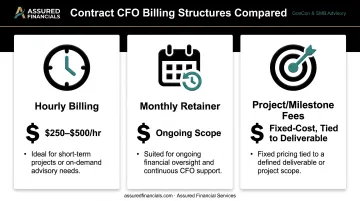
- Hourly billing: pay only for the CFO's actual time, often a handful of hours per week
- Monthly retainer: a recurring fee for ongoing strategic support, from cash-flow reviews to board reporting
- Project or milestone-based fees: a fixed cost tied to one deliverable, such as raising a funding round or preparing for an acquisition
Engagements typically start small and scale as needs grow. A company might begin with a few hours a month for cash-flow oversight, then expand once it enters fundraising, pursues an acquisition, or takes on a cost-type government contract requiring DCAA-compliant accounting.
This is also where a contract CFO differs from an outsourced bookkeeper or controller. Bookkeepers and controllers keep the transactional side accurate: reconciling accounts, closing the books, processing payroll. A CFO uses that data to answer bigger questions: Can we afford to hire five people this quarter? Should we take on debt or equity? What's our real runway?
That split also shows up in how services are packaged. Assured Financial Services folds bookkeeping oversight and accounting management into its virtual CFO offering, while fractional CFO work stays focused on strategy. Many clients use both together.
What Does a Contract CFO Actually Do?
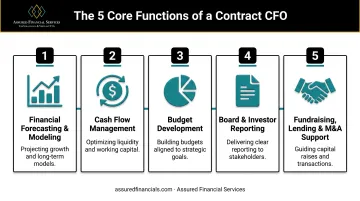
A contract CFO's day-to-day work centers on five core areas:
- Financial forecasting and modeling: Building forward-looking projections instead of only reporting what already happened
- Cash flow management: Tracking burn rate, runway, and working capital before they become emergencies
- Budget development: Building a budget tied to strategic priorities, not last year's numbers plus a percentage bump
- Board and investor-ready reporting: Packaging financials so lenders, investors, or board members can decide quickly
- Fundraising, lending, and M&A support: Preparing due diligence materials and structuring deals
The real value is connecting that financial data to decisions the CEO has to make: pricing changes, hiring timing, expansion plans, and how much capital to raise and when.
For government contractors, the job gets more technical. Generalist CFOs and accountants typically aren't equipped to handle DCAA audit readiness, indirect rate structuring across fringe, overhead, and G&A pools, FAR Part 31 cost-allowability rules, or annual ICE incurred-cost submissions.
AFS's team, for example, handles ICE Model preparation, direct-versus-indirect cost classification, and multi-year catch-up filings for contractors who've fallen behind. That work sits well outside what a standard bookkeeper or general CPA firm usually manages.
Cross-border businesses face their own layer of complexity: FBAR and FATCA obligations, multi-jurisdictional tax exposure, and foreign entity structuring. A U.S. person with foreign accounts must file under FBAR rules once aggregate holdings exceed $10,000 at any point during the year, a threshold that catches more growing companies than most owners realize.
Signs It's Time to Bring One On
These inflection points usually make the gap clear:
- Financial decisions have outgrown what your internal team can confidently handle
- You're preparing to approach investors or lenders for capital
- You've won or are pursuing a cost-type government contract requiring compliant accounting
- Your business is expanding across borders and taking on new tax exposure
- You've lost visibility into cash flow as the company has scaled
If two or more of these sound familiar, it's usually time to bring in contract CFO support.
Contract CFO vs. CPA vs. CEO: Where Does It Fit?
| Role | Type | Reports To | Primary Focus |
|---|---|---|---|
| CPA | Licensing credential | N/A | Accounting, audit, tax compliance |
| CFO | Executive role | CEO / ownership | Financial strategy, capital, forecasting |
| Contract CFO | Fractional executive role | CEO / ownership | Same strategic finance work, part-time or project-based |
| CEO | Executive role | Board / owners | Overall company direction |
Is a CFO higher than a CPA? These aren't comparable ranks. A CPA is a licensing credential earned through education, examination, and experience, focused on accounting, audit, and compliance. A CFO is an executive leadership role focused on strategy and capital allocation.
A CFO may or may not hold a CPA license. Plenty of effective CFOs never sat for the exam; plenty of CPAs never move into an executive strategy role. They're different tracks, not different rungs on the same ladder.
Is a CFO higher than a CEO? Within a normal organizational structure, no. The CFO typically reports to the CEO and leads the finance function, while the CEO holds overall authority across sales, operations, product, and finance alike.
Bringing in a contract CFO doesn't change this hierarchy. Even as an outside resource, a contract CFO still operates at the executive level and typically reports to ownership or the CEO. The work is planning and capital decisions, not just monthly reports.
How Much Do Contract CFO Services Cost?
Costs vary by pricing model, company complexity, and scope. Typical market pricing breaks down three ways:
- Hourly billing: Rates commonly fall in the $250 to $500 per hour range for experienced fractional and contract CFOs, according to Forbes.
- Monthly retainers: Priced around expected hours and scope. Light cash-flow oversight costs less than a retainer covering board reporting, fundraising support, and GovCon compliance.
- Project or milestone fees: Fixed costs tied to one deliverable, such as due diligence for an acquisition or a full financial model for a raise.
What drives the price up or down:
- Company revenue and transaction volume
- Industry complexity — a standard SMB versus a government contractor managing indirect rate structures
- Scope of deliverables (reporting only versus reporting plus fundraising plus compliance)
- Frequency and number of hours required per month
Contract CFO vs. Full-Time Hire
A full-time CFO in the U.S. now averages $438,509 per year in base salary alone, according to Salary.com, before benefits, payroll taxes, bonuses, or equity. For a growing business that doesn't yet need 40 hours a week of executive finance work, that's a heavy fixed cost for capacity that may sit partially unused.
A contract CFO lets you pay for the strategic capacity you actually need, scaling up during a raise or compliance push and back down once the work is done.
The Cost of Skipping It
Going without CFO-level insight carries its own price. For government contractors, unallowable-cost penalty rules can result in disallowed costs plus interest, doubling for repeat violations. Missed FBAR or FATCA filings carry penalties running into the tens of thousands of dollars per instance. Weighed against those numbers, a contract CFO's fee is often the cheaper option.
Why Businesses Choose Assured Financials for Contract CFO Services
Assured Financial Services specializes in three types of complexity most generalist firms don't handle well: government contractors, cross-border businesses, and established SMBs with $5 million or more in revenue.
- Every engagement is founder-led by an IRS Enrolled Agent with more than 15 years of combined experience across corporate finance and federal government contracting
- AFS employs staff with active federal security clearances, supporting government contractors on classified and security-conscious program engagements
- All work is performed in-house by U.S.-based staff — no offshore outsourcing, ever, so client financial data never leaves domestic hands
- There's no minimum engagement requirement to start; a free 30-minute consultation determines the right scope
What sets this apart from a standard fractional CFO shop is the integration: tax strategy and CFO-level financial leadership under one roof, instead of juggling separate vendors for planning, compliance, and execution.
For a government contractor preparing an ICE submission, or a cross-border business managing FBAR exposure, that coordination matters. The CFO work and the compliance work inform each other rather than happening in silos.

Frequently Asked Questions
How much does an outsourced CFO cost?
Pricing depends on the engagement model — hourly, retainer, or project-based — plus company complexity. Hourly rates commonly run $250 to $500, while retainers and project fees scale with scope and required hours.
Is CFO higher than CPA?
No — they aren't comparable ranks. A CPA is a licensing credential focused on accounting and compliance, while a CFO is an executive role focused on strategy. A CFO may or may not hold a CPA license.
Is a CFO higher than a CEO?
No. The CFO typically reports to the CEO and leads the finance function, while the CEO holds overall authority across the entire company.
What's the difference between a fractional CFO and a contract CFO?
The terms are often used interchangeably. "Fractional" usually implies an ongoing part-time relationship, while "contract" often signals a defined-scope or project-based engagement.
How long does a typical contract CFO engagement last?
Engagements range from short-term projects lasting a few months to ongoing, year-round relationships. The right length depends on whether you're solving a specific problem or need continuous financial leadership.
Can a contract CFO help with government contract compliance like DCAA audit readiness?
Yes, if they have specific GovCon experience. A specialized contract CFO can guide indirect rate structuring, DCAA accounting-system readiness, and FAR-related financial reporting — work generalist CFOs typically aren't equipped to handle.