CB Insights tracked 431 VC-backed companies that shut down since 2023 and found that 70% ran out of capital before they closed. The firm is careful to note that running dry is usually the final cause, not the root one. The underlying drivers were poor product-market fit (43%), bad timing (29%), and unsustainable unit economics (19%).
Founders wear every hat in the early days. Financial strategy usually loses out to product, sales, and hiring. But every major decision — pricing, headcount, fundraising terms — is a financial decision, whether you treat it like one or not.
This guide covers why startups need financial advisory support, what that support actually includes, the signs you've outgrown DIY finance, what to look for in a partner, and what it typically costs.
Key Takeaways
- Cash runs out is the top shutdown trigger; the real failure is missing financial visibility earlier
- Fractional CFO retainers deliver full strategic coverage at a fraction of full-time CFO cost
- Financial advisory means forecasting and fundraising prep, not only annual tax filing
- Revenue milestones, funding rounds, and GovCon complexity signal when to bring in formal support
- No-minimum, scalable engagements make advisory realistic before you raise a dollar
Why Startups Need Financial Advisory From Day One
Founders make dozens of financially consequential calls before they ever hire a CFO: what to charge, who to hire, where to spend limited cash. Without financial modeling behind those decisions, founders are guessing. A financial advisor stress-tests the guess before it becomes an expensive mistake.
Tax strategy is another blind spot. Many founders only think about taxes once a year, during filing season. That's backwards. Entity structure, the timing of income and deductions, and quarterly estimated payments all shape your tax bill, if you plan for them before year-end.
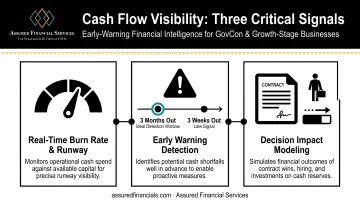
Cash flow visibility is what keeps those decisions from blowing up the runway:
- Knowing your burn rate and runway in real time, not after the books close
- Spotting a cash shortfall three months out instead of three weeks out
- Understanding how a hiring decision or new contract changes your runway
Fundraising readiness is where a lot of this comes together. VCs and angels expect clean books, a defensible financial model, and reporting that doesn't fall apart under diligence. Scrambling to reconstruct a year of messy bookkeeping right before a raise is a common, avoidable reason term sheets stall.
The proactive-versus-reactive difference matters here. A once-a-year tax filing approach treats your books as a compliance chore. A year-round advisory relationship treats them as a decision-making tool. That distinction compounds. Every quarter you plan ahead is a quarter you're not scrambling to fix problems that already happened.
Financial advisory is an investment in decision quality, not another expense line. Founders who build that infrastructure early spend less time firefighting and more time running the business.
What Does a Startup Financial Advisor or Fractional CFO Actually Do?
A startup financial advisor blends technical accounting knowledge with strategic guidance aimed at founders, not accountants. The role centers on translating those numbers into decisions a non-finance founder can actually act on.
Key Service Areas
- Bookkeeping, reporting, and internal controls: accurate recordkeeping, monthly or quarterly financial statements, and the internal processes that keep your numbers reliable
- Budgeting and financial modeling: forecasts and scenario planning that show how a hiring decision or pricing change moves your runway
- Tax planning and compliance: continuous strategy around entity structure, deductions, and estimated payments, not a once-a-year scramble
- Fundraising and investor relations support: investor-ready financial statements, board reporting, and cash-flow forecasts that hold up under diligence
Not every firm covers every item on that list equally well. Some lean heavily into bookkeeping and reporting; others are built for forecasting and investor conversations. Match the firm to the gap you actually have.
Fractional CFO vs. Full-Time CFO
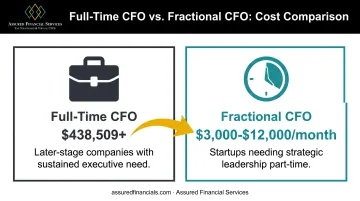
Hiring a full-time CFO is a major commitment most early-stage startups can't justify. Salary.com puts the average US CFO salary at $438,509 as of 2026, and that figure doesn't even include benefits, bonuses, or equity.
Fractional CFO engagements look very different:
| Option | Typical Cost | Best Fit |
|---|---|---|
| Full-time CFO | $438,509+ annual salary | Later-stage companies with sustained executive-level need |
| Fractional CFO | $3,000-$12,000/month | Startups needing strategic finance leadership part-time |
Pilot's 2025 pricing data puts most early- to mid-stage engagements in the $5,000-$8,000 per month range. You get the same strategic thinking at a fraction of the fixed cost, and you can scale the engagement as your needs grow.
Signs Your Startup Has Outgrown DIY Finances
DIY finance works fine until it doesn't. A few signals usually show up first:
- Revenue and funding milestones. Approaching a priced round or crossing into multi-million-dollar revenue exposes the gap between a spreadsheet and a real financial system. Investors expect formal reporting at this stage, and catch-up under a deal deadline is stressful and avoidable.
- Fundraising or audit requirements. Nothing exposes messy books faster than a term sheet or an audit request. If you can't answer basic diligence questions cleanly, that's your sign.
- New operational complexity. Government contracts that need compliant accounting, cross-border sales or international founders adding tax complexity, and multiple entities that need consolidated reporting all outpace what a founder or part-time bookkeeper can reasonably manage.
When any one of these hits, formal advisory support stops being optional. It becomes infrastructure.
What to Look for in a Startup Financial Advisory Partner
Not every accounting firm understands startups. Generalist experience with small businesses doesn't automatically translate to fundraising cycles, burn-rate management, or investor reporting expectations.
Look for:
- Startup-specific experience — a track record with companies at your stage, not just small businesses in general
- Transparent, flexible pricing — fixed-fee, tiered, or scalable structures that fit a tight budget, without surprise hourly bills
- Direct access to senior advisors — not a relationship routed through junior staff or an offshore team you never actually talk to
That last point matters more than founders often realize. If a firm hands you off to a junior associate after the sales call, you lose the strategic counsel you hired them for. Ask directly who will handle your account day-to-day, and how senior that person is.
How Much Does Startup Financial Advisory Cost?
Pricing varies widely depending on scope, complexity, and how the firm structures its fees.
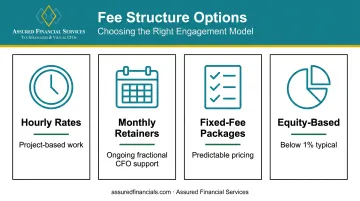
Common fee structures:
- Hourly rates — typical for narrow, project-based work
- Monthly retainers — the most common structure for ongoing fractional CFO support
- Fixed-fee packages — predictable pricing for defined scopes of work
- Equity-based compensation — occasionally used for advisor relationships, generally in smaller percentages than founders expect
Equity grants for ongoing advisors tend to run well below 1%, based on current Carta and Founder Institute benchmark data—not the 1–2% range some founders assume.
Retainer pricing benchmarks vary by provider. Kruze Consulting reports startup-focused CFO work running $8,000–$16,000 per month or $250–$500 per hour, while Pilot's data shows a broader $3,000–$12,000 monthly range.
The spread comes down to scope: messier books, specialized compliance work, and more frequent support all push cost higher.
Fractional versus full-time is where the real savings show up. A fractional engagement covers strategic finance leadership at a monthly cost that's a small fraction of a full-time executive salary, without the long-term commitment.
Many firms, including Assured Financial Services, structure engagements with no minimum commitment. That means a startup can start small, get exactly the support it needs right now, and scale the relationship as complexity grows, rather than committing to a package built for a company three stages ahead of where it actually is.
Choosing a Partner for Complex Growth-Stage Needs
Some startups outgrow generalist advisory support entirely. Three situations in particular call for specialized expertise most firms simply don't have.
Government contracting. Startups scaling into federal work face DCAA compliance requirements, indirect rate structures, and incurred cost submissions that generalist accountants and most startup-focused CFO firms rarely touch. Assured Financial Services built its practice around exactly this gap.
The founder brings over 15 years across corporate finance and federal government contracting, including:
- DCAA standards and FAR Part 31 cost principles
- Indirect rate design
- Implementation on QuickBooks Online, Unanet, and Deltek Costpoint
That mix of corporate finance discipline and GovCon technical fluency is hard to find under one roof.
Cross-border operations. Foreign investors, international founders, or overseas revenue introduce FBAR and FATCA obligations, plus multi-jurisdictional tax rules that most domestic accountants aren't fluent in. A U.S. person with foreign accounts exceeding $10,000 in aggregate value at any point in the year may trigger FBAR filing requirements, and the compliance details compound quickly from there.
Sensitive or classified programs. Startups working on government programs involving classified or sensitive data increasingly need advisors who keep financial data entirely in-house, domestically, with security-cleared staff. Offshore bookkeeping teams simply aren't an option in this category.
If your startup fits any of these three categories, prioritize a firm built specifically for that complexity over a generalist advisor learning as they go.
Frequently Asked Questions
Is $200,000 enough to work with a financial advisor?
Yes, in many cases. Most startup advisory firms don't set strict revenue or funding minimums, and $200,000 is often enough to justify fractional CFO or tax support as complexity grows.
Is paying 1% to a financial advisor worth it?
It depends on the deal. Ongoing startup advisor equity usually falls in the 0.05%–0.5% range, so 1% is high. Worth it only if the advisor’s involvement clearly improves fundraising or strategy.
When should a startup hire a financial advisor or CFO?
Key triggers include approaching a fundraising round, crossing meaningful revenue milestones, or taking on new complexity like government contracts or international operations. Many startups become ready for this support between seed and Series A.
What's the difference between a bookkeeper and a startup financial advisor?
Bookkeepers record and reconcile historical transactions. Financial advisors and fractional CFOs provide forward-looking strategy, forecasting, and decision support built on top of those records.
Can an early-stage startup afford a fractional CFO before raising funding?
Yes. Fixed-fee fractional CFO arrangements make support accessible pre-funding, and scope can grow with the business—you don’t need to wait until after a raise.
Do startup financial advisors help with fundraising?
Yes. Advisors prepare investor-ready financials, cash-flow forecasts, and board reporting that strengthen your position in diligence and negotiations.