
Most write-ups on virtual CFO benefits stop at buzzwords like "strategic insight" or "financial clarity." Owners rarely learn which specific numbers a virtual CFO actually moves, or how to tell if the engagement is working.
This article breaks down the measurable, day-to-day advantages of virtual CFO support and what it takes to get real value out of the relationship.
Key Takeaways
- A virtual CFO delivers executive-level strategy and forecasting at a fraction of a full-time hire's cost
- Cash flow visibility improves through forecasting, budgeting, and early warning signals before shortfalls hit
- Compliance risk drops through DCAA-ready accounting systems and cross-border reporting oversight
- Complex businesses — GovCon, cross-border, $5M+ revenue — see the largest returns
- Value compounds only when the engagement is ongoing, not a once-a-year consultation
What Is a Virtual CFO (Brief Context)
A virtual CFO is an outsourced financial executive who delivers the same strategic planning, forecasting, and compliance oversight as a traditional CFO—on a part-time or fractional basis. No office, no six-figure salary line item, no year-long recruiting process.
This model shows up most often in three places:
- Growth-stage SMBs that have outgrown their bookkeeper but aren't ready for a full executive hire
- Government contractors managing DCAA and FAR accounting requirements
- Cross-border businesses navigating multi-jurisdiction tax exposure
Used well, a virtual CFO is a mechanism for financial clarity and control. The real value shows up in the decisions it enables.
Key Advantages of a Virtual CFO
The advantages below tie directly to numbers owners already track: cost, cash flow, and compliance. None of this is abstract. The weight each advantage carries shifts with how complex the business actually is, which is why each section below flags when it matters most.
Cost Efficiency Without Sacrificing Expertise
A virtual CFO delivers executive-level financial leadership without the full-time salary, bonus, and equity package that comes with a traditional hire.
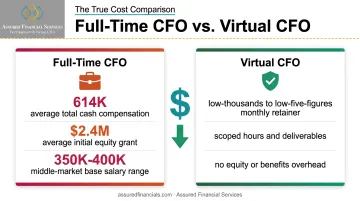
According to Heidrick & Struggles' 2024 CFO compensation survey, the average full-time CFO at a private equity-backed company earns $614,000 in total cash compensation alone, plus an average equity grant worth $2.4 million at initial award. Even middle-market CFOs commonly land in the $350,000–$400,000 base salary range.
Fractional and virtual CFO retainers typically run in the low thousands to low five figures per month, scaled to scope and complexity. That is a fraction of what a full-time executive costs before benefits are even factored in.
Here's how it works in practice: instead of a fixed six-figure-plus salary commitment, a business pays for scoped hours and deliverables. That structure frees up payroll budget for hiring, marketing, and equipment instead of locking it into overhead.
KPIs most affected:
- Cost-per-deliverable
- Overhead ratio
- Payroll-to-revenue ratio
When it matters most: This advantage hits hardest for businesses under $10M in revenue that need senior-level financial input but can't yet justify a full executive package. AFS structures its virtual CFO engagements around exactly this gap: customized to what the business actually needs rather than a one-size-fits-all retainer.
Improved Cash Flow Visibility and Decision-Making
A virtual CFO builds the forecasting models, budgets, and reporting dashboards most SMBs simply don't have in-house. That typically means cash position reviews, scenario planning ahead of a hire or capital purchase, and early warning signals before a shortfall actually happens.
In a 2025 Federal Reserve survey of over 7,600 employer firms, 51% cited uneven cash flow as a financial challenge and 56% cited difficulty covering operating expenses.
Late payments compound the pressure. Separate research from Intuit QuickBooks found businesses with more overdue invoices were far more likely to report cash-flow problems than those with fewer late payments.
Proactive visibility changes the equation. Instead of scrambling for a line of credit after the fact, owners see the shortfall coming and can plan around it. That translates into faster, more confident calls on hiring, expansion, or capital investment.
AFS's virtual CFO scope includes ongoing cash-flow monitoring, budgeting, and rolling forecasts built around a business's contract mix and growth plans, not a generic template.
KPIs most affected:
- Cash conversion cycle
- Forecast accuracy
- Days cash on hand
When it matters most: Rapid growth, seasonal revenue swings, and funding or loan applications are the moments this pays off most.
Stronger Compliance and Risk Mitigation
A virtual CFO builds and maintains the financial controls, reporting structures, and jurisdictional compliance a business needs to survive an audit. For complex businesses, that gets specific fast.
For government contractors, it means DCAA-compliant accounting systems, proper job costing, and defensible indirect rate structures.
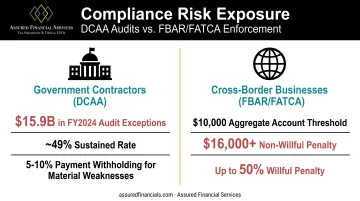
The stakes are real. DCAA's FY2024 Report to Congress documented $15.9 billion in audit exceptions across the year, with roughly 49% of examined exceptions ultimately sustained. Under DFARS, a material weakness in a contractor's accounting system can trigger payment withholding of 5% to 10% until it's corrected.
For cross-border businesses, it means FBAR and FATCA-aware reporting. Any U.S. person with foreign financial accounts exceeding $10,000 in aggregate value at any point in the year generally has an FBAR filing obligation. Non-willful violations can carry penalties north of $16,000; willful violations can reach 50% of the account balance.
Proactive compliance work keeps a contract eligible and a business out of penalty territory. AFS combines virtual CFO strategy with specialized DCAA/FAR and cross-border tax expertise, so complex businesses get financial leadership and compliance protection from one integrated source instead of juggling separate vendors.
KPIs most affected:
- Audit pass rate
- Indirect rate accuracy
- Compliance exception count
When it matters most: GovCon firms preparing for a DCAA audit and cross-border businesses managing multi-jurisdiction tax obligations see the highest payoff here.
What Happens When Virtual CFO Support Is Missing or Ignored
Without CFO-level oversight, the same patterns show up again and again:
- Inconsistent financial reporting that makes it hard to trust the numbers
- Higher forecasting error when projections rest on gut feel instead of data
- Reactive firefighting during cash shortfalls instead of planned decisions
- Rising costs from missed efficiencies nobody was watching for
- Growth bottlenecks when every financial decision routes through one overloaded owner
The risk sharpens for complex businesses. GovCon firms without compliant accounting systems can jeopardize contract eligibility — a DCAA system disapproval can sideline an otherwise winning bid. Cross-border businesses risk unreported foreign income or entity structures triggering FBAR and FATCA penalties outlined above.
None of this happens overnight. It builds quietly until a funding application, an audit notice, or a cash crunch forces the issue.
How to Get the Most Value from a Virtual CFO
The value of a virtual CFO compounds when the relationship is ongoing and proactive, not a once-a-quarter check-in that gets filed away.
A few things separate businesses that get real value from those that don't:
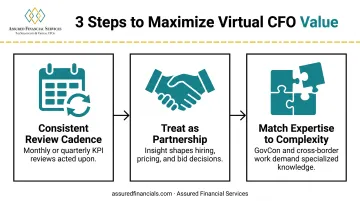
- Review forecasts and KPIs on a consistent cadence. Monthly or quarterly reviews only help if the recommendations actually get acted on, not just read.
- Treat the engagement as a partnership, not a report generator. Use their insight to shape real decisions: hiring, pricing, and contract bids.
- Match the provider's expertise to your complexity. A generalist can handle basic bookkeeping. A GovCon contractor or cross-border business needs someone fluent in DCAA, FAR, or FBAR. Mismatched expertise caps the value you get, no matter how polished the reporting looks.
AFS scopes every engagement around a free 30-minute consultation. The goal is to match GovCon, cross-border, or general SMB expertise to what the business actually needs, rather than selling a fixed package.
Conclusion
The real value of a virtual CFO comes from several advantages working together:
- Cost control that frees up payroll budget
- Cash flow clarity that replaces guesswork
- Compliance protection that keeps contracts and cross-border filings intact
Those advantages compound over time, but only with consistent, proactive engagement rather than a one-time consultation.
Businesses with real financial complexity—GovCon contractors, cross-border companies, and fast-growing SMBs—get the most from a virtual CFO who understands their regulatory and operational landscape. If that sounds like your business, start with a no-commitment conversation with Assured Financial Services.
Frequently Asked Questions
How much does a virtual CFO cost?
Monthly retainers vary based on scope and complexity, typically running well below a full-time CFO's six-figure salary and benefits package. Assured Financial Services (AFS) scopes pricing after a free consultation rather than publishing a fixed rate.
Can a CFO work remotely?
Yes. Virtual CFOs operate fully remotely using cloud accounting platforms, video calls, and shared dashboards. With the right systems in place, location has little effect on service quality.
What's the difference between a virtual CFO and a fractional CFO?
The terms are often used interchangeably. "Virtual" emphasizes remote delivery, while "fractional" emphasizes part-time engagement scope. Many providers, including AFS, offer both as complementary services.
How is a virtual CFO different from a bookkeeper or accountant?
Bookkeepers and accountants handle historical recordkeeping and compliance filings. A virtual CFO focuses on forward-looking strategy, forecasting, and decision support.
What size business actually needs a virtual CFO?
Most businesses benefit once revenue, complexity, or compliance needs exceed what a bookkeeper or part-time accountant can manage. That often means around $5M+ in revenue, or sooner when GovCon or cross-border obligations are in play.
How quickly can a business see results after engaging a virtual CFO?
Initial visibility into budgets, forecasts, and cleaner reporting often appears within the first 30-60 days. Deeper strategic gains, such as improved cash conversion or compliance readiness, build over the following quarters.