Controlled foreign corporation (CFC) rules exist for a specific reason: to stop taxpayers from parking income offshore in low-tax jurisdictions and deferring U.S. tax indefinitely. Misunderstanding them is expensive. Between unexpected Subpart F inclusions, GILTI exposure, and steep Form 5471 penalties, getting this wrong can cost tens of thousands of dollars.
This guide breaks down how a CFC is defined, how the IRS taxes CFC income through Subpart F, GILTI, and Section 956, what planning strategies can reduce your exposure, and how similar rules apply outside the U.S.
Key Takeaways
- A foreign corporation is a CFC when U.S. shareholders (each with ≥10%) own more than 50% of voting power or value
- Subpart F and GILTI income is taxed to U.S. shareholders yearly, whether or not distributed
- A Section 962 election or GILTI High-Tax Exclusion can cut or eliminate U.S. tax on CFC income
- Dozens of countries, including the UK, Germany, Japan, and Australia, run their own CFC-style regimes
What Is a Controlled Foreign Corporation?
Under IRC Section 957, a foreign corporation is a CFC when U.S. shareholders collectively own more than 50% of its total combined voting power or total value of stock on any single day during the tax year. That "any day" language matters — a company can slip in and out of CFC status mid-year, and each day is tested separately.
Not every U.S. owner counts toward that threshold, though. IRC Section 951(b) defines a "U.S. shareholder" as any U.S. person owning at least 10% of the corporation's voting power or value. That 10% line does two jobs: it determines who has to report the company's income, and whose ownership is aggregated to test CFC status.
Ownership Thresholds and Attribution Rules
Ownership isn't limited to shares held directly in your own name. The IRS looks at three categories:
- Direct ownership — stock held personally or by your company
- Indirect ownership — stock held through a foreign entity you control
- Constructive ownership — stock attributed to you from family members, partnerships, or option holders
The Tax Cuts and Jobs Act of 2017 repealed the prior limitation on "downward attribution" under IRC 958(b)(4). That repeal expanded who counts as a CFC and a U.S. shareholder, sometimes pulling foreign-owned groups with no obvious U.S. connection into CFC territory.
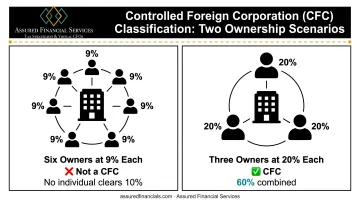
Two quick ownership examples show how the thresholds work:
- Six unrelated owners, each holding 9% — no single owner clears the 10% shareholder threshold, so this isn't a CFC even though combined ownership tops 50%.
- Three owners, each holding 20% — each clears 10% individually, and together they hold 60%. This is a CFC.
Why CFC Rules Exist
Before Subpart F existed, U.S. taxpayers could stash income in a foreign corporation based in a tax haven and simply never bring the cash home. As long as the cash stayed offshore, U.S. tax could be deferred, sometimes indefinitely. CFC rules close that loophole by taxing certain categories of foreign corporate income to U.S. shareholders the year it's earned, not the year it's distributed.
How the IRS Taxes Controlled Foreign Corporation Income
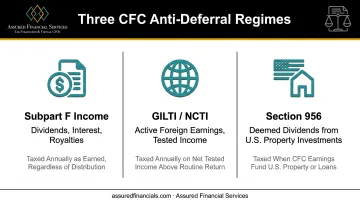
The anti-deferral principle behind CFC taxation is simple: certain categories of income get taxed to the U.S. shareholder currently, whether or not the CFC ever pays a dividend. Three regimes govern which income falls into that bucket.
Subpart F Income
Subpart F income is largely passive or mobile income defined under IRC Sections 952 through 954, including:
- Dividends, interest, rents, and royalties
- Insurance income
- Certain related-party sales and services income
A de minimis exception applies to foreign base company income and insurance income combined:
- Below the lesser of 5% of gross income or $1 million: none of it counts as Subpart F income
- Above that threshold: the full amount becomes taxable
- Above 70% of gross income: the entire CFC's income can fall under a full-inclusion rule
Global Intangible Low-Taxed Income (GILTI)
GILTI, introduced by the 2017 Tax Cuts and Jobs Act, captures active foreign business earnings that Subpart F missed. For tax years beginning before 2026, GILTI equaled a shareholder's net CFC tested income minus a 10% deemed return on Qualified Business Asset Investment (QBAI).
That formula just changed. Under the 2025 tax law, GILTI was renamed net CFC tested income (NCTI), and the QBAI carve-out disappeared for tax years beginning after December 31, 2025. In practice, there is no more 10% routine-return exclusion: nearly all tested income from a CFC now flows into the calculation.
Section 956: Investment in U.S. Property
Section 956 targets a different maneuver: using CFC earnings to benefit U.S. shareholders without a formal dividend. If a CFC invests in U.S. property, that investment can trigger a deemed dividend. Common examples include:
- Loans to its U.S. shareholder
- Purchases of U.S. stock
- U.S. branch operations
This provision hits individuals especially hard. Corporate shareholders often neutralize the inclusion with a hypothetical Section 245A deduction. Individuals get no such relief.
Without a Section 962 election, the income is taxed at ordinary rates (up to 37% for the 2025 tax year, per the IRS), with no Section 250 deduction and no foreign tax credit access. Individual shareholders with CFC investments in U.S. property need to plan for that exposure before the investment is made.
Tax Planning Strategies to Reduce CFC Tax Exposure
Once you know a foreign entity is a CFC, the real question is how much that income actually costs you. Several mechanisms can change that answer.
The Section 962 Election
Individual U.S. shareholders can elect under Section 962 to be taxed on Subpart F and GILTI inclusions as if they were a domestic corporation. That unlocks two benefits otherwise unavailable to individuals:
- The Section 250 deduction against net CFC tested income
- A limited foreign tax credit for tax the CFC already paid abroad
The catch: any later distribution of that income is taxed again to the extent it exceeds the U.S. tax already paid under the election. It's a defer-and-defer-again tool, not a permanent exclusion.
The GILTI High-Tax Exclusion
If a CFC operates in a jurisdiction with a real corporate tax burden, the GILTI High-Tax Exclusion (HTE) may remove its income from the calculation entirely. The current threshold requires an effective foreign tax rate greater than 18.9% — 90% of the 21% U.S. corporate rate.
This election isn't cherry-picked entity by entity without limits. It binds all U.S. shareholders and applies consistently across the CFC group, so it has to be evaluated at the group level, not just for one company.
Restructuring and Timing
Some businesses can reduce or eliminate CFC exposure through structural changes:
- Adjusting ownership percentages so no single U.S. person crosses the 10% shareholder threshold
- Restructuring entity layers to change how attribution rules apply
- Timing distributions or acquisitions around measurement dates
The right approach depends heavily on where the CFC operates:
| Foreign Tax Rate | Likely Best Fit |
|---|---|
| High (above 18.9%) | GILTI High-Tax Exclusion |
| Moderate | Section 962 election |
| Low | Blended approach, multiple elections |
Getting the sequencing wrong, such as electing HTE without checking group consistency or making a 962 election without projecting distribution-stage tax, can cost more than doing nothing at all.
Assured Financial Services treats CFC planning as a year-round process, not a once-a-year filing exercise. The team works with business owners and expats to model elections against actual foreign tax rates and lock in a strategy before the tax year closes.
Controlled Foreign Corporation Rules Around the World
The U.S. isn't alone in taxing offshore corporate income. Dozens of countries run comparable regimes aimed at the same basic problem: income parked in low-tax jurisdictions to avoid home-country tax.
| Country | How it works |
|---|---|
| United Kingdom | Taxes a UK company's share of profits from UK-controlled nonresident companies, with exemptions for low-profit or low-margin cases |
| Germany | Attributes passive CFC income taxed below 15% abroad |
| Japan | Includes undistributed profits of low-tax foreign related corporations |
| Australia | Attributes non-active ("tainted") income of foreign companies controlled by residents |
| New Zealand | Generally attributes passive income; control can mean five or fewer residents holding over 50%, or one resident holding at least 40% |
| Brazil | Applies to controlled and affiliated entities below a roughly 20% sub-taxation threshold |
| Sweden | Taxes owners of foreign entities taxed below roughly 11.8% |
Most of these regimes share three structural features:
- Ownership threshold often near 50%
- Focus on passive or mobile income
- Minimum foreign tax rate test
That consistency isn't accidental. The OECD's BEPS Action 3 report laid out a shared framework for CFC design in 2015, and many countries have shaped their rules around it since.
For anyone with ownership across multiple jurisdictions, that overlap matters. The same income can trigger inclusion rules in more than one country at once.
Compliance and Reporting Requirements
U.S. shareholders who meet the CFC ownership thresholds generally must file Form 5471 annually. The form reports income inclusions, ownership changes, and the CFC's earnings and profits. Filer requirements fall into five categories depending on ownership percentage, officer or director status, and whether you're acquiring, disposing of, or already holding CFC stock.
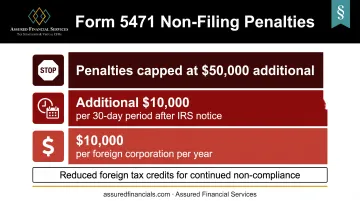
The penalties for skipping it are steep. According to the IRS's Form 5471 instructions:
- $10,000 per foreign corporation, per year for failure to file
- An additional $10,000 for every 30-day period after an IRS notice if the return still isn't filed within 90 days, up to $50,000 more
- Reduced foreign tax credits when non-compliance continues
These gaps often surface years later in an audit, or when someone consolidates foreign holdings for a bank or visa application. Assured Financial Services, led by an IRS Enrolled Agent with unlimited practice rights before the IRS, works with cross-border business owners and expats to track Subpart F and GILTI inclusions, prepare Form 5471, and resolve past compliance gaps in-house.
Frequently Asked Questions
What is a controlled foreign company?
A controlled foreign company is a foreign-registered business more than 50% owned by shareholders based in another country. That ownership makes it subject to the shareholders' home-country anti-deferral tax rules, including current taxation of certain income.
How do I know if a company is a CFC?
Check two things: do U.S. shareholders, each owning at least 10%, collectively hold more than 50% of the company's voting power or value? If yes, on any day during the tax year, it's a CFC.
What are controlled foreign company rules?
These rules require shareholders to report and pay tax currently on certain foreign corporate earnings, even without a distribution. They exist to prevent taxpayers from deferring home-country tax by holding income offshore indefinitely.
Which countries have CFC rules?
The U.S., UK, Germany, Japan, Australia, New Zealand, Brazil, and Sweden all enforce CFC-style regimes, among others. Many of these rules have grown more standardized under OECD BEPS guidance since 2015.
What is the difference between Subpart F income and GILTI?
Subpart F targets specific passive and mobile income categories, such as dividends, interest, and royalties. GILTI (now NCTI) targets broader active business earnings that Subpart F doesn't otherwise capture.
Do I need to file Form 5471 if I own a controlled foreign corporation?
Most U.S. shareholders meeting CFC ownership thresholds must file Form 5471 annually. Filer categories vary based on ownership level and specific events, so confirm requirements with a tax professional to avoid penalties.