
Introduction
Partnerships don't pay federal income tax. That single fact leads thousands of business owners astray every year.
General partnerships, limited partnerships, LLPs, and multi-member LLCs are all "pass-through" entities. Profits and losses flow to the partners' personal returns instead of being taxed at the entity level. But pass-through doesn't mean no filing.
Every one of those entities must still file Form 1065 annually. Miss the deadline and penalties run $220 per partner, per month—fast enough to sting partnerships with several owners.
This guide breaks down what Form 1065 actually is, who has to file it, the key schedules inside it, how partners get taxed on their share of income, and the deadlines and penalties that catch even experienced owners off guard.
Key Takeaways
- Form 1065 is an information return: partnerships rarely owe entity-level income tax, but accurate filing is still mandatory
- Each partner receives a Schedule K-1 reporting their share of income, deductions, and credits
- Calendar-year partnerships must file by March 15 (15th day of the 3rd month after year-end)
- Late filing triggers a per-partner, per-month penalty that multiplies quickly with more partners
What Is Form 1065 and Who Must File It
Form 1065, officially the U.S. Return of Partnership Income, is the annual information return partnerships use to report income, deductions, gains, and losses to the IRS. The partnership doesn't pay tax on that income directly. Profits and losses pass through to the partners, who report their share on their own returns whether or not they received a distribution.
Domestic filing requirements are broad. Any of the following must file Form 1065:
- General partnerships
- Limited partnerships (LPs)
- Limited liability partnerships (LLPs)
- Multi-member LLCs classified as partnerships for federal tax purposes
There's one narrow exception: a partnership doesn't need to file if it "neither receives income nor incurs any expenditures treated as deductions or credits for federal income tax purposes" during the year, according to the IRS's own instructions for Form 1065.
That exception is stricter than most owners assume. A partnership that made no profit, distributed no cash, or sat mostly dormant still generally must file if it had any reportable activity — including minor expenses.
Foreign Partnerships and Special Filers
Foreign partnerships aren't automatically off the hook. A foreign partnership generally must file Form 1065 if it has income effectively connected with a U.S. trade or business, or U.S.-source income — even when it's based entirely overseas or owned only by foreign persons.
Two narrow exceptions exist:
- No U.S. partners' meaningful stake — no effectively connected income, no more than $20,000 of U.S.-source income, and less than 1% of every item allocated to direct U.S. partners.
- No U.S. partners at all — and proper Form 1042/1042-S withholding by the partnership or another withholding agent.
These exceptions turn on specific technical conditions. Confirm eligibility before assuming a foreign partnership is exempt.
One more special case: religious or apostolic organizations exempt under Section 501(d) still must file Form 1065. Taxable income gets allocated to members as a dividend, whether distributed or not.
Breaking Down Form 1065: Key Schedules You Need to Know
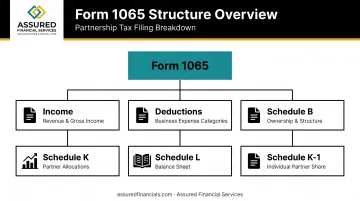
Form 1065 isn't a single page. The main form reports income and deductions; attached schedules cover ownership, allocations, the balance sheet, and each partner's share.
| Component | What It Covers |
|---|---|
| Income | Gross receipts, cost of goods sold, and other business income that net to total income or loss |
| Deductions | Salaries, guaranteed payments to partners, rent, interest, and depreciation that reduce total income |
| Schedule B | Entity structure, accounting method, ownership percentages, and other operational disclosures |
| Schedule K | Income, losses, deductions, and credits allocated among partners by ownership share |
| Schedule L | Balance sheet of assets, liabilities, and partners' capital at year start and year end |
| Schedule K-1 | Each partner's individual share from Schedule K, used on their personal return |
Guaranteed payments deserve extra care. These are fixed amounts paid to partners for services or use of capital, regardless of partnership profit. They are deducted on the main form and reported separately to the recipient partner because they get different tax treatment than a distributive share.
Schedule L matters more than owners often realize. If this year's beginning capital account doesn't match last year's ending balance, the IRS systems are built to flag the mismatch.
How Partnership Income Is Taxed: Schedule K-1 and Self-Employment Tax
Partners owe tax on their distributive share of partnership income regardless of whether they actually pocketed any cash. Each partner's share is reported on Schedule K-1 (Form 1065). A partner who left profits in the business to fund growth still owes tax on that amount at year-end.
Self-Employment Tax: Not Always Straightforward
General partners who materially participate in the business typically owe self-employment tax on their distributive share. Limited partners are generally exempt from SE tax on their share, but guaranteed payments for services rendered are a notable exception and remain subject to SE tax regardless of partner classification.
That "limited partner" exemption has gotten murkier. In Soroban Capital Partners LP (2023), the Tax Court held that it could examine a state-law limited partner's actual role and responsibilities rather than accepting the label at face value. Partners who are functionally active in the business, regardless of what their partnership agreement calls them, may no longer qualify for the SE tax exemption.
Loss Limitations Partners Often Miss
Income tax is only part of the picture. Three separate rules can also restrict how much loss a partner can actually deduct:
- Basis limitation: losses are deductible only up to the partner's adjusted outside basis
- At-risk rules: losses can't exceed what the partner could actually lose in the activity
- Passive activity rules: losses from activities without material participation can only offset passive income, not wages or other nonpassive income
These rules apply in that order, and disallowed losses carry forward rather than disappearing. A partner who assumes a K-1 loss is automatically deductible is often surprised come filing season.
Cross-Border Partners Add Complexity
When partners or operations sit outside the U.S., the reporting burden grows. Partnerships with foreign partners or overseas operations may face additional filings:
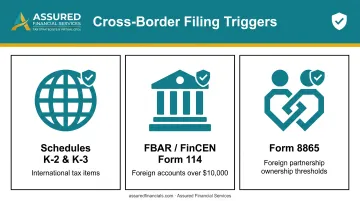
- Schedules K-2 and K-3: required when partners have items relevant to U.S. tax or international reporting
- FBAR (FinCEN Form 114): required if the partnership has a financial interest in foreign accounts exceeding an aggregate value of $10,000 at any point during the year
- Form 8865: triggered by certain ownership thresholds in foreign partnerships
Generalist preparers who handle only a few partnership returns a year often miss these. Assured Financial Services works specifically with cross-border and internationally connected partnerships, so catching these triggers before a deadline passes is part of the standard review, not an afterthought.
Clean, well-organized books throughout the year, not a scramble in March, make it possible to compute each partner's share correctly the first time and avoid costly K-1 corrections later.
Filing Deadlines, Extensions, and Penalties
The standard deadline for Form 1065 is the 15th day of the third month after the tax year ends. For calendar-year partnerships, that's March 15.
Need more time? File Form 7004 for an automatic six-month extension. Filing extends until September 15 for calendar-year filers. The extension covers the return filing deadline only — not payment obligations tied to partners' estimated taxes.
What Late Filing Actually Costs
Under IRC Section 6698, filing Form 1065 late or with missing information triggers a penalty of $255 per partner, per month (or partial month), capped at 12 months. That's per the IRS's 2025 Form 1065 instructions.
Run the math on a five-partner firm that files six months late: that's $255 × 5 partners × 6 months = $7,650 in penalties alone, before any tax owed by the partners themselves.
There's a separate penalty for K-1s that aren't furnished correctly or on time:
- $60 per statement if corrected within 30 days
- $130 if corrected after 30 days but before August 1
- $340 if corrected after August 1 or never furnished
- $680 per statement for intentional disregard, with no annual cap
Getting Penalties Reduced
Partnerships aren't stuck once a penalty notice arrives. Options include:
- Reasonable-cause abatement — submitting a written explanation of why the failure occurred despite ordinary business care
- Rev. Proc. 84-35 relief — available to partnerships with 10 or fewer partners who are all individuals and reported their share timely
- First-Time Abate — available if the partnership filed on time for the prior three years with no other penalties
Assured Financial Services handles this process through its penalty abatement service. The team reviews IRS notices and account transcripts, identifies the right relief path, and submits the request with federally authorized representation.
Common Filing Mistakes and Why Professional Guidance Matters
Most Form 1065 problems trace back to a handful of recurring issues:
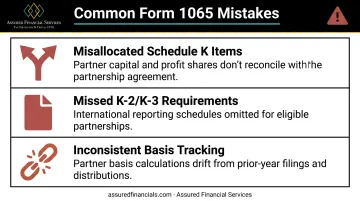
- Misallocated Schedule K items — income or deductions split incorrectly among partners, especially when ownership percentages changed mid-year
- Missed K-2/K-3 requirements — overlooked when a partnership has even one partner with foreign tax obligations
- Inconsistent basis tracking — partner basis calculated fresh each year instead of carried forward accurately, leading to overstated loss deductions
None of these are exotic. They're the predictable result of treating partnership taxes as a once-a-year event instead of an ongoing process.
Partnerships with real complexity — multiple partners, cross-border ownership, or government contracting revenue — need more than annual filing. Timing decisions, entity structure, and quarterly estimates all affect the return long before March arrives.
When those issues surface, a partnership needs more than a seasonal preparer. Assured Financial Services is led by an IRS Enrolled Agent—the highest credential the IRS awards—with unlimited practice rights to represent taxpayers before the IRS in all 50 states.
Support for partnerships includes:
- Hands-on Form 1065 preparation and Schedule K-1 accuracy review
- Year-round tax strategy for growth-stage and cross-border partnerships
- IRS representation if a notice or penalty appears
Frequently Asked Questions
When must a partnership file its tax return?
March 15 for calendar-year partnerships—the 15th day of the third month after year-end. You can request more time with Form 7004 (see extension question below).
What is the penalty for filing a partnership tax return late?
The penalty is $255 per partner for each month or part of a month the return is late, capped at 12 months. Reasonable-cause relief may reduce or eliminate the penalty.
How much tax do partners pay on partnership income?
Partners pay tax on their Schedule K-1 distributive share at their individual rates. General partners who materially participate may also owe self-employment tax on that share.
What is the difference between Form 1065 and Schedule K-1?
Form 1065 is the partnership's entity-level informational return. Schedule K-1 reports each partner's share of income, deductions, and credits from Form 1065.
Do all partnerships need to file Form 1065?
Almost all do. The only exception is a partnership that had neither income nor any deductible or creditable expenses during the entire tax year.
Can a partnership get an extension to file Form 1065?
Yes, Form 7004 grants an automatic six-month extension. It only extends the filing deadline, not any payment obligations tied to partners' estimated taxes.