Introduction
The word "audit" tends to trigger panic before anyone even opens the letter. Many business owners, professionals, and cross-border taxpayers struggle with the assumption that the IRS works like statutory audit systems abroad: cross a set revenue line, and an audit becomes automatic.
That's not how it works in the United States.
The IRS doesn't use a fixed turnover or receipt threshold that guarantees an audit. Instead, it relies on risk-based selection: statistical scoring, random sampling, and links to other examinations already underway.
In FY2025, the IRS closed 497,621 audits and recommended $26.8 billion in additional tax. The selection process behind those numbers has almost nothing to do with a simple income cutoff.
This guide breaks down how audit selection actually works, who faces elevated risk, which red flags matter most, and how proactive planning reduces your exposure.
Key Takeaways
- IRS audit selection is risk-based—not tied to any fixed revenue threshold
- Self-employed filers, high earners, cash businesses, and cross-border taxpayers face higher scrutiny
- Audits range from simple mail notices to full in-person field examinations
- Organized records and an IRS Enrolled Agent lower exposure and response stress
What Is a Tax Audit — and Why Does "Applicability" Look Different in the U.S.?
The IRS defines an audit as a review of a taxpayer's books, accounts, and financial records to confirm that reported income, deductions, and tax liability were calculated correctly under the law.
The agency is careful to note that being selected for an audit doesn't automatically mean something is wrong. Plenty of returns get pulled for review and come back clean.
The purpose behind this system is straightforward:
- Verify that reported figures match the law
- Deter underreporting and outright tax evasion
- Protect the integrity of a self-assessment system where taxpayers calculate their own liability
Where confusion usually starts is the trigger. In countries like India, a statutory audit becomes mandatory once business turnover crosses roughly ₹1 crore, or professional gross receipts cross ₹50 lakh, under Section 44AB. That's a fixed, legally defined trigger. A Chartered Accountant signs off before the return is even filed.
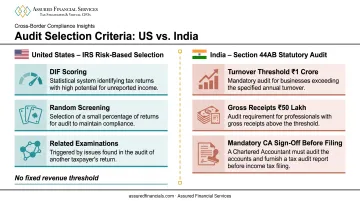
No equivalent threshold exists at the U.S. federal level. There's no dollar amount where the IRS says "you've crossed this line, so you must be audited." Selection is probabilistic, not automatic.
Who Conducts a U.S. Tax Audit?
Another structural difference: a U.S. tax audit is conducted directly by IRS examiners or revenue agents, after the return has already been filed. There's no private accountant certifying compliance beforehand the way a statutory audit regime requires.
This distinction matters most for cross-border businesses and U.S. expats. They're often juggling two systems at once: one country's pre-filing statutory audit requirement and the IRS's post-filing, risk-based examination model.
Reconciling both without clear guidance is where filings go wrong. That's a common reason cross-border clients work with Assured Financial Services for U.S. compliance support alongside their foreign obligations.
Who Is Actually Subject to an IRS Audit? Understanding True Applicability Rules
How the IRS Selects Returns for Audit
Most returns get flagged through one of a few methods:
- DIF scoring: The Discriminant Inventory Function System scores each return by how far it deviates from statistical norms built from National Research Program data. Higher scores mean higher examination potential. Exact formulas stay confidential.
- Random selection and computerized screening: Some returns are pulled at random or flagged through automated document matching against W-2s and 1099s.
- Related examinations: If a business partner, investor, or another taxpayer connected to your return is already under audit, yours can get pulled in too.
None of these methods care what your gross revenue was last year. They care about anomalies, connections, and statistical outliers.
Applicability by Taxpayer Type
Some filers simply carry more risk than others.
Self-employed professionals. Doctors, consultants, freelancers, and anyone filing Schedule C face more scrutiny than W-2 wage earners. Self-reported income without third-party withholding gives the IRS less independent verification to lean on.
High-income earners. Audit coverage climbs sharply as income rises. According to the IRS 2025 Data Book, examination coverage for total positive income between $1 million and $5 million sits at 0.9%, jumps to 3.9% for the $5 million to $10 million bracket, and reaches 6.6% for filers above $10 million.
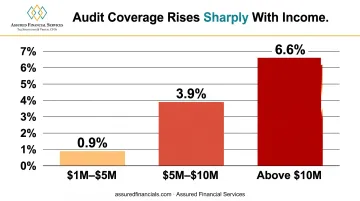
That's more than seven times the coverage rate of the lowest bracket in that comparison.
Cash-intensive businesses. IRS examination guidance specifically directs agents to treat unusual or frequent cash transactions as a lead for possible unreported income.
Worker classification issues. Misclassifying employees as 1099 contractors can trigger employment tax liability, even if it doesn't automatically flag an income tax audit on its own.
Cross-border taxpayers. FBAR and FATCA reporting obligations add real complexity. Foreign financial institutions now report account information on U.S. taxpayers directly to the IRS, so unreported overseas income has fewer places to hide.
Assured Financial Services helps clients get Form 8938, FinCEN Form 114, and related filings right before a mismatch draws attention.
How Long the IRS Has to Audit You
The IRS generally has three years from filing to audit a return. That window extends to six years if you omit more than 25% of gross income, and there is no time limit for fraud or unfiled returns.
Types of IRS Tax Audits You Could Face
Not every audit looks the same. There are three main formats, and each carries a different level of intensity.
| Audit Type | Format | Typical Focus |
|---|---|---|
| Correspondence | Handled entirely by mail | A specific line item — one deduction, one income source |
| Office | In-person interview at an IRS office | Itemized deductions, Schedule C profit/loss, rental income |
| Field | Revenue agent visits your home or business | Full financial records, interviews with staff, complete return review |
Correspondence audits are the most common by far. You get a letter requesting documentation for one specific item, you respond with the supporting paperwork, and in many cases that's the end of it.
Office audits go deeper. You're sitting across from an examiner, and the conversation usually centers on itemized deductions or self-employment income.
Field audits are the most comprehensive. An IRS revenue agent shows up at your business, reviews your books directly, and may talk to your employees. These take longer and carry the highest stakes — the point where professional representation often makes the biggest difference.
Top Red Flags That Increase Your Audit Risk
These patterns draw IRS attention more often than others:
- Income mismatches: Return figures that don't match W-2s and 1099s already on file can trigger an automated CP2000 notice
- Outsized deductions: Home office, travel, and meals claims—or repeated business losses—that look large relative to income
- Cash-intensive operations: Frequent or unusually structured cash activity that is hard to document
- Worker misclassification: Treating employees as independent contractors to avoid payroll taxes
- Unreported foreign accounts: Missing FBAR or FATCA Form 8938 filings, which foreign institutions now help the IRS detect
- Math errors and missing schedules: Usually a correction notice first; unresolved issues can still escalate
- Sharp year-over-year swings: Large jumps or drops in income or expenses without a clear explanation
Kiplinger's audit red flag research also flags disproportionate home office, meals, and travel claims, plus repeated losses that can invite hobby-loss scrutiny.
How to Prepare For — and Reduce — Your Audit Risk
You can't eliminate audit risk entirely, but you can stack the odds in your favor.
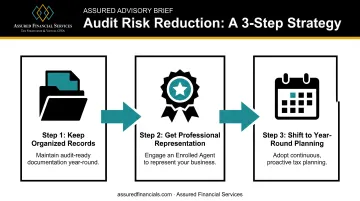
Keep organized records. Dated receipts, invoices, and bank statements for at least three years form your first line of defense. Cross-border or complex filings often warrant holding onto documentation even longer, since foreign reporting issues can surface well past the standard lookback window.
Get professional representation. An IRS Enrolled Agent holds unlimited practice rights before the IRS in all 50 states, on any tax matter. Assured Financial Services holds this credential, so if a notice arrives, you aren't the one communicating with the IRS. AFS handles correspondence, office, and field audits directly, plus appeals if you dispute the outcome.
Shift to year-round planning. Once-a-year reactive filing means problems only surface after the return is already submitted. A proactive approach reviews entity structure, income and deduction timing, and quarterly estimated payments throughout the year. For cross-border clients, that includes FBAR and FATCA obligations—catching issues while there's still time to fix them.
Frequently Asked Questions
Is a tax audit mandatory for professionals?
No. Under U.S. federal law, no audit is mandatory simply because someone is a professional or crosses a revenue line. IRS selection is risk-based, unlike statutory systems used in some other countries.
What is the limit for tax audit for professionals — 75 lakhs?
That threshold and the "lakh" terminology come from India's Section 44AB statutory audit rule. It has no equivalent under U.S. tax law, so cross-border filers must treat the two systems as entirely separate.
What are red flags for tax audits?
The most common triggers include income mismatches against W-2s or 1099s, outsized deductions relative to income, cash-heavy business operations, and unreported foreign accounts.
How far back can the IRS audit my tax returns?
Generally three years from filing. That extends to six years for substantial income underreporting, and there's no limit at all for fraud or unfiled returns.
Can working with an IRS Enrolled Agent reduce my audit risk?
An Enrolled Agent's federal credential and unlimited representation rights support proactive risk review and direct IRS communication—catching errors early and keeping any audit more controlled.
What should I do if I receive an audit notice from the IRS?
Read it carefully, gather only what's specifically requested, and respond by the deadline. Consider bringing in professional representation before you respond, since an incomplete reply can make things worse.