Introduction
If you hold a foreign bank account, own shares in an overseas investment fund, or have a stake in a business outside the United States, your financial information is likely already being shared between governments. Many account holders don't realize this until a letter from the IRS shows up.
FATCA and CRS sound like interchangeable acronyms. They aren't. Confusing the two, or assuming compliance with one satisfies the other, is one of the costliest mistakes cross-border individuals and businesses make.
This guide breaks down what each regime actually requires, who has to comply, what happens when you don't, and how to get ahead of it before the IRS gets ahead of you.
Key Takeaways
- FATCA requires foreign banks and U.S. persons to report foreign account details directly to the IRS
- CRS automatically exchanges account data across 100+ countries under the OECD framework
- Individuals, businesses, and financial institutions can face separate — and overlapping — reporting duties
- Missing Form 8938 can trigger IRS penalties up to $60,000
What Is FATCA?
The Foreign Account Tax Compliance Act (FATCA) became law in 2010 as part of the HIRE Act. Its purpose is straightforward: stop US persons from hiding money offshore to evade taxes.
FATCA works through intergovernmental agreements (IGAs) between the US and partner countries. Under these agreements, foreign financial institutions (FFIs) (banks, brokerages, investment funds) must identify accounts held by "US persons" and report them, either to their local tax authority (which forwards data to the IRS) or directly to the IRS itself.
Who Must Report Under FATCA
Two separate groups carry FATCA obligations:
- Foreign financial institutions must run due diligence on their account holders, flag US-reportable accounts, and report balances, income, and identifying details to the IRS every year.
- US persons (citizens, green card holders, and certain entities) must self-report specified foreign financial assets on Form 8938 if those assets cross IRS thresholds.
Those thresholds vary depending on where you live and how you file:
| Filing Status & Location | Value on Last Day of Year | Value at Any Point During Year |
|---|---|---|
| Living in US, unmarried or filing separately | Over $50,000 | Over $75,000 |
| Living in US, married filing jointly | Over $100,000 | Over $150,000 |
| Living abroad, unmarried or filing separately | Over $200,000 | Over $300,000 |
| Living abroad, married filing jointly | Over $400,000 | Over $600,000 |
Source: IRS Form 8938 instructions
Notice that expats get a much higher threshold than US-based filers. That gap catches people off guard constantly: someone living in the US with $60,000 spread across two foreign accounts may owe a filing, while someone abroad with the same balance doesn't.
FATCA Forms & Compliance Touchpoints
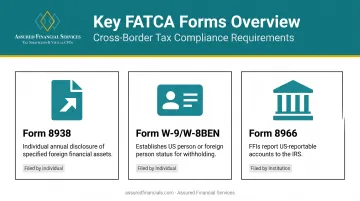
A handful of forms show up repeatedly in FATCA compliance:
- Form 8938 — the annual statement individuals attach to their tax return disclosing specified foreign financial assets
- Form W-9 / W-8BEN — tax residency certifications that establish whether someone is a US person or a foreign person for withholding purposes
- Form 8966 — the form FFIs and certain other filers use to report US-reportable accounts to the IRS
Here's a detail that trips people up: opening a new foreign account almost always requires signing a self-certification of US person status on the spot. Get that wrong (even accidentally) and it can create compliance headaches years down the line when the bank's records don't match your actual filings.
What Is CRS?
The Common Reporting Standard (CRS) is the OECD's answer to FATCA, developed in 2014. People often call it "FATCA for the rest of the world," and that's a fair shorthand. The mechanics differ in one critical way.
FATCA cares about US citizenship or green card status. CRS cares about tax residency, full stop. That means CRS can pull in someone with no US connection at all, simply because they're tax resident somewhere other than where they bank.
How CRS Reporting Works
Financial institutions in CRS-participating countries identify account holders who are tax resident elsewhere. They report that information to their own tax authority, which then automatically exchanges it with the tax authority in the account holder's country of residence.
Sound familiar? It should. The reporting chain mirrors FATCA's Model 1 IGA structure closely.
CRS also requires self-certification at account opening, similar to FATCA's process. Instead of asking about US person status, the form asks for every country where the account holder is tax resident and the Tax Identification Number (TIN) for each one.
Someone with residences or tax obligations in two or three countries must disclose all of them, not just a "primary" jurisdiction.
Why CRS Matters for Cross-Border Individuals & Businesses
CRS's reach is enormous. In 2024, 116 jurisdictions exchanged data on more than 171 million financial accounts, worth close to €13 trillion.
Those figures come from the OECD's 2025 peer review of automatic exchange practices. Participation is still expanding as more jurisdictions join the exchange network.
That scale matters because dual tax residents, US expats, and foreign nationals with US ties can land in both FATCA and CRS reporting at once. Common overlap cases include:
- US citizens abroad whose local banks report under CRS while FATCA still applies to them as US persons
- Dual tax residents who must self-certify every residency jurisdiction, not one "home" country
- Foreign nationals with US ties who hold accounts in CRS countries and also trigger US reporting
A US citizen living in Germany with a German bank account is a clear example: FATCA picks them up as a US person, and CRS can surface the same account if another tax residency is in play.
FATCA vs. CRS: Key Differences You Should Know
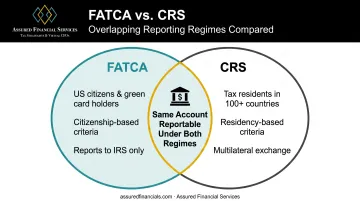
Both regimes chase the same goal: visibility into offshore assets. They just get there differently.
| Aspect | FATCA | CRS |
|---|---|---|
| Origin | US federal law (2010) | OECD standard, adopted by member countries (2014) |
| Legal basis | Bilateral IGAs between the US and partner countries | Multilateral framework, adopted voluntarily by participating jurisdictions |
| Who's reportable | US citizens, green card holders, and entities with substantial US ownership | Anyone tax resident in a participating jurisdiction other than where they bank |
| Reach | One country (the US) as the receiving authority | 100+ countries exchanging with each other |
Practical takeaway: the identifying criteria differ, so the same account can be reportable under both regimes at once.
- Financial institutions do not choose FATCA or CRS — they run both tests independently
- Meeting one regime’s rules does not satisfy the other
- Cross-border account holders get caught when they assume a single filing or self-certification covers both
Who Needs to Comply — and What Happens If You Don't
Individuals and US Persons With Foreign Ties
Any US citizen or green card holder, regardless of where they live, with foreign accounts exceeding the IRS thresholds must file Form 8938. Many of them also need to file FinCEN Form 114, better known as the FBAR, since the two have different triggers.
The FBAR threshold is much lower and simpler: aggregate foreign account value over $10,000 at any point during the year, according to FinCEN's reporting guidance. Form 8938 doesn't replace FBAR. Plenty of taxpayers need to file both, to different agencies, on different forms.
Foreign nationals aren't exempt from paperwork either. Opening a financial account in most countries now means certifying tax residency and, if applicable, US person status upfront.
Businesses and Entities With Cross-Border Exposure
Entity structures add another layer:
- LLCs, trusts, and partnerships with foreign ownership or US controlling persons may be classified as passive NFFEs/NFEs, which ties reporting obligations to the individuals who control them
- Businesses with foreign investors, subsidiaries, or bank accounts need to determine whether they're an active or passive entity for FATCA/CRS purposes. That classification determines exactly what gets reported and to whom
Getting the entity classification wrong doesn't just create paperwork problems. It can misdirect reporting entirely, leaving genuine obligations unmet while the business assumes it's covered.
The Cost of Getting It Wrong
Form 8938 penalties escalate quickly:
- Initial penalty: $10,000 for failing to file or filing incomplete information
- Continuing penalty: An additional $10,000 for every 30-day period (or part of one) that the failure continues beyond 90 days after IRS notice
- Maximum additional penalty: $50,000, bringing the total exposure to $60,000
That's before accounting for separate underpayment penalties: up to 40% on tax attributable to an undisclosed foreign asset, or 75% if fraud is involved.
The IRS treats willful and non-willful non-compliance differently. Non-willful failures (the honest "I didn't know I had to file this" cases) may qualify for streamlined filing procedures with reduced penalty exposure.
Willful violations fall under the IRS's voluntary disclosure practice, which can limit criminal exposure but requires full, truthful, and timely cooperation. Neither path is available once the IRS has already opened an examination.
How Assured Financial Services Helps You Navigate FATCA & CRS
Cross-border tax exposure rarely comes with a clear instruction manual. Every situation (a US citizen with a UK pension, a foreign national who just opened a US brokerage account, an LLC with an overseas investor) carries its own mix of thresholds, forms, and entity rules.
Assured Financial Services works with clients who carry this exposure: US expats, foreign nationals with US ties, and businesses with cross-border ownership or accounts.
The firm reviews accounts, entities, and residency to determine whether FATCA, CRS-related self-certification and tax-residency rules, or both apply. It then handles the US filings that follow, including:
- Form 8938 and FBAR for foreign financial assets and accounts
- Forms 5471 and 5472 for foreign entity reporting
- Forms 3520 and 3520-A for foreign trust reporting
What sets the firm apart from a generalist accounting practice:
- IRS Enrolled Agent founder with unlimited rights to represent clients before the IRS in all 50 states, including inquiries, penalty notices, and back-filed foreign accounts
- In-house, US-based work only with no offshore outsourcing, so foreign account details never leave domestic hands
- Principal-led engagements so every compliance review gets executive-level attention, not a handoff to a junior pool

If you're unsure whether your foreign accounts, foreign business interests, or residency situation trigger FATCA, CRS, or both, reach out to Assured Financial Services for a compliance review before the IRS reaches out first.
Frequently Asked Questions
Who needs to fill in FATCA?
US persons — citizens, green card holders, and certain entities — with specified foreign financial assets above IRS thresholds must file Form 8938. Foreign financial institutions also report US account holders directly to the IRS.
What is a FATCA CRS declaration?
A self-certification form financial institutions require when you open an account. It captures your tax residency and, if applicable, your US person status for reporting purposes.
What is FATCA for US citizens?
US citizens must report specified foreign financial assets on Form 8938 if those assets exceed the applicable threshold, regardless of where they live in the world.
What is the difference between FATCA and CRS?
FATCA is a US law that identifies reportable persons by citizenship or green card status. CRS is a multilateral OECD standard, adopted by 100+ countries, that identifies reportable persons by tax residency instead.
Do I need to file both FBAR and FATCA Form 8938?
Often, yes. FBAR and Form 8938 have different thresholds and go to different agencies (FinCEN versus the IRS), so many taxpayers with foreign accounts end up filing both.
What happens if I don't comply with FATCA or CRS reporting requirements?
Non-compliance can trigger significant IRS penalties, including escalating fines on Form 8938 filings. If you have unfiled foreign account disclosures, seek professional guidance before the IRS contacts you.