If your business only has a W-2 and a mortgage deduction, that confusion probably doesn't matter much. But if you're managing government contracts, foreign accounts, or several revenue streams at once, generic once-a-year tax help stops working.
Many businesses in this position still get the same treatment as a simple sole proprietor: a shoebox of documents handed over in March, a return filed in April, and silence until next year. That's not a strategy. It's a transaction.
This guide breaks down what a tax advisory specialist actually is, what the role covers day to day, how it differs from a CPA or a standard tax preparer, and how to know when your business has outgrown reactive tax help.
Key Takeaways
- A tax advisory specialist focuses on forward-looking strategy, not just filing last year's return.
- The title is not a separate IRS credential; CPAs, Enrolled Agents (EAs), or tax attorneys hold it.
- An EA has unlimited IRS representation rights nationwide, so a CPA license is helpful but not required.
- Businesses with GovCon contracts, cross-border income, or $5M+ in revenue typically need advisory support, not just tax prep.
What Is a Tax Advisory Specialist?
A tax advisory specialist is a tax professional with advanced training in tax law who focuses on strategy and liability reduction, not return preparation alone. The distinction matters: preparing a return documents what already happened. Advisory work tries to change the outcome before it happens.
"Tax advisory specialist" isn't a licensed title the way "CPA" or "attorney" is. It's a functional description that can apply to:
- A CPA with an advisory-focused practice
- An IRS Enrolled Agent (EA)
- A tax attorney handling planning and structuring work
The EA Credential Explained
Most people have never heard of the Enrolled Agent designation. An EA is licensed directly by the U.S. Department of the Treasury after passing a rigorous three-part IRS exam covering individual and business tax law, or through qualifying prior IRS experience.
According to the IRS, enrolled agent status is the highest credential it awards. EAs have unlimited practice rights to represent taxpayers before the IRS on any tax matter, in any IRS office, for any taxpayer.
Unlike a CPA, whose scope covers audit, attestation, and broad financial reporting, an EA's entire practice area is tax.
A Shift Toward Year-Round Advisory
The accounting industry itself is moving away from the old "prepare and file" model. A 2025 survey of 219 U.S. accounting firms covered by CPA Practice Advisor found that only 17% still billed tax planning and advisory work hourly, down from 20% the year before. A quarter of firms now charge more than $2,000 annually for advisory services alone.
Firms are pricing advisory as a distinct, ongoing service — not an add-on to filing.
Tax Advisory vs. Tax Preparation
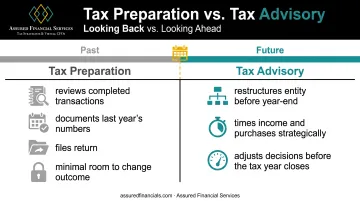
The clearest way to separate these two roles: tax preparation looks backward, tax advisory looks forward.
A tax preparer collects your documents, applies the tax code to what already happened, and files the return. That work is necessary, but it's retrospective — there's little room left to change the outcome once the calendar year has closed.
A tax advisory specialist works before the transactions happen. That might mean:
- Restructuring the business entity (S-corp versus LLC, for example) before year-end
- Timing income or large purchases to shift tax exposure between this year and next
- Reviewing entity structure ahead of a major contract or acquisition
Example: A preparer files last year's return as accurately as possible. An advisory specialist looks at this year's projected income in October and restructures compensation or timing decisions so next April's bill looks different.
What Does a Tax Advisory Specialist Do?
In practice, the role covers four connected areas: research, structuring, review, and decision support. A tax advisory specialist:
- Tracks changes in tax law and translates them into client-specific action
- Structures entities, transactions, and income timing to reduce liability
- Strategically reviews (not just prepares) returns for missed planning opportunities
- Advises on how financial decisions (hiring, financing, expansion) affect tax exposure
Representation When Things Go Wrong
When a client faces an audit, dispute, or collections matter, the advisor with proper credentials steps in as an authorized representative before the IRS or state tax authority. That work is advocacy: negotiating payment terms, disputing findings, or managing correspondence on the client's behalf.
Cross-Border and Government Contract Complexity
Two client types tend to need advisory-level support the most: internationally connected businesses and federal contractors.
For cross-border clients, FBAR and FATCA are separate reporting regimes with different thresholds and forms. Filing one does not satisfy the other, per IRS guidance comparing the two:
| Requirement | Trigger | Form |
|---|---|---|
| FBAR | Foreign accounts exceeding $10,000 aggregate at any point in the year | FinCEN Form 114 |
| FATCA | Specified foreign assets above IRS thresholds (varies by filing status/residency) | Form 8938 |
For government contractors, the work looks different: building DCAA-compliant accounting systems, structuring indirect cost pools (fringe, overhead, G&A), and aligning financial reporting with FAR cost-allowability rules.
Year-Round, Not Once-a-Year
Advisory-model firms run quarterly check-ins covering cash flow visibility, capital planning, and emerging tax issues, rather than a single meeting in tax season. Assured Financial Services, for example, structures its engagements this way: reviewing financial statements, monitoring forecasts, and coordinating tax strategy with clients on a recurring basis rather than reconnecting only when a return is due.
Tax Advisory Specialist vs. CPA vs. Enrolled Agent vs. Tax Attorney
A tax advisory specialist is a role, not a single license. The person in that role may be a CPA, an Enrolled Agent, a tax attorney, or hold more than one of those credentials. None of the licenses are mutually exclusive. What changes is scope.
| Credential | Basis | Focus | IRS Representation |
|---|---|---|---|
| CPA | State license, degree + exam | Broad accounting, audit, attestation, tax | Unlimited |
| Enrolled Agent (EA) | Federal license via IRS/Treasury | Tax exclusively | Unlimited |
| Tax Attorney | State bar admission | Litigation, disputes, privileged advice | Unlimited |
- CPA: Requires a college degree and passing the CPA exam, which covers auditing, financial reporting, and taxation. Strong choice if you need attestation or audited financials alongside tax work.
- Enrolled Agent: Licensed by the Treasury after a three-part IRS exam. Tax is the entire focus, with no audit or attestation work competing for attention.
- Tax Attorney: Best suited for litigation, complex disputes, or situations where attorney-client privilege matters. Routine return-preparation documents are not automatically privileged just because an attorney prepared them.
Do you need a CPA to get real tax advisory help? No. An EA holds equal, and often more tax-specific, authority to represent you before the IRS in all 50 states. The CPA license adds value for broader accounting needs, but it isn't a requirement for authorized tax advisory work.
Signs Your Business Needs a Tax Advisory Specialist
A few situations usually mean DIY tax work or generalist bookkeeping is no longer enough:
- Revenue and complexity have grown. At or above roughly $5M in annual revenue, hiring, financing, and contract pricing decisions create tax consequences most generalist bookkeeping setups miss.
- Cross-border activity exists. Foreign accounts, overseas income, or international entities create multi-jurisdiction exposure a domestic-only preparer is rarely equipped to handle.
- The IRS is already involved. Audits, back taxes, payroll tax delinquency, or wage garnishment call for someone authorized to represent you, not just explain the notice.
- Government contract work has started. DCAA compliance, indirect rates, and cost-type contract reporting need systems and expertise most generalist accountants do not maintain.
How to Choose the Right Tax Advisory Specialist
Finding the right fit comes down to matching credentials and specialization to your actual complexity, not hiring the first firm with "tax" in its name.
- Verify credentials and representation rights. Confirm the person is an EA, CPA, or attorney, and that they can legally represent you before the IRS if a dispute arises.
- Match specialization to your complexity. A firm skilled in restaurant bookkeeping isn't necessarily equipped for DCAA compliance or FBAR filings.
- Prioritize a year-round model. Look for quarterly check-ins and ongoing planning, not a single tax-season phone call.
- Confirm how sensitive data is handled. If you're a federal contractor, ask directly whether staff hold security clearances and whether any work is outsourced offshore.
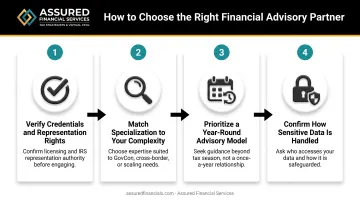
Those four checks describe a narrow profile. Assured Financial Services was built for it: the firm is led by an IRS Enrolled Agent with more than 15 years of combined corporate finance and federal contracting experience.
Every engagement is handled by an in-house, U.S.-based, security-cleared team with no offshore outsourcing. The practice focuses on GovCon, cross-border, and established SMB clients at $5M+ in revenue, the segment that tends to outgrow generalist bookkeeping first.
Frequently Asked Questions
What does a tax advisor actually do?
A tax advisor researches tax law changes, structures transactions and entities, reviews returns, and represents clients before the IRS, all aimed at reducing liability while staying compliant.
Do you need a CPA to be a tax advisor?
No. An IRS Enrolled Agent holds equal or greater federal representation authority specifically for tax matters, and tax attorneys can also serve as advisors depending on the situation.
Is a tax advisory specialist worth the cost for a small business?
For businesses with genuine complexity (multiple revenue streams, government contracts, or cross-border activity), proactive planning typically offsets the fees through reduced tax exposure over time.
How is a tax advisory specialist different from a bookkeeper?
Bookkeepers record historical financial transactions as they happen. Tax advisory specialists interpret that data to build forward-looking strategy that changes future tax outcomes.
Can a tax advisory specialist represent me before the IRS?
Only CPAs, EAs, and attorneys hold this authority. Confirm which credential your advisor holds before engaging them for audit or dispute support.