Introduction
Foreign bank account reporting sounds like a niche compliance issue. It isn't. Every year, expats, dual citizens, green card holders, and business owners with overseas operations get blindsided by FBAR rules they didn't know applied to them.
Non-willful penalties can exceed $16,000 per violation, and "I didn't know" rarely helps once the IRS comes calling.
For the 2025 tax year (filed in 2026), missing or incorrect FBARs still carry those same consequences. This guide covers who must file, the 2026 deadline, what counts toward the $10,000 threshold, exemptions, how to file, and what to do if you're already behind.
Key Takeaways
- FBAR deadline for 2025 accounts: April 15, 2026 (auto-extends to October 15, 2026)
- $10,000 threshold is aggregate across all foreign accounts, not per account
- File FBAR (FinCEN Form 114) with FinCEN, not the IRS, separate from your tax return
- Non-willful penalties can top $16,000 per year; voluntary compliance can eliminate them
What Is an FBAR and Who Must File It
An FBAR is FinCEN Form 114, the Report of Foreign Bank and Financial Accounts. Under the Bank Secrecy Act, it discloses foreign accounts to the Treasury Department.
It is an informational filing only—it does not create tax liability on its own. You file it electronically through FinCEN's BSA E-Filing System, separate from your federal income tax return.
Who Qualifies as a "U.S. Person" for FBAR Purposes
The FBAR obligation applies broadly to:
- U.S. citizens, including dual citizens living abroad
- Green card holders, regardless of where they currently live
- Resident aliens who meet the substantial presence test
- Domestic entities: LLCs, corporations, partnerships, trusts, and estates
Physical residence has no bearing on this. A U.S. citizen who has lived abroad for 30 years carries the same FBAR duty as someone living in Ohio with a single foreign brokerage account.
The Two-Part Filing Trigger: Financial Interest or Signature Authority
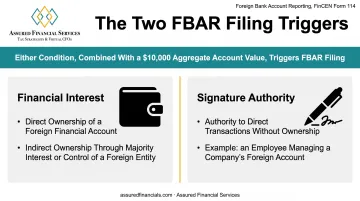
You must file if the aggregate value of your foreign accounts exceeded $10,000 at any time during the calendar year, and you have either of the following:
- Financial interest — direct ownership, or an indirect interest through majority ownership of an entity that holds the account
- Signature authority — authority to direct transactions on the account even without owning it (for example, an employee who manages a company's foreign account)
Joint accounts count in full toward that $10,000 threshold for each U.S. person owner.
A narrow spousal exception applies: if both spouses sign Form 114a and one files for both, the non-filing spouse does not need a separate submission. Without that signed form, each spouse files independently and reports the entire account value.
FBAR Filing Deadlines for 2026
The FBAR filing deadline for the 2025 calendar year is April 15, 2026. Miss that date, and you automatically receive an extension to October 15, 2026 — no application, form, or fee required.
That automatic extension trips people up in one specific way: they assume it aligns with their tax deadlines. It doesn't.
- Extending your income tax return does not extend your FBAR deadline
- The June 15 automatic extension for Americans living abroad does not extend your FBAR deadline either
- The FBAR deadline runs entirely on its own track, filed with FinCEN, not the IRS
If April 15 falls on a weekend or federal holiday, the deadline shifts to the next business day. FinCEN also periodically issues relief notices for natural disasters or other specific circumstances. Check FinCEN's reporting page for any 2026-specific notices before you file.
Your filing deadline also starts the record-retention clock. Keep these details for five years from the due date:
- Account name and number
- Financial institution name and address
- Account type
- Maximum value the account reached during the year
That last point trips up a lot of filers: report the maximum balance during the year, not the year-end balance.
What Counts Toward the $10,000 Threshold — and What's Exempt
Here's the question that generates the most confusion: does a $3,000 account need to be reported?
Yes, if your combined foreign accounts hit $10,001 at any point during the year (even for a single day), you must report every account, including ones that never held more than a few hundred dollars. The threshold is aggregate, not per account.
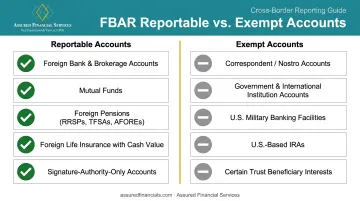
Commonly Reportable Accounts
- Foreign bank and brokerage accounts
- Mutual funds and pooled investment funds with regular valuations
- Foreign pension or retirement accounts, including Canadian RRSPs and TFSAs, Mexican AFOREs, and similar arrangements (no blanket retirement-account exemption)
- Foreign life insurance policies with cash value
- Accounts held only through signature authority, even with zero ownership
Accounts Exempt from FBAR Reporting
- Correspondent or nostro accounts used solely for bank-to-bank settlement
- Accounts owned by governmental entities or international financial institutions
- Accounts at U.S. military banking facilities, including those located overseas
- U.S.-based IRA or retirement plan accounts, even if they hold foreign assets
- Certain trust beneficiary interests, when the trust itself already reports the accounts
For accounts held in a foreign currency, convert the year's maximum value to U.S. dollars using the Treasury's year-end exchange rate for 2025, available through the Treasury Reporting Rates of Exchange dataset. If no Treasury rate exists for that currency, use another verifiable rate and note its source.
How to File Your FBAR Online (FinCEN Form 114)
FBARs are filed exclusively through FinCEN's BSA E-Filing System. You cannot attach one to Form 1040, mail it with your tax return, or submit it to the IRS in any form.
Before you sit down to file, gather:
- Account numbers for every reportable account
- Full names and addresses of each financial institution
- Maximum account value during 2025, converted to USD
- Whether you held the account through ownership, joint ownership, or signature authority only
A common mistake: treating signature-authority accounts as optional to report. They're not. If you can direct transactions on an employer's foreign account, that account belongs on your FBAR even though you don't own a dollar of it.
Once your records are ready, file online:
- Create or sign in to a BSA E-Filing account at fincen.gov
- Complete FinCEN Form 114 with each account’s details and maximum USD value
- Review for accuracy, submit the form, and save the confirmation number
You don’t have to file it yourself. Form 114a lets you authorize a tax professional to file on your behalf. Signature authority, joint ownership, and multi-entity structures are where filing errors most often occur.
Working with someone who handles these filings regularly, like the team at Assured Financial Services, helps get ownership and authority categories right the first time.
FBAR Penalties and Getting Compliant If You're Behind
FBAR penalty exposure is steeper than most people assume, and amounts are adjusted for inflation almost every year.
| Violation Type | Current Penalty |
|---|---|
| Non-willful | Up to $16,536 per FBAR, per year (not per account) |
| Willful | Greater of $165,353 or 50% of the account balance at the time of the violation |
| Criminal (willful) | Up to $250,000, five years imprisonment, or both — up to $500,000 and 10 years in aggravated cases |
That "per report, not per account" distinction for non-willful violations comes from the Supreme Court's 2023 ruling in Bittner v. United States. The Court held that a non-willful failure to file is one violation, not one violation for every unreported account.
That is meaningful protection. It does not eliminate penalty risk.
Recent circuit decisions are narrowing the gap between "I didn't know about the rule" and willful conduct. Courts in the Sixth, Ninth, and Eleventh Circuits have found that objective recklessness, not just deliberate intent, can meet the willfulness bar.
Ignoring known red flags, giving inconsistent explanations, or still not filing after you learn about the obligation can move a case from the $16,536 tier into the $165,353-or-50% tier quickly.
That escalation risk is why catching up proactively beats waiting to see whether the IRS notices.
Two Paths to Getting Compliant
- Delinquent FBAR Submission Procedures — for filers current on tax returns but behind on FBARs. File the missed forms with a reasonable-cause statement; the IRS generally will not penalize if account income was already reported and taxed.
- Streamlined Filing Compliance Procedures — for filers behind on both returns and FBARs. You file three years of returns, six years of FBARs, and certify that the failure was non-willful.
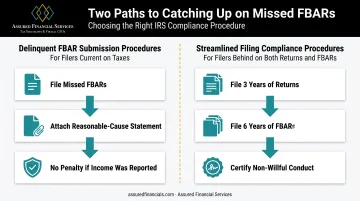
Both paths hinge on one thing: the failure has to be non-willful. That's a legal determination, not a guess, and it's worth getting right before you submit anything.
If you are already behind, Assured Financial Services can help you choose the right path and manage the filing. The firm's founder is an IRS Enrolled Agent with unlimited practice rights before the IRS in all 50 states and represents individuals and businesses on FBAR delinquency, penalty risk review, and multi-year compliance catch-up.
Frequently Asked Questions
Who is required to file an FBAR and who is exempt?
Any U.S. person with a financial interest in or signature authority over foreign accounts exceeding $10,000 in aggregate must file. IRAs, correspondent accounts, and certain trust or government accounts are exempt.
Do I need to file an FBAR for foreign accounts under $10,000?
Individual account size doesn't matter. If the combined maximum value of all your foreign accounts exceeds $10,000 at any point during the year, every account must be reported, even ones with small balances.
What types of accounts are exempt from FBAR reporting?
Main exemptions include correspondent/nostro accounts, government and international financial institution accounts, U.S. military banking facility accounts, and U.S.-based retirement accounts.
Is the FBAR deadline the same as my tax return deadline?
No. The FBAR deadline (April 15, with an automatic extension to October 15) runs independently of income tax deadlines, including the June 15 extension available to Americans abroad.
What happens if I miss the FBAR deadline?
Late filing can trigger civil penalties, but voluntary compliance programs like the Delinquent FBAR Submission Procedures can eliminate penalties entirely for non-willful filers who come forward proactively.
Do I need to report an account I only have signature authority over, not ownership?
Yes. Signature authority alone creates a filing obligation, even with zero ownership interest: a common example is an employee who can direct transactions on a foreign employer account.