Many family business owners struggle with a simple problem: the rules that apply to hiring, gifting, and transferring ownership inside a family are genuinely different from standard business tax rules, and most generalist accountants don't specialize in the overlap.
Without proactive planning, families risk overpaying taxes, triggering unnecessary IRS scrutiny, or losing control of the business mid-transition. This guide walks through entity structure choices, tax-smart family employment, gifting and trust strategies, and the succession timing that ties it all together.
Key Takeaways
- Entity structure determines which family tax exemptions actually apply to your business
- Hiring your own children can be tax-free under specific entity structures
- Gifting and trusts like IDGTs and GRATs move future appreciation out of your taxable estate
- Succession planning works best when started 5-10 years before a transition, not after
Structuring Your Family Business for Tax Efficiency
Your entity choice (sole proprietorship, husband-and-wife qualified joint venture, multi-member LLC, or S-corp) determines which family tax exemptions you can actually use. This decision shapes how income flows to family members, which payroll exemptions survive, and how much self-employment tax everyone pays.
Get the structure wrong early, and you may lock yourself out of exemptions that would have saved thousands annually.
Should a Husband-and-Wife LLC Be 50/50?
Not necessarily. Spouses in non-community property states can elect Qualified Joint Venture (QJV) treatment for a jointly owned, jointly operated business, but only if it is not held through a state-law entity like an LLC.
Each spouse then reports their share as a sole proprietor on a separate Schedule C, files one joint Form 1040, and skips Form 1065 entirely.
The ownership split matters because:
- Each spouse pays self-employment tax only on their allocated share
- Each spouse builds separate Social Security earnings credit and Medicare coverage
- A 50/50 split isn't required — percentages should reflect actual involvement in the business
Whatever split you choose, document it consistently across every filing. Inconsistent reporting between years is a red flag.
Community property states work differently. A jointly owned unincorporated business there may qualify for special treatment as either a partnership or a disregarded entity, but the rules diverge from standard QJV treatment. A quick professional review before you finalize the split prevents costly rework later.
As revenue climbs, many spousal businesses outgrow the QJV or basic LLC structure. Once payroll tax exposure outweighs the simplicity of a sole proprietorship, model an S-corp election before you restructure.
Assured Financial Services pairs tax planning with virtual CFO support so you can compare those numbers before you file, not after.
Hiring Family Members: Can Your LLC Pay Your Kids Tax-Free?
Yes, but only under narrow conditions. Sole proprietorships and parent-owned partnerships where every partner is the child's parent can pay children under 18 wages exempt from Social Security, Medicare, and FUTA taxes. The moment your LLC adds a non-parent partner or elects corporate taxation, that exemption disappears.
Even without the FICA break, federal income tax still offers a useful opening. For 2026, the single-filer standard deduction is $16,100, according to IRS Publication 505. Pay your child wages up to that amount for real work, and those wages can be entirely free of federal income tax, on top of avoiding FICA if your entity qualifies.
Documentation That Keeps You Audit-Ready
The exemption only holds up if the arrangement is legitimate. That means:
- Market-rate pay for real, age-appropriate work, not inflated compensation disguised as a gift
- Timesheets tracking actual hours worked
- Written job descriptions matching the tasks performed
- Standard payroll processing, even when the wages are tax-exempt
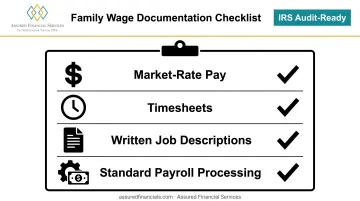
Skip any of these and you're handing the IRS an easy argument that the "wages" were really a disguised gift, which changes the tax treatment entirely.
Spouses face a separate choice: qualified joint venture (QJV) partner versus traditional W-2 employee. The QJV route builds separate Social Security credits; W-2 status opens different retirement plan contribution options. Neither is universally better. It depends on which spouse needs more retirement coverage.
A child's earned wages can also fund a custodial Roth IRA, up to the lesser of $7,500 or their earned income for 2026. That starts tax-advantaged savings decades earlier than most families plan for.
Gifting and Trust Strategies to Transfer Ownership Tax-Efficiently
Moving ownership out of your estate before you die is often the single biggest lever in family business tax planning. The tools range from simple annual gifts to sophisticated irrevocable trusts.
The basics: For 2026, the annual gift tax exclusion is $19,000 per recipient, according to the IRS, with a $15 million lifetime basic exclusion amount per individual. Gifting ownership stakes gradually, using the annual exclusion each year, avoids triggering large taxable transfers all at once.
Valuation Discounts and Appraisals
Minority or non-marketable interests in a closely held business are often worth less on paper than a simple percentage of company value would suggest. Discounts for lack of control or marketability can meaningfully reduce the taxable value of a gift.
To substantiate this with the IRS, you'll need either a qualified appraisal or a detailed disclosure identifying your valuation method, financial data, and the specific discounts claimed on Form 709. Skip proper disclosure, and the statute of limitations on that gift may never start running.
IDGTs and GRATs: Freezing Value for Heirs
Two trust structures do most of the heavy lifting here:
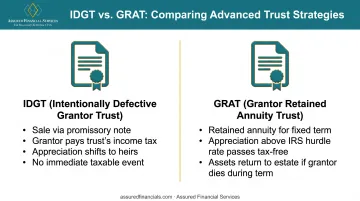
Intentionally Defective Grantor Trust (IDGT). You sell business interests to the trust for a promissory note at fair market value. Because the trust is disregarded for income tax purposes, the sale generally isn't a taxable event. Future appreciation shifts to your heirs, and you keep paying the trust's income tax yourself, which preserves more growth inside the trust.
Grantor Retained Annuity Trust (GRAT). You fund the trust, retain an annuity for a fixed term, and any appreciation above the IRS's monthly hurdle rate passes to beneficiaries free of additional transfer tax. Survive the term and beat the hurdle, and it works well. Die during the term, and most assets return to your estate.
Loans and the Basis Trade-Off
An alternative: loan money to family members (often through a grantor trust) using the IRS Applicable Federal Rate (AFR) to finance a sale. This shifts income tax burden to the buyer while minimizing transfer tax exposure.
Lifetime gifts carry the donor's original basis forward (carryover basis), while inherited property generally receives a stepped-up basis at date of death.
If your family has significant unrealized capital gains, waiting for inheritance might save more tax than gifting early. The right call depends on your timeline and expected appreciation.
Succession Timing and Common Tax Pitfalls to Avoid
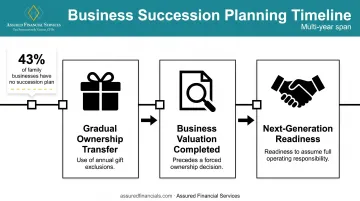
An Exit Planning Institute article citing PwC's Family Business Survey found that 43% of family-business owners had no succession plan at all. That's nearly half of family businesses gambling their transition on improvisation.
Advisors typically recommend starting the succession process 5-10 years before an intended exit. That runway allows time to:
- Transfer ownership gradually using annual gift exclusions
- Complete valuations before a health event or market shift forces a rushed decision
- Prepare the next generation for actual operating responsibility, not just ownership on paper
Audit Triggers Specific to Family Businesses
Family businesses draw particular IRS attention around a few recurring issues:
- Wages that are above or below what the work actually justifies
- Family members classified as contractors when they function as employees
- Inconsistent or missing documentation of hours worked and duties performed
None of these are automatically fatal, but each one weakens your position if the IRS ever asks questions.
Family Dynamics Are a Tax Issue Too
Sibling equity, in-law involvement, and non-active heirs shape tax outcomes as much as family relationships. A perfectly designed intentionally defective grantor trust (IDGT) or gifting schedule can unravel fast if one sibling feels shortchanged and contests the transfer. Build family alignment into the strategy itself, not as an afterthought.
When to Bring in a Tax Professional for Family Business Planning
Gift, estate, income, and payroll tax rules overlap constantly in family business planning. DIY succession and gifting strategies carry real risk, especially once your business crosses into significant valuation territory where a misstep gets expensive fast.
Growth-stage family businesses—generally $5 million or more in annual revenue—need proactive, year-round tax strategy, not a once-a-year filing relationship. That is the work Assured Financial Services (AFS) is built for. AFS's model combines:
- Integrated tax planning covering entity structure, income timing, and retirement contributions
- Fractional and virtual CFO support for cash-flow visibility and financial infrastructure
- IRS Enrolled Agent representation with direct authority before the IRS in all 50 states if wage arrangements or ownership transfers draw scrutiny
There's no minimum engagement required to start the conversation. A free 30-minute consultation is enough to talk through where your business stands.
Frequently Asked Questions
What is the best way to transfer a family business to my child?
It depends on your priority. Minimizing estate tax favors trusts like IDGTs or GRATs, retaining retirement income favors an installment sale, and simplicity favors a will or basic estate plan. Get a professional evaluation before committing to one path.
Should husband and wife LLC be 50/50?
Not necessarily. The Qualified Joint Venture election lets spouses split income by actual involvement, which affects Social Security credits and self-employment tax for each spouse. Document whatever split you choose deliberately and consistently.
Can my LLC pay my kids tax free?
It depends on entity structure — only sole proprietorships or parent-only partnerships qualify for the FICA exemption. Wages up to the standard deduction can also be income-tax-free if the work and pay are legitimate.
What is the annual gift tax exclusion for family business transfers?
For 2026, it's $19,000 per recipient, with a $15 million lifetime exemption per individual. Gifting business shares gradually lets you use that exclusion fresh every year.
Do I need a trust to pass down my family business?
Not always. Trusts are usually the most tax-efficient tool for larger, appreciating businesses, but smaller transfers can often be handled through direct gifting or a straightforward estate plan.
When should I start succession planning for my family business?
Start 5-10 years before your intended transition. Given that 43% of family-business owners have no succession plan at all, starting early already puts you ahead of most.