
Many owners find themselves staring at bank balances instead of real numbers. Cash flow gets murky. Tax-saving opportunities slip by unused. Decisions get made on gut feel instead of data, which makes lenders nervous and investors ask harder questions.
This guide breaks down what a real estate CFO actually does, the warning signs that you've outgrown basic bookkeeping, whether a fractional CFO or full-time hire fits your situation, and what credentials and costs typically look like.
Key Takeaways
- Real estate CFOs steer portfolio-wide cash flow, capital stack decisions, and entity structuring
- No legal "CFO certificate" exists; CPA, MBA, or IRS Enrolled Agent credentials signal specialized expertise
- Fractional CFO services deliver senior financial leadership without a six-figure salary commitment
- Compensation varies widely by portfolio size, complexity, and engagement type
What Is a Real Estate CFO?
A real estate CFO is the senior financial executive responsible for capital structure, financial strategy, and forward-looking decisions across a property portfolio or investment business. This person isn't tracking receipts. They're deciding how much debt versus equity a project should carry, forecasting liquidity six months out, and telling you whether to sell, refinance, or hold.
That's a different job from a bookkeeper or a controller.
- Bookkeepers record transactions and maintain accurate financial records
- Controllers manage the accounting close, GAAP compliance, and internal controls (and typically report to the CFO)
- CFOs operate one level up, focused on capital markets, financial planning, and where the business is headed rather than where it's already been
Why Real Estate Finance Gets Complicated Fast
Real estate businesses accumulate financial complexity that most other industries don't face at the same scale:
- Multiple LLCs or entities, often one per project or property
- Joint ventures with separate profit-sharing and reporting requirements
- Different lenders per deal, each with its own covenants and reporting demands
- Properties at different lifecycle stages (development, lease-up, stabilization, or sale) running simultaneously
A single owner might be managing a stabilized apartment building, a property mid-construction, and a JV deal that just closed, all at once. Each has different cash flow patterns and different reporting needs.
The term "CFO" scales accordingly. At a large REIT, it means an institutional executive overseeing billions in assets. For a growth-stage investor with eight properties, it might mean a fractional CFO who steps in a few hours a week to apply the same strategic oversight without the institutional overhead.
Core Responsibilities of a Real Estate CFO
A real estate CFO's job spans six interconnected areas. Miss one, and the others tend to suffer too.
Capital Stack and Financing Strategy
Every deal needs a mix of debt and equity, and the order matters. Senior debt gets paid first, then mezzanine debt, then preferred equity, then common equity, with risk increasing as you move down that stack.
JPMorgan's own example of a typical commercial real estate capital stack shows roughly 55% senior debt, 15% preferred equity, and 30% common equity. The right mix depends entirely on the deal and the lender's risk appetite.
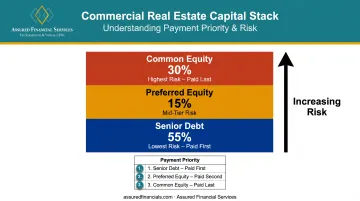
A CFO evaluates lender terms, covenants, and risk exposure before signing, not after.
Cash Flow Forecasting and Liquidity Management
Real estate cash flow is lumpy. Construction draws hit at odd intervals, lease-up income ramps slowly, and closings land whenever they land. NAIOP recommends rolling 18-to-24-month forecasts that account for construction milestones, financing resets, rate changes, and lease-up delays — not a static annual budget.
The job is to turn that lumpiness into a forecast that still covers payroll, debt service, and distributions.
Property-Level Profitability Reporting
Tax-basis books tell you what you owed the IRS. They don't tell you which asset is actually performing. A CFO builds reporting around Net Operating Income (NOI): total income minus operating expenses, excluding debt service and capital costs. That view shows which properties are winning, which are dragging, and which are ready to sell or refinance.
Financial Reporting and Stakeholder Communication
Lenders and investors expect credible, standardized reporting. That means financial statements, construction progress reports, and rent rolls that hold up to scrutiny. Strong CFOs own that reporting relationship year-round rather than scrambling before a lender's quarterly check-in.
Tax Strategy Integration
Depreciation, cost segregation, and 1031 exchanges work as year-round planning tools, not April filing exercises. Under IRS rules, residential rental property depreciates over 27.5 years and nonresidential property over 39 years. Cost segregation studies can accelerate portions of that timeline when applied correctly.
A CFO who tracks tax exposure year-round catches these opportunities before they disappear.
Risk Management
Interest rate exposure, occupancy risk, and market fluctuations all threaten cash flow. Reserves, selective hedging, and diversified exposure keep one bad quarter from sinking the portfolio.
Signs Your Real Estate Business Needs CFO-Level Support
Some warning signs show up before the crisis does. Watch for these:
- You're deciding based on bank balance, not data. If a buy, sell, or refinance decision comes down to "there's money in the account" rather than project-level profitability numbers, you're flying blind.
- Lenders are asking questions your team can't answer. When a lender wants cost-to-complete figures, lease-up rent rolls, or covenant compliance details and your bookkeeper hesitates, that's a credibility problem waiting to surface.
- Tax surprises keep happening. Missed depreciation strategies or entity-structuring gaps that only get caught at filing time point to a lack of proactive, year-round planning.
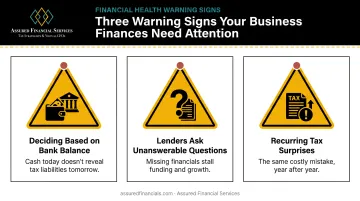
None of these alone means you must hire a CFO tomorrow. But two or three together usually mean the current setup has been outgrown.
Fractional CFO vs. Full-Time CFO for Real Estate Businesses
Not every portfolio needs a full-time executive hire, or can justify one.
When a Full-Time CFO Makes Sense
Large portfolios and institutional funds that need daily executive presence typically bring a CFO in-house. That usually means six-figure-plus salary and benefits, which only pencils out once portfolio complexity and deal volume justify a full-time seat.
When Fractional Makes More Sense
Growth-stage real estate investors and operators who need senior strategy without a daily executive are better served by a fractional or virtual CFO. The model delivers the same capital planning and forecasting expertise at a fraction of the overhead.
Fractional support is usually the better fit when you need:
- Capital planning and cash flow forecasting across deals
- Executive-ready reporting without a full-time seat
- Year-round tax strategy tied to operating decisions
- Senior guidance during growth, not only at filing time
Assured Financial Services structures its virtual CFO model around this gap. Every engagement is led directly by the firm's founder, an IRS Enrolled Agent with 15+ years in corporate finance, rather than rotating clients between junior staff. Clients get CFO-level leadership (cash flow forecasting, capital planning, executive reporting) paired with proactive tax strategy under one roof, without a six-figure commitment.
The most effective fractional relationships aren't activated once a year at tax time. They run year-round, so cash flow gaps and tax planning windows get caught while there's still time to act.
Qualifications, Credentials, and Cost: What to Expect
No government agency issues a "CFO license." Anyone can hold the title. What matters is the credential and experience behind it.
Credentials That Signal Real Expertise
| Credential | What It Verifies |
|---|---|
| CPA | Accounting/tax competency through the AICPA's Uniform CPA Exam |
| MBA | Graduate-level business strategy training |
| CFA | Investment analysis expertise (3 exam levels, 4,000+ hours of experience) |
| IRS Enrolled Agent (EA) | Federally licensed tax practitioner with unlimited IRS representation rights nationwide |
For real estate investors specifically, real-world experience with capital stacks, multi-entity structuring, and project-level accounting often matters more than any single letter combination.
That said, an EA credential carries particular weight for investors managing multi-property tax exposure. It grants unlimited representation before the IRS on any tax matter in all 50 states, the same credential held by AFS's founder.
What Full-Time CFOs Earn
Full-time CFO compensation varies enormously by company size. Robert Half's 2026 data puts U.S. CFO base salaries at:
- 25th percentile: $195,500
- Median: $269,750
- 75th percentile: $321,750
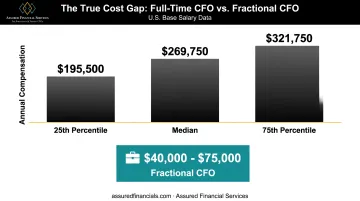
Figures climb further at larger, more complex organizations.
Fractional CFO engagements scale down from there. Instead of a fixed six-figure salary plus benefits, you pay for the level of strategic support your portfolio actually needs. AFS is built around that model: senior-level guidance without the overhead of a full-time executive hire.
Frequently Asked Questions
What is a CFO in real estate?
A real estate CFO is the senior financial executive who oversees capital strategy, cash flow, reporting, and tax-aware decision-making across a property portfolio. The role focuses on forward planning, not day-to-day bookkeeping.
Is a CFO certificate required in real estate?
No specific certificate is legally mandated for the CFO title. Credentials like CPA, MBA, or IRS Enrolled Agent status demonstrate specialized financial expertise instead.
How much should a CFO in real estate get paid?
Pay varies widely by portfolio size and complexity. Full-time national CFO salaries often fall between $195,000 and $320,000. A fractional CFO is a lower-cost alternative to a full-time hire.
What's the difference between a real estate CFO and a controller?
A controller manages the accounting close, compliance, and internal controls. A CFO focuses on forward-looking strategy, capital planning, and relationships with lenders and investors.
When should a real estate business hire a fractional CFO instead of a full-time one?
Fractional CFOs suit growing portfolios or businesses not yet at the revenue or complexity level to justify a full-time executive salary. Many owners hit this stage once revenue climbs into the $3 million to $5 million range.
Can a CFO help with real estate tax strategy?
Yes. An integrated CFO and tax approach helps owners proactively plan around depreciation, cost segregation, 1031 exchanges, and entity structuring rather than reacting once filing season arrives.