
Most business owners don't see it coming. A lien typically follows a string of unanswered notices and a balance that quietly grew larger while other priorities took over. By the time the lien is filed, the notice-and-demand stage is already behind you.
This guide covers what a federal tax lien actually is, why the IRS files one, the exact steps to stop or remove it, and when it's time to bring in an Enrolled Agent or other authorized tax professional instead of handling the IRS alone.
Key Takeaways
- Paying in full releases a federal tax lien fastest; withdrawal, discharge, subordination, and OIC remain valid alternatives.
- Match the remedy to your situation: full pay, need time, sell/refinance property, or dispute the filing.
- Act quickly to limit credit damage, keep financing options open, and reduce levy risk on wages or accounts.
- An IRS Enrolled Agent can file the right remedy and represent you before the IRS so you avoid costly missteps.
What Is an IRS Tax Lien?
A federal tax lien is the government's legal claim against everything you own and everything you acquire afterward, once a tax debt goes unpaid. It doesn't target one bank account or one piece of property. It attaches to real estate, vehicles, business equipment, and receivables alike, until the debt is satisfied.
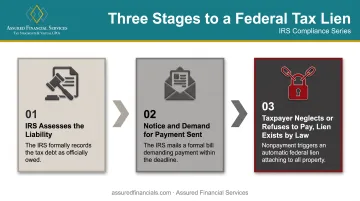
The lien follows a fixed sequence set by law, according to the IRS's guidance on federal tax liens:
- The IRS assesses the liability - a formal record of what you owe, based on filed returns, an audit adjustment, or an IRS-prepared substitute return.
- The IRS sends a Notice and Demand for Payment - an official bill.
- You neglect or refuse to pay in full - at this point, the lien exists automatically, by operation of law, even before anything is filed publicly.
To protect its position against other creditors, the IRS usually files a Notice of Federal Tax Lien at the local courthouse or county recorder's office. That filing is what makes the lien public record, visible to lenders, title companies, and anyone running a background check on your business.
Lien vs. Levy: Why the Distinction Matters
A lien and a levy get confused constantly, but they aren't the same thing.
- A lien is a claim. It secures the government's interest in your property without taking anything from you directly.
- A levy is the seizure itself, meaning the IRS actually takes wages, bank funds, or other assets to satisfy the debt.
A lien typically comes first. Levies follow a Final Notice of Intent to Levy, usually sent at least 30 days before enforcement begins. That gap matters: resolving the lien early, before the IRS moves to the levy stage, is what protects your paycheck and your bank account.
What Happens If a Tax Lien Is Not Removed?
Leaving a lien in place doesn't freeze the problem. It grows around it.
- Attaches to current and future property, including business receivables, and can resurface after bankruptcy
- Blocks a clean property sale or refinance until the IRS is paid from closing proceeds
- Surfaces on public record in mortgage underwriting, business lending, and finance-sector background checks (credit bureaus dropped tax liens from consumer reports in 2018)
- Raises the risk of an IRS levy or wage garnishment the longer it sits unresolved
Common Reasons the IRS Files a Tax Lien
Liens don't appear randomly. They follow a predictable pattern of missed chances to resolve a balance before it escalates.
- Unpaid income tax. Whether individual or business, the IRS files a lien after the full notice stream goes unanswered and the balance stays open.
- Delinquent payroll and employment tax deposits. Missed Form 941 deposits are pursued more aggressively because they involve trust fund money (income and Social Security tax withheld from employees but never remitted). The IRS can also assess the Trust Fund Recovery Penalty personally against responsible parties, so liability may not stay with the business alone.
- Unfiled tax returns. Miss enough deadlines, and the IRS may prepare a substitute return with the least favorable assumptions and none of your usual deductions, then pursue that balance like any other debt.
For government contractors juggling multiple cost-type contracts, payroll tax delinquencies deserve particular attention. Between indirect rate true-ups and DCAA reporting demands, payroll deposits are an easy line item to fall behind on during a cash crunch, and the trust fund exposure makes it one of the costliest categories to let slide.
How to Stop an IRS Tax Lien: Step-by-Step
Picking a resolution method before confirming the exact balance, lien type, and filing date is how taxpayers waste months on applications the IRS eventually kicks back. Working through these steps in order helps you identify the right removal method, gather the documentation it requires, and avoid re-filing errors that delay a release.
Step 1: Confirm the Lien Details and Your Total Balance
Pull an IRS account transcript through your Individual Online Account. You can also request one by mail (typically 5–10 days) or through the automated line at 800-908-9946. For lien-specific questions, the IRS Centralized Lien Operation (800-913-6050) can confirm your payoff amount.
Before choosing a resolution path, verify:
- The exact balance owed, including accrued penalties and interest.
- The lien filing date and which tax periods it covers.
- Whether a Notice of Federal Tax Lien was actually recorded at your local courthouse.
- Whether the lien was filed against the wrong taxpayer or property you never owned (grounds for a Form 12277 withdrawal).
Step 2: Determine Which Removal Method Fits Your Situation
Once the numbers are confirmed, match your circumstances to a resolution path:
- Can pay in full now - plan for a straightforward release.
- Can't pay in full, but can pay over time - set up an installment agreement, preferably a Direct Debit Installment Agreement that may later qualify for lien withdrawal.
- Can't realistically pay the assessed amount - weigh an Offer in Compromise against your income, assets, expenses, and earning capacity.
- A sale, refinance, or closing is pending - pursue discharge or subordination instead of waiting on full resolution.
Step 3: Apply the Correct Method
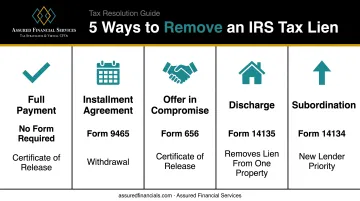
Each path has its own form and timeline:
| Method | What You File | What Happens |
|---|---|---|
| Full Payment | N/A | IRS issues a Certificate of Release, generally within 30 days |
| Installment Agreement | Set up a DDIA, then Form 12277 | Withdrawal possible once qualifying payments post |
| Offer in Compromise | Form 656 + Form 433-A(OIC) or 433-B(OIC) | Lien releases once the accepted offer amount is fully paid |
| Discharge | Form 14135 | Removes the lien from one specific property |
| Subordination | Form 14134 | Lets a new lender move ahead of the IRS in priority |
This is the stage where one paperwork mistake or missing document sends an application back to square one. An Enrolled Agent or authorized tax professional can file these forms correctly the first time and deal with the IRS on your behalf—so you're not the one on hold with Collections.
Step 4: Confirm the Release and Protect Your Records
Getting the IRS to agree to a release isn't the finish line. Confirm it actually shows up in the public record:
- Request written confirmation - a Certificate of Release, Form 668(Z), or withdrawal notice.
- Verify it was sent to the same recording office where the original lien was filed.
- Follow up with the Centralized Lien Operation if nothing arrives within 30 days of full payment.
- Pull an updated credit report and check county records to confirm the lien no longer shows as an open claim.
Full Payment vs. Other Relief Options: Which Path Fits Your Situation
There's no universal "right" method. It depends on your ability to pay, how urgent the situation is, and whether a property transaction is riding on the outcome.
Scenario 1: Funds Are Available Now
Fix: Pay the full balance. Full payment is the fastest path to release—often within 30 days.
Alternative: If cash is tight this month but available soon, confirm the IRS payoff amount and expected release timing before you choose a short-term bridge (loan, credit, or asset sale).
Scenario 2: Payment Is Possible Over Time, Not All at Once
Fix: Set up a Direct Debit Installment Agreement, then request withdrawal once qualifying conditions are met.
Alternative: A standard installment agreement stops new collection action, but it doesn't remove the public lien notice on its own.
Scenario 3: The Full Balance Cannot Realistically Be Paid
Fix: Pursue an Offer in Compromise, ideally with an Enrolled Agent or tax resolution professional preparing the financial disclosure package the IRS requires.
Alternative: Currently Not Collectible status pauses active collection, but it leaves the lien and the underlying debt in place.
Scenario 4: A Sale, Refinance, or Closing Needs to Happen Now
Fix: Apply for a discharge of that specific property, or a subordination that lets the transaction proceed.
Alternative: Pay the IRS claim on that property from closing or escrow proceeds. It can clear the deal, but it reduces your net proceeds dollar-for-dollar.
Choose based on cash on hand and how soon you need clear title or credit flexibility—then act before the lien blocks the next transaction or financing decision.
Mistakes to Avoid and How to Prevent Future Liens
Most lien problems get worse because of what happens after the notice arrives, not because of the original tax debt itself.
Common mistakes:
- Ignoring IRS notices. Silence accelerates the move from lien to levy and removes whatever negotiating leverage you had.
- Applying for the wrong relief option. Requesting a discharge when a full payoff was affordable, for example, wastes review time on both ends.
- Assuming an installment agreement erases the lien. It doesn't. Withdrawal has to be separately requested, usually via Form 12277, once qualifying conditions are met.
Prevention going forward:
- File and pay every return on time, and respond to the first IRS notice, not the fifth.
- Work with a tax professional for proactive planning and IRS representation year-round, not only after a lien has already landed.
At Assured Financial Services, that means year-round tax strategy, quarterly estimated filings, and entity-structure reviews designed to catch a cash-flow problem before it becomes a compliance problem.
Most liens are resolvable when addressed early. The right method depends on your financial circumstances. Professional representation usually shortens the timeline and helps you avoid paperwork errors that cost taxpayers months.
Frequently Asked Questions
What is a federal tax lien?
A federal tax lien is the government's legal claim against your property after an assessed tax debt goes unpaid following notice and demand. It attaches to real estate, vehicles, and business assets you own now or acquire later.
How do I stop a levy?
Resolve the underlying tax debt first—through full payment, an installment agreement, or Currently Not Collectible status—to prevent the IRS from escalating to a levy. A pending agreement generally blocks a new levy from being issued.
What happens if a lien is not removed?
An unresolved lien damages your ability to secure credit, blocks property sales or refinancing until the IRS is paid, and raises the risk of a levy or wage garnishment the longer it sits.
What is the difference between a tax lien and a tax levy?
A lien is a claim against your property. A levy is the actual seizure of that property or funds, such as wages or bank account balances.
Can a tax lien be removed without paying the full amount owed?
Yes. Withdrawal, discharge, subordination, and an accepted Offer in Compromise can all resolve or lift a lien without requiring full payment upfront.
How long does it take for the IRS to release a tax lien after payment?
The IRS is required to issue a release within 30 days of full payment. If it hasn't arrived by then, contact the Centralized Lien Operation to follow up.