
Most taxpayers don't know where to start. Should you hire a CPA, an enrolled agent, a tax attorney, or just a seasonal preparer? What should any of this actually cost?
This guide breaks down when hiring a tax professional makes sense, what each credential actually means, realistic pricing, and how to pick someone qualified for your specific situation — whether that's a messy year or a genuinely complex business.
Key Takeaways
- A PTIN lets anyone prepare taxes for pay, but only CPAs, EAs, and attorneys can represent you before the IRS.
- Self-employment, business ownership, IRS notices, or cross-border ties are clear signals to hire a professional.
- Fees vary by complexity, location, and pricing model. Get an itemized quote before you sign.
- Complex businesses (GovCon, international income, $5M+ revenue) benefit most from year-round advisory, not annual filing alone.
Signs You Need to Hire a Tax Professional
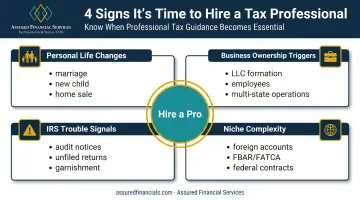
Some triggers are personal. Others are structural. Either way, they tend to show up before you realize how much they'll cost you if handled wrong.
Personal Life Changes That Complicate Your Return
- New self-employment or freelance income: 1099 income brings self-employment tax, quarterly estimates, and deduction rules software often misapplies.
- Marriage or divorce: filing status changes affect brackets, credits, and asset division.
- Buying or selling a home: capital gains exclusions and mortgage interest deductions have specific thresholds.
- Inheritance: basis step-up rules and potential estate filings aren't intuitive.
- A new child: credits and dependent rules shift almost every year.
Business Ownership Triggers
Forming an LLC or S-corp changes how you're taxed, not just what paperwork you file. Triggers that raise the stakes include:
- Hiring employees or contractors
- Multi-state operations or nexus
- Crossing into a higher revenue bracket
- Entity-structure and timing decisions with multi-year impact
A generalist preparer might file this year's return correctly but miss the entity or timing choice that would have saved money going forward.
IRS Trouble Signals
Audit notices, unfiled back returns, wage garnishment, or payroll tax delinquency require representation, not just preparation. This is a critical distinction: a preparer can file your return, but only a credentialed professional can speak to the IRS on your behalf when things go sideways.
Niche Complexity Most Preparers Can't Handle
Foreign income, foreign bank accounts subject to FBAR/FATCA reporting, and federal contract work requiring DCAA-compliant accounting sit outside what generalist preparers or off-the-shelf software are built to manage. These aren't edge cases if you're an expat, a dual-national, or a government contractor. They're standard operating conditions.
Complexity aside, the time cost adds up even on straightforward returns.
The IRS estimates 12 hours of total taxpayer burden per Form 1040, rising to roughly 21 hours for business filers, covering recordkeeping, planning, and form completion (IRS 2025 Form 1040 instructions). That's time pulled away from running a business or, frankly, living your life.
Types of Tax Professionals: Which One Do You Actually Need?
The baseline is low. A Preparer Tax Identification Number (PTIN) is the only legal requirement to be paid for tax prep. Anyone with one can call themselves a "tax preparer." Credentials and actual expertise vary enormously beyond that.
Here's how the main categories break down:
| Credential | Licensing Body | Representation Rights | Best For |
|---|---|---|---|
| PTIN-only preparer | None beyond IRS PTIN registration | None for returns signed after 2015 | Simple W-2 returns |
| CPA | State board licensure | Unlimited before the IRS | Tax prep, audits, broader financial planning |
| Enrolled Agent (EA) | U.S. Treasury / IRS | Unlimited in all 50 states | Tax-specific matters, IRS representation |
| Tax attorney | State bar | Unlimited before the IRS | Legal disputes, complex estate structuring, criminal tax matters |
CPAs: Broad Financial Expertise
A Certified Public Accountant is state-licensed, having passed the Uniform CPA Exam and met education and experience requirements that vary by state. CPAs handle tax prep but also audits, financial statement work, and general business accounting. That wider scope goes beyond pure tax specialization.
Enrolled Agents: The Federally Licensed Tax Specialist
An Enrolled Agent is authorized directly by the U.S. Treasury, with unlimited rights to represent taxpayers before the IRS in all 50 states on any tax matter. This is the credential held by Assured Financial Services' founder.
EAs generally focus exclusively on taxation rather than splitting attention across broader accounting services. That focus makes them the most tax-specialized of the credentialed options: federal representation authority without the state-by-state variability that can apply to CPA licensing.
Tax Attorneys: For Legal Complexity
Attorneys are best suited to legal disputes, complex entity or estate structuring, and criminal tax matters, not routine annual filing. If your situation involves litigation risk or privileged communications, this is the right lane.
Non-Credentialed and Seasonal Preparers
Non-credentialed and seasonal preparers work fine for simple, single-income returns. They cannot represent you in an audit, and training varies enormously from one preparer to the next.
Do you need a CPA or a basic preparer? Simple W-2 returns rarely need more than a basic preparer or software. Self-employment, business ownership, multiple income sources, or IRS issues call for a credentialed CPA or EA.
How Much Does It Cost to Hire a Tax Professional?
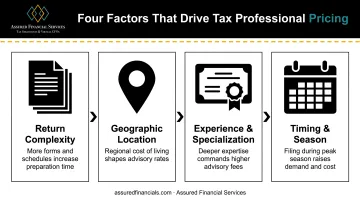
What you pay depends less on a sticker price and more on the work involved. Four factors drive most of the difference:
- Return complexity: a Schedule C or multiple K-1s costs more than a standard W-2 filing.
- Geographic location: rates in major metro areas run higher than rural markets.
- Experience and niche specialization: someone fluent in GovCon or international tax will charge accordingly.
- Timing: peak season (February through April) typically costs more than off-season planning work.
Common Pricing Models
- Flat fee: one price for a defined scope of work.
- Hourly rate: billed by time spent, common for complex or ongoing engagements.
- Per-form/schedule pricing: a base fee plus charges for each additional form.
- Hybrid models: a flat base fee with add-ons for complexity.
Always request an itemized cost breakdown before committing. A vague quote is a red flag in itself.
The Biggest Red Flag: Refund-Based Fees
Avoid any preparer who charges a percentage of your refund, or who promises a bigger refund than competitors before reviewing your documents.
The IRS specifically warns taxpayers to avoid preparers who base fees on refund size or direct refunds into their own accounts. That model creates an incentive to overstate deductions or credits, and the liability lands on you, not them.
What Proactive Planning Actually Buys
A once-a-year filing fee is easy to compare. Harder to see upfront is what year-round planning saves you.
Entity structure reviews, quarterly estimate management, and income timing decisions made before December 31 (not after) often pay for the engagement through lower tax exposure and fewer penalties.
How to Choose the Right Tax Professional
Verify credentials and working process before you hire anyone. Don't take a website claim at face value.
- CPA: Confirm licensing through the relevant state board of accountancy.
- EA: Verify status directly with the IRS Office of Enrollment.
- Any preparer: Check the IRS Directory of Federal Tax Return Preparers for active PTIN holders with listed credentials.
Questions to Ask During a Consultation
Use the consultation to learn how they work—not only what they charge:
- How are fees determined, and can I get that in writing?
- Will my return be outsourced, and if so, where?
- What's your experience handling audits or IRS notices?
- What happens if you make an error on my return?
Warning Signs to Walk Away From
Treat any of these as a deal-breaker:
- Reluctance to sign the return or provide a PTIN
- Pressure tactics or rushed decision-making
- Refund promises that sound too good to be true
- Vague answers about where your data is processed
When Complex Financial Situations Call for a Specialized Firm
Generalist accountants and seasonal preparers handle straightforward returns well. They fall short for government contractors managing DCAA compliance, businesses with cross-border tax exposure, or growth-stage companies making high-stakes financial decisions. In those cases, a missed detail is a compliance failure, not a minor correction.
This is the gap Assured Financial Services was built to fill. The firm was founded by an IRS Enrolled Agent with more than 15 years across corporate finance and federal government contracting, and every engagement is led directly by that founder rather than handed off to junior staff.
What Sets This Model Apart
- GovCon depth on DCAA-ready cost pools, indirect rates, and Incurred Cost Submissions (ICE), grounded in accounting configuration and FAR cost principles
- Cross-border compliance for FBAR (FinCEN Form 114), FATCA Form 8938, and foreign entity reporting on Forms 5471 and 5472
- In-house, security-cleared U.S. staff for every engagement, including no-notice DCAA floor checks and sensitive program data
- Integrated CFO support (bookkeeping oversight, cash-flow forecasting, KPI reporting) alongside tax strategy so decisions and tax positions stay aligned year-round

FBAR and Form 8938 are not interchangeable: an FBAR is generally required once aggregate foreign accounts exceed $10,000 at any point in the year, while Form 8938 thresholds are higher and depend on filing status and residency.
If your situation involves government contract compliance, international tax obligations, or you're running a business at $5 million or more in annual revenue, a once-a-year filing relationship probably isn't enough. Assured Financial Services offers a no-minimum initial conversation: a free consultation to see whether specialized support fits your situation.
Frequently Asked Questions
How much does it cost to hire a tax professional?
Fees typically range from under $100 for simple returns to several hundred dollars or more for complex situations, depending on complexity, location, and pricing model. Always request an upfront, itemized quote.
Do I need to hire a CPA or a tax preparer?
Simple returns can often be handled by a basic preparer or software. Business ownership, multiple income streams, or IRS issues call for a credentialed CPA or EA who can also represent you if needed.
What is the difference between an EA and a CPA?
EAs are federally licensed specifically in taxation, with unlimited IRS representation rights in all 50 states. CPAs are state-licensed with broader accounting expertise that extends beyond taxes into audits and financial reporting.
Can a tax preparer represent me in an IRS audit?
Only CPAs, Enrolled Agents (EAs), and attorneys can represent taxpayers before the IRS on audits, appeals, and collections. Non-credentialed preparers cannot, regardless of who prepared the original return.
When should I hire a tax professional instead of filing myself?
Consider hiring a professional when you have self-employment income, business ownership, major life events, IRS notices, or cross-border or multi-entity complexity. Any of these can turn a simple filing into a costly mistake.
Is it worth hiring a tax professional for a small business?
For growing businesses and anything beyond a simple sole proprietorship, proactive tax planning and compliance support usually pay for themselves through lower tax exposure and fewer penalties over time.