Here's the part most people miss: fixing unfiled returns isn't as simple as sitting down and filing whatever's missing. The right outcome depends on how many years you actually need to file, whether the IRS has already stepped in with a Substitute for Return, and how carefully the filing is handled once you start.
This article walks through exactly how many years you need to file, the step-by-step process, what documents you'll need, the IRS rules that shape your outcome, common mistakes to avoid, and when it makes sense to bring in professional representation.
TL;DR
- The IRS generally expects six years of returns filed to be considered in good standing (Policy Statement 5-133).
- Refunds and credits expire 3 years after the original due date — after that, they're gone for good.
- Filing voluntarily beats letting the IRS file a Substitute for Return, which rarely includes your deductions or credits.
- Failure-to-file and failure-to-pay penalties compound monthly, but relief options exist.
- A professional can pinpoint exactly which years to file and negotiate directly with the IRS on your behalf.
How to File Your Unfiled Tax Returns With the IRS
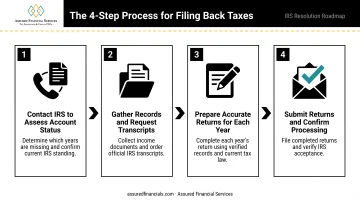
Filing back taxes follows a specific sequence. Skip a step or do them out of order, and you risk delays, mismatched income figures, or an IRS response that undoes your progress.
Step 1: Contact the IRS to Assess Your Account Status
Before preparing anything, find out where your account actually stands.
- Check whether a delinquent-return investigation or Substitute for Return (SFR) has already started
- Determine if a local revenue officer has been assigned — this signals in-person enforcement, not just standard notices
- If an SFR has already been assessed, request additional time to file an accurate return in its place
This step tells you whether you're filing proactively or responding to enforcement already in motion. Those are two very different situations.
Step 2: Gather Records and Request IRS Transcripts
Once you know your status, pull the records that will anchor your returns.
- Order Wage and Income Transcripts via Form 4506-T or the IRS "Get Transcript" tool to reconstruct missing W-2, 1099, and 1098 data
- Pull account transcripts to verify withholding or estimated payments that can offset your balance
- Collect personal records for deductions and credits separately — transcripts won't show those
Most transcript requests process within 5 to 10 business days when submitted online, though mailed requests can take longer.
Step 3: Prepare Accurate Returns for Each Required Year
Prepare each year on its own rules, and file the oldest year first so later returns stay consistent.
- Use the tax forms and rules for each specific year, not current-year versions — brackets, deductions, and credits shift annually
- Match reported income exactly to what's on your IRS transcripts to avoid triggering extended review
- Claim every deduction and credit you're entitled to, even for years the IRS already filed an SFR without them
- Use year-specific software or a tax professional when multiple years or complex income are involved
Step 4: Submit Returns to the Correct IRS Unit and Confirm Processing
- Mail returns to the address listed on any notice you've received, or the standard filing address if there's no notice
- Expect longer processing on returns replacing an SFR, since the IRS scrutinizes those more closely
- Follow up if you have no acknowledgment within about 30 days (longer for SFR replacements) — don't assume silence means success
Why You Should File Now: The Risks of Waiting
There's no statute of limitations on the requirement to file. Unlike collection activity, which the IRS eventually has to stop pursuing, the obligation to file a past-due return never expires. Under IRC 6501(c)(3), the IRS can assess tax "at any time" when a required return wasn't filed.
Waiting compounds the damage in several ways:
- Refunds expire. After three years, any refund or credit you were owed is forfeited permanently.
- Social Security earnings go unreported. Unfiled self-employment income never hits your earnings record, and corrections get much harder after roughly 3 years and 3 months.
- Loan applications stall. Mortgage lenders and business lenders routinely require filed returns before approving financing.
Left unresolved, a Substitute for Return (SFR) tax bill can escalate quickly. The IRS can move from assessment to a federal tax lien or a levy on wages and bank accounts.
Repeated non-filing can add more penalties, and in rare willful cases it can trigger a criminal referral. Filing now limits how far that enforcement path can run.
What You Need Before Filing Back Tax Returns
Gathering the right records upfront prevents inaccurate returns and the processing delays that come with them. Here's the core list:
- Prior-year W-2s and 1099s for each missing year
- Self-employment or business income records, including invoices and expense logs
- Mortgage interest statements, investment income statements, and any 1098s
- The correct prior-year tax forms — not the current year's versions
You'll also need access to an IRS Online Account or the ability to request transcripts directly. If a representative is handling this for you, they'll need a signed Power of Attorney (Form 2848) authorizing them to act with the IRS on your behalf. Assured Financial Services starts each engagement with a confidential review of transcripts, notices, and filing history so nothing is filed on incomplete or assumed information.
Key Factors That Affect Your Back Tax Filing Outcome
The outcome of filing back taxes hinges on a handful of specific IRS rules, not just paperwork accuracy.
The Six-Year Lookback Rule
Under IRM 4.12.1, Policy Statement 5-133 states enforcement periods are "not to be more than six years," though the IRS can extend or shorten that based on compliance history and other factors. Filing fewer years than required won't resolve your issue. Filing more than necessary just wastes time on returns the IRS won't act on.
Refund Statute of Limitations
Refunds and credits, including the Earned Income Tax Credit, can only be claimed within 3 years of the original due date. Miss that window, and the money is gone — no matter how accurate the return is.
Substitute for Return (SFR) Status
An IRS-filed SFR often skips deductions and credits you're actually entitled to, which inflates the balance owed.
Replacing it with an accurate self-filed return can cut that bill, though it takes longer to process since the IRS compares it closely against its own records.
Accumulating Penalties and Interest
Failure-to-file penalties run 5% per month, capped at 25%, while failure-to-pay penalties run 0.5% per month, also capped at 25%, according to the IRS failure-to-file penalty page. When both apply in the same month, the combined rate is 5%, not 5.5%.
The longer you wait, the fewer penalty-relief options remain. Programs like first-time abatement favor early voluntary compliance.
Common Mistakes and Your Resolution Options If You Owe
Common Mistakes to Avoid
- Filing too many or too few years back without confirming the actual requirement with the IRS first
- Reporting income that doesn't match IRS transcripts, which flags the return for extended review
- Ignoring an existing SFR (Substitute for Return) or enforcement notice instead of formally responding to or replacing it
- Trying to negotiate a payment plan before all required returns are actually filed
Your Resolution Options If You Owe
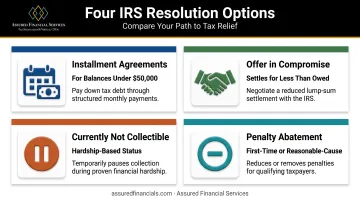
If filing reveals a balance, you have several paths depending on your finances:
- Installment Agreements: Streamlined terms are available for balances at or below $50,000, often without a full financial disclosure requirement
- Offer in Compromise: Settles the debt for less than owed based on documented ability to pay; requires full financial disclosure and fits only specific situations
- Currently Not Collectible Status: Pauses collection activity for taxpayers facing genuine hardship, though the debt and interest remain
- Penalty Abatement: First-time abatement or reasonable-cause arguments can reduce failure-to-file and failure-to-pay penalties on qualifying years
Working through these options without professional help is possible, but it's easy to misjudge which path fits your finances.
Assured Financial Services is led by an IRS Enrolled Agent with unlimited practice rights before the IRS in all 50 states. The firm can identify which years need filing, prepare returns that match IRS transcripts, and negotiate installment agreements or an Offer in Compromise on your behalf.
Frequently Asked Questions
What happens if I have unfiled tax returns for several years?
You risk an IRS-filed Substitute for Return, lost refunds, compounding penalties, and possible enforcement action. Voluntarily filing, even years late, almost always leads to a better outcome than continuing to wait.
How many years back do I need to file unfiled tax returns?
The IRS generally follows a six-year rule under Policy Statement 5-133. More years may be required if there's a large balance due or business returns are involved.
Will I go to jail for not filing my taxes?
Criminal prosecution is rare and reserved mainly for willful, repeated evasion. Most non-filers resolve their situation through voluntary filing and civil penalties instead.
What if I can't afford to pay the taxes I owe once I file?
Filing and paying are separate obligations. Installment agreements, an Offer in Compromise, or Currently Not Collectible status can all apply even if you can't pay in full right away.
Does the IRS forgive unfiled tax returns after a certain time?
No. There's no statute of limitations on the requirement to file. The ability to claim refunds or credits, however, expires 3 years after the original due date.
Can a tax professional help me if I haven't filed in years?
Yes. A credentialed professional, such as an IRS Enrolled Agent, can request transcripts, determine exactly which years are required, prepare accurate returns, and represent you directly before the IRS.