
Introduction
Earning income in one country is complicated enough. Earn it in two, hold accounts in a third, or run a business with foreign clients, and the tax rules multiply fast.
Many taxpayers stumble into this complexity often without planning for it — a remote hire abroad, an inherited foreign account, a new overseas client. The risks are real:
- Double taxation on the same income
- Missed FBAR or FATCA filings
- Overlooked tax treaty benefits
- Penalties that stack up quickly for non-compliance
Remote and hybrid work has only accelerated this. Among companies founded since 2010, 93% now offer fully remote or hybrid arrangements, according to Journal of Accountancy's 2024 analysis of Flex Index data. That shift means more workers, and more businesses, now carry cross-border tax exposure than ever before.
This guide breaks down what international tax planning actually involves, who needs it, the core strategies available, and how to build a compliant, tax-efficient plan.
Key Takeaways
- International tax planning legally structures income and entities to cut tax exposure across borders
- Expats, foreign nationals, remote-first companies, and businesses with foreign subsidiaries all fall in scope
- FEIE, the Foreign Tax Credit, tax treaties, and entity structuring form the core toolkit
- FBAR and FATCA non-compliance carries steep, escalating civil penalties
- Year-round planning , not once-a-year filing, is what actually prevents overpayment
What Is International Tax Planning and Why It Matters
International tax planning is the legal structuring of income, assets, entities, and transactions to minimize worldwide tax liability while staying compliant in every jurisdiction involved. Done well, it is coordination across jurisdictions, not a hunt for loopholes.
Without that coordination, double taxation becomes the default outcome. A freelancer earning income in Portugal, for example, could face tax from both the IRS and Portuguese authorities on the same dollars unless credits, exclusions, or treaty provisions are applied correctly.
Planning vs. Evasion
The IRS draws a clear line here. Per its own Internal Revenue Manual, "avoidance of taxes is not a criminal offense." Legitimate planning involves:
- Shaping transactions before they happen, not disguising them after
- Full disclosure of relevant facts
- No concealment, subterfuge, or misrepresentation
Evasion, by contrast, involves deceit and hidden facts. That distinction matters because aggressive structures that cross the line invite scrutiny from both the IRS and foreign tax authorities.
Why This Keeps Getting More Complicated
International tax rules don't sit still. The U.S.-Chile income tax treaty entered into force in December 2023, the first new comprehensive U.S. bilateral tax treaty in over a decade, per the U.S. Treasury Department.
Reporting thresholds, GILTI-related rules, and treaty provisions shift often enough that a one-time filing mindset leaves gaps. Ongoing professional guidance, not a once-a-year transaction, produces stronger, more durable results.
Who Needs International Tax Planning
International tax exposure isn't reserved for multinational conglomerates. It shows up for individuals and small businesses far more often than most people expect.
Individuals commonly affected:
- U.S. citizens living or working abroad
- Foreign nationals with U.S.-source income, green cards, or visa-related filing obligations
- Dual-status filers navigating part-year residency rules
Businesses commonly affected:
- Companies with foreign clients, vendors, or contractors
- Employers with remote international staff
- Businesses holding foreign bank accounts subject to FBAR or FATCA
- Companies with foreign subsidiaries or branch operations
A single foreign vendor payment or one overseas bank account can trigger reporting obligations that a domestic-only accountant simply isn't equipped to catch.
That gap is where Assured Financial Services focuses. AFS handles multi-jurisdiction tax planning, expatriate and foreign-national returns, FBAR and FATCA compliance, and foreign entity and trust reporting (Forms 5471, 5472, 3520, and 3520-A).
The firm serves clients across Maryland, Virginia, Washington DC, and internationally, with all work done in-house by a U.S.-based team and no offshore outsourcing.

Core Strategies and Building Blocks of an Effective International Tax Plan
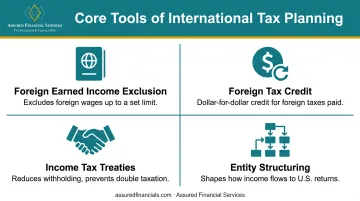
A solid international tax plan rests on a handful of coordinated tools. Used together, they address the double-taxation problem directly.
Foreign Earned Income Exclusion and Housing Exclusion
The FEIE lets qualifying expats exclude a set amount of foreign-earned wages from U.S. taxable income. For 2026, the maximum exclusion is $132,900 per qualifying person, according to the IRS.
To qualify, a taxpayer needs a foreign tax home and must pass one of two tests:
- Bona Fide Residence Test — uninterrupted residence in a foreign country covering an entire tax year
- Physical Presence Test — at least 330 full days abroad within any consecutive 12-month period
The Foreign Housing Exclusion works alongside FEIE and can further reduce U.S. tax on qualifying foreign housing costs such as rent and related utilities.
Foreign Tax Credit
The Foreign Tax Credit gives a dollar-for-dollar credit for income taxes already paid to a foreign government, filed on Form 1116. It's the most direct tool against double taxation.
- The credit can't exceed U.S. tax liability multiplied by the ratio of foreign-source income to total income
- Unused credit carries back one year and forward up to 10 years
- It cannot be claimed on the same income already excluded under FEIE — the two must be coordinated, not stacked
Income Tax Treaties
The U.S. maintains income tax treaties with dozens of countries to prevent double taxation and reduce withholding rates. Most include Limitation on Benefits (LOB) rules that block third-country residents from treaty shopping.
To claim treaty benefits, you generally need to:
- Meet an objective LOB test, or obtain a favorable IRS determination
- Keep documentation that supports residency and eligibility
- Apply the correct reduced withholding rate only where the treaty allows it
Business Entity Structuring
How a business structures its foreign operations shapes how income and losses flow to U.S. returns, what gets reported, and when tax is due.
- Pass-through entities pass foreign income directly to owners' personal returns
- Corporations may face different timing and character treatment
- Foreign subsidiaries versus branches carry different reporting obligations
Businesses with foreign subsidiaries that meet Controlled Foreign Corporation thresholds (generally more than 50% U.S. ownership) face additional rules. Recent legislation (P.L. 119-21) replaced the former "GILTI" regime with "net CFC tested income" for tax years beginning after December 31, 2025, changing how these inclusions are calculated.
Make entity and ownership decisions before you expand. Retrofitting a structure after income starts flowing is slower, costlier, and often less effective.
Common Compliance Risks: FBAR, FATCA, and Double Taxation Pitfalls
Reporting failures are where international tax exposure turns expensive fast.
FBAR and FATCA Thresholds
| Requirement | Who Files | Threshold |
|---|---|---|
| FBAR (FinCEN Form 114) | U.S. persons with foreign financial accounts | Aggregate value over $10,000 at any point in the year |
| Form 8938 (living in U.S., single) | U.S. residents | Over $50,000 at year-end or $75,000 at any time |
| Form 8938 (living abroad, single) | U.S. persons abroad | Over $200,000 at year-end or $300,000 at any time |
The Penalties Are Steep
Per the Code of Federal Regulations penalty table, FBAR violations alone can be severe:
- Non-willful violations: up to $16,536 per violation (2025 adjustment)
- Willful violations: up to the greater of $165,353 or 50% of the account balance
Form 8938 failures add a separate layer: up to $10,000 initially, plus $10,000 for every 30 days of continued non-filing after IRS notice, capping around $60,000.
Reasonable-cause relief exists for non-willful violations corrected with accurate delinquent filings, but that relief isn't automatic.
Where Double Taxation Sneaks In
Overpayment usually happens when FEIE, FTC, and treaty benefits aren't coordinated. Common mistakes include:
- Excluding income under FEIE, then claiming FTC on that same excluded portion
- Missing a treaty provision that would have reduced or eliminated withholding
That mix-up is a leading cause of unnecessary overpayment among expats and cross-border business owners. It is almost always fixable with better coordination upfront.
How to Build Your International Tax Strategy and Choose the Right Advisor
Building an effective plan starts with knowing exactly where you stand.
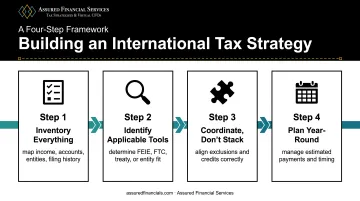
- Inventory everything — foreign income sources, financial accounts, entity structures, and prior filing history to spot exposure and past gaps
- Identify applicable tools — determine whether FEIE, FTC, treaty provisions, or entity restructuring apply to your situation
- Coordinate, don't stack — make sure exclusions and credits work together rather than overlapping incorrectly
- Plan year-round — quarterly estimated payments, timing of income, and entity decisions all affect the outcome
Those steps only hold up if your advisor actually works cross-border rules day to day. Choosing that person is part of the strategy.
Why a Generalist Accountant Often Isn't Enough
Treaty qualification, LOB provisions, and entity structuring nuances require specific international tax credentials and cross-border experience. A domestic-only preparer may simply not encounter these issues often enough to catch them.
When you evaluate help, look for:
- IRS representation credentials (such as Enrolled Agent status)
- Hands-on work with FEIE, FTC, FBAR/FATCA, and treaty positions
- Year-round planning, not a once-a-year filing pass
- U.S.-based, in-house delivery with no offshore handling of your data
Assured Financial Services was founded by an IRS Enrolled Agent, a federally licensed practitioner with unlimited practice rights before the IRS in all 50 states on all tax matters. AFS provides proactive, year-round cross-border compliance and planning for expats, foreign nationals, and internationally connected businesses.
All work stays with U.S.-based staff in-house—no offshore outsourcing—and there is no minimum engagement required to start a conversation.
Frequently Asked Questions
How does tax planning work?
Tax planning means proactively analyzing income, deductions, credits, and entity structures throughout the year, not just at filing time, to legally minimize liability while staying compliant.
Do US citizens living abroad pay taxes twice?
The U.S. taxes citizens on worldwide income regardless of residence, but tools like the Foreign Earned Income Exclusion (FEIE), Foreign Tax Credit, and tax treaties are specifically designed to prevent or reduce true double taxation when applied correctly.
How does international tax work?
International tax is the interaction of U.S. law, foreign law, and treaties that govern how cross-border income is taxed, reported, and credited across jurisdictions.
What happens if I don't file FBAR or FATCA forms?
Failing to report foreign accounts can trigger substantial civil penalties, and willful failure can carry criminal exposure. Timely filing or voluntary disclosure programs help limit that risk.
Can a small business benefit from international tax planning?
Yes. Even SMBs with foreign vendors, remote international staff, or a single foreign bank account can face reporting obligations and benefit from proactive structuring that avoids double taxation.
Do I need a specialized advisor for international tax issues, or can any accountant handle it?
International tax rules are highly specialized and change often. An advisor with cross-border and treaty expertise—such as an IRS Enrolled Agent—is a stronger fit than a generalist accountant.