Introduction
You built the business. Now comes the harder part: handing it off without watching decades of work turn into a tax bill your family can't pay or a fight nobody wins.
Every family business owner faces the same tension. You want income and control while you're still around, but you also want your successors to inherit something worth having, not a smaller company hollowed out by estate and gift tax. Many owners put off this planning because it feels distant or uncomfortable, right up until a health scare or an unexpected offer forces the issue.
With the federal estate tax exemption still historically high but scheduled to drop after 2025, timing matters. This guide covers the tax rules, ownership structures that protect value, and the step-by-step process to run before you hand over the keys.
Key Takeaways
- Balance three priorities: your economic benefit, next-gen operational control, and family tax reduction.
- Only 34% of U.S. family businesses have a documented, communicated succession plan (PwC).
- FLPs, IDGTs, GRATs, and ESOPs can cut gift and estate tax exposure when structured correctly.
- Start planning 5 to 10 years before your intended exit.
Why Family Business Succession Planning Can't Wait
A family business is often a paycheck, a retirement fund, and a legacy wrapped into a single asset. Transferring it carries far more weight than selling a typical business to a third party.
Here's the uncomfortable reality: only 34% of U.S. family businesses have a robust, documented, and communicated succession plan, according to PwC's family business research. That leaves the majority of family-owned companies exposed to a scramble if leadership changes unexpectedly.
The Three Competing Priorities
Every transfer creates tension between:
- Economic benefit — the retiring owner's need for income, retirement funds, or sale proceeds
- Control — the next generation's ability to actually run the business without interference
- Tax reduction — minimizing gift, estate, and income tax exposure across the transfer
Get the balance wrong and the consequences show up fast. Siblings fight over control. A business gets sold to outside buyers because no family member is ready or willing to take over. Or an estate has to liquidate operating assets just to cover a tax bill that nobody planned for in advance.
Reactive transitions triggered by a death, disability, or sudden dispute rarely preserve full enterprise value. A proactive plan, drafted years in advance, almost always does.
When Should You Start Planning?
Tax and estate advisors generally recommend a window of 5 to 10 years before your intended exit. Davis Wright Tremaine goes further, advising owners to start "10 years or more" ahead of retirement.
That timeline isn't arbitrary. Successor development takes years, not months. Valuation discounts and gifting strategies need time to compound. Legal structures like trusts require careful drafting and, in some cases, multi-year funding schedules to work as intended.
The Tax Landscape Every Family Business Must Navigate
Three tax categories drive most succession decisions: gift tax on lifetime transfers, estate tax on transfers at death, and income tax triggered by sales or distributions. A fourth, the generation-skipping transfer (GST) tax, applies when assets pass to grandchildren or trusts that bypass a generation entirely.
The Federal Exemption (and Why Timing Matters)
The federal gift and estate tax lifetime exemption stood at $13.99 million per individual in 2025, rising to $15 million in 2026 under updated legislation, according to the IRS. This exemption had been scheduled to shrink significantly after 2025 under prior law, but recent legislative changes removed that scheduled reduction.
Married couples can combine exemptions, effectively doubling the amount they can transfer tax-free. That said, exemption amounts and rules can shift with future legislation, so lock in transfers under today's rules rather than waiting for a permanent answer that may never come.
Carryover Basis vs. Stepped-Up Basis
How and when you transfer assets changes your heirs' future tax bill:
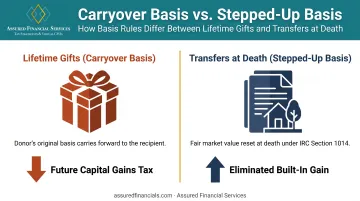
- Lifetime gifts generally carry over the donor's original basis. If the business has appreciated significantly, that appreciation becomes taxable capital gain when the recipient eventually sells.
- Transfers at death generally receive a stepped-up basis equal to fair market value on the date of death, under IRC Section 1014. This can eliminate years of built-in capital gain for heirs.
That basis trade-off sits at the center of most succession timelines. Gift early and you may cut estate tax exposure while handing heirs a larger future capital gains bill; wait until death and you may erase built-in gain while leaving more value exposed to estate tax if the exemption falls or the business keeps growing.
Valuation Discounts and Entity Structure
Gifting minority or non-voting interests in the business, rather than outright control, often supports valuation discounts for lack of control and lack of marketability. These discounts reduce the taxable value of the gift, but they require a qualified independent appraisal, not an assumed percentage.
Your entity structure also determines which strategies are even on the table:
- C-corporations may qualify for the Qualified Small Business Stock (QSBS) exclusion under IRC Section 1202
- Partnerships and LLCs can use Section 754 elections to adjust inside basis after ownership transfers
- S-corporations face stricter ownership and transfer restrictions than partnerships
Choosing the right structure before you start gifting or selling interests preserves options that are far harder to recreate once transfers are underway.
Proven Structures & Strategies for a Tax-Efficient Transfer
Once you understand the tax landscape, the next question is which legal structure fits your situation. Each one solves a slightly different problem.
Family Limited Partnerships (FLPs)
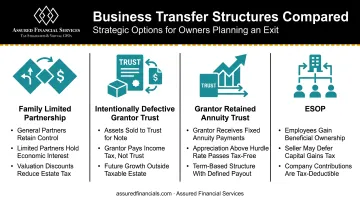
An FLP separates control from economic benefit. As the general partner, you retain decision-making authority. Limited partner interests, which carry no control, can be gifted to family members over time, often at a discounted value.
Intentionally Defective Grantor Trusts (IDGTs)
An IDGT lets you "sell" business interests to a trust in exchange for a promissory note. Because the trust is disregarded for income tax purposes, the sale doesn't trigger a taxable capital gains event.
Future appreciation moves outside your taxable estate. You keep paying the trust's income tax, which itself works as an extra tax-free gift to your heirs.
Grantor Retained Annuity Trusts (GRATs)
A GRAT transfers future appreciation to heirs largely gift-tax-free. You place business interests into the trust, retain a fixed annuity payment for a set term, and if the business outperforms the IRS's assumed growth rate, the excess passes to beneficiaries without additional gift tax.
Buy-Sell Agreements
A buy-sell agreement sets clear terms for what happens to ownership upon death, disability, divorce, or other trigger events. Most are funded with life insurance so the business or co-owners have cash on hand to complete the purchase.
Two structural choices exist:
- Cross-purchase — remaining owners buy the departing owner's interest directly
- Entity redemption — the business itself redeems the interest
A word of caution: following the Connelly v. United States decision, business owners should not assume company-owned life insurance proceeds are excluded when valuing shares for estate tax purposes. Independent valuations, ideally on an annual cadence, are essential to keeping the agreement enforceable and accurate.
ESOPs and Charitable Structures
An Employee Stock Ownership Plan allows a tax-deferred sale of C-corporation stock under IRC Section 1042. The ESOP must own at least 30% of the company immediately after the sale, and proceeds must be reinvested in qualified replacement property.
Owners with philanthropic goals can use a charitable remainder trust instead: it provides a retained income stream during life, with the remainder passing to charity.
All of these structures need coordinated drafting. An estate attorney handles the legal documents; a tax professional manages ongoing compliance, elections, and optimization so the structure keeps working as designed.
Building Your Succession Plan: Key Steps & Timeline
A workable plan answers four questions before a single document gets drafted:
- Who will own the business? Ownership and operational control don't have to go to the same person.
- Who will operate it day to day? Day-to-day leadership can sit with a family member, a non-family executive, or a staged handoff.
- How do family dynamics factor in? Sibling rivalry, in-law involvement, and differing risk tolerance all matter.
- How does the transition affect the family's overall tax picture?
Equal vs. Equitable Distribution
Those ownership and operating answers rarely point to a pure 50/50 split among heirs. Treating everyone equally sounds fair, but it can undermine the business. An active operator often needs controlling equity to run the company effectively, while non-active family members may be better served with other assets, life insurance proceeds, or income streams instead of a stake they can't manage.
The Practical Sequence
Build on a multi-year runway, not a last-minute scramble:
- Identify and mentor a successor — begin 3–5 years before the handoff so skills and trust can transfer
- Select the right legal and tax structure — align entity type, family goals, and tax exposure about 2–3 years out
- Document the plan in writing — finalize agreements 12–24 months ahead; verbal deals breed conflict later
- Review regularly — revisit when tax law, valuations, or family circumstances change
Avoiding Common Pitfalls & Getting Expert Support
More succession plans collapse from family conflict and poor communication than from tax or legal missteps. Putting expectations in writing early, even informally, heads off a surprising amount of resentment down the road.
The Liquidity Paradox
Many family businesses are highly valuable on paper and cash-poor in reality. If most of the estate's value sits in the business itself, paying estate taxes can force a fire sale of operating assets. Two tools help:
- Life insurance held in an irrevocable life insurance trust (ILIT), providing liquidity outside the taxable estate
- Section 6166 deferral, which lets qualifying estates where closely held business interests exceed 35% of the adjusted gross estate pay federal estate tax in installments over up to 10 years
Don't Forget State Taxes
Federal planning gets most of the attention, but state-level estate, inheritance, and income tax rules can meaningfully change net proceeds. Several states, including Maryland, still impose their own estate or inheritance taxes on top of federal obligations, which makes state-specific review a necessary part of any complete plan.
How Assured Financial Services Supports Family Business Owners
Succession planning touches tax strategy, cash flow, and entity structure all at once, which is exactly the territory Assured Financial Services works in every day. The firm's year-round tax planning approach means the analysis doesn't wait for a crisis or a filing deadline.
For family business owners weighing a transition, Assured Financial Services offers:
- Entity structure analysis to support the most tax-efficient transfer
- **Fractional and virtual CFO services** for the cash flow visibility ownership transitions require
- IRS representation by an Enrolled Agent with unlimited practice rights in all 50 states
Every engagement is led directly by the founder, so owners get consistent executive-level attention at a critical stage—not a handoff between staff.

Frequently Asked Questions
How do I plan for succession in a family business?
Identify and prepare a successor, choose the right legal and tax structure, document the plan in writing, and review it regularly with your tax and legal advisors as circumstances change.
How many family businesses have a succession plan?
Only about 34% of U.S. family businesses report having a documented, communicated succession plan, per PwC. Plans that do exist commonly fail due to poor communication and family conflict rather than tax or legal errors.
What are the 5 D's of succession planning?
Practitioners commonly frame the 5 D's as Death, Disability, Divorce, Disagreement, and Departure (including retirement), the trigger events every succession plan should address in advance.
When should a family business start succession planning?
Most experts recommend starting 5 to 10 years before your intended exit, giving enough time for successor development, tax structuring, and valuation discounts to take full effect.
What happens if a family business has no succession plan?
Without a plan, families risk disputes over control, forced asset sales to cover unexpected estate tax bills, and in some cases losing the business to non-family buyers entirely.
Can a CPA or CFO help with family business succession planning?
Yes. CPAs, Enrolled Agents, and fractional CFOs help structure tax-efficient transfers, model cash flow impacts of different scenarios, and coordinate with estate attorneys on trust and entity structures.