This isn't a small problem. 83% of small-business owners say working with a financial professional is important for smarter decision-making, according to a 2025 SCORE and Equitable survey. Yet most companies in that position can't justify a six-figure CFO salary.
That gap is exactly why fractional CFO services have grown so fast. This guide breaks down what a fractional CFO actually is, how the engagement works, how it differs from a controller or interim CFO, and how to tell if your business is ready for one.
Key Takeaways
- A fractional CFO delivers senior-level financial strategy part-time, without full-time salary and equity costs
- Engagements run on hourly, retainer, or project-based pricing — typically $3,000 to $16,000 monthly
- Unlike a controller, a fractional CFO focuses on forecasting and decisions, not historical bookkeeping
- Common triggers include fast growth, fundraising, compliance complexity, or cash flow unpredictability
- Most firms start with a no-commitment consultation before scoping any engagement
What Is a Fractional CFO?
A fractional CFO is an experienced financial executive who works with a company on a part-time, contract, or retainer basis. Instead of hiring a permanent chief financial officer, the business gets strategic financial leadership scaled to what it actually needs.
You'll see the terms "fractional CFO," "virtual CFO," and "outsourced CFO" used almost interchangeably across the industry. In practice, they point to the same core idea from slightly different angles.
Fractional emphasizes part-time capacity, virtual emphasizes remote delivery, and outsourced emphasizes third-party status. Most providers don't draw a hard line between them.
A single fractional CFO typically supports several client companies at once, dedicating a set block of hours or days each week or month to each one. That's the trade-off: you get senior expertise without paying for someone's undivided full-time attention.
How Fractional CFO Engagements Typically Work
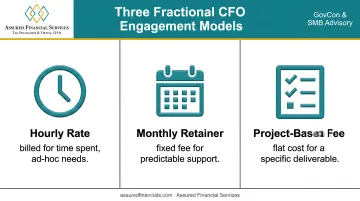
Engagement structures generally fall into three categories:
- Hourly rate — billed for time spent, common for lighter or ad-hoc needs
- Fixed monthly retainer — a set fee for ongoing, predictable support
- Project-based fee — a flat cost tied to a specific deliverable, such as a fundraising model or audit prep
Most relationships start with a discovery phase. That usually includes a review of current financials and conversations with company leadership before scope or pricing is finalized.
From there, the arrangement is built to flex. A business might need heavier support during a fundraising push and a lighter touch during steady periods—something a fixed full-time hire simply can't do.
At Assured Financial Services, this flexibility shows up in a two-tier model: Fractional CFO support for strategy (pricing, growth planning, capital decisions) paired with Virtual CFO support for ongoing financial operations. Clients can use one or both, and the balance shifts as their needs change. There's no minimum engagement required just to start a conversation.
Fractional CFO vs. Full-Time CFO vs. Interim CFO vs. Controller
These four roles get confused constantly, but the distinctions matter for budgeting and hiring decisions.
The core difference: a fractional CFO provides ongoing part-time strategic leadership. A full-time CFO is a permanent executive. An interim CFO is a temporary full-time hire bridging a leadership gap. A controller manages accounting operations, not strategy.
| Role | Primary Focus | Time Commitment | Best Fit |
|---|---|---|---|
| Fractional CFO | Strategy, forecasting, decision support | Part-time, ongoing or long-term | Growing businesses not ready for full-time cost |
| Full-Time CFO | Full financial leadership + team management | Permanent | Companies with sustained complexity |
| Interim CFO | Stabilizing finance during a transition | Full-time, temporary | Filling a sudden CFO vacancy |
| Controller | Bookkeeping, compliance, payroll accuracy | Ongoing, operational | Day-to-day accounting execution |
Fractional CFO vs. Full-Time CFO
A full-time CFO comes with salary, benefits, and often equity. A fractional CFO runs on a retainer or hourly rate, with no benefits package and no long recruitment cycle. Hiring timeline differs too: a fractional arrangement can typically start within days, while an executive search for a permanent CFO can stretch for months.
Fractional CFO vs. Interim CFO
Interim CFOs are almost always full-time and temporary, stepping in to cover a vacancy or manage a transition until a permanent hire is found. Fractional CFOs work part-time and often stay on for years, growing with the business rather than exiting once a replacement is found.
Fractional CFO vs. Controller or Bookkeeper
Controllers and bookkeepers keep the historical record straight: accurate books, payroll, and compliance filings. A fractional CFO looks forward: building forecasts, shaping strategy, and helping leadership decide what to do next. The two roles complement each other rather than compete.
What Does a Fractional CFO Actually Do?
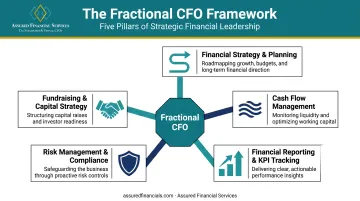
Most fractional CFO engagements cover five core areas. The mix shifts with company stage and industry, but the work usually looks like this.
Financial strategy and planning
Build long-term financial plans, budgets, and growth roadmaps matched to the company's real position, constraints, and goals.
Cash flow management
Monitor liquidity, tighten working capital, and extend runway before shortfalls show up in operations.
Financial reporting and KPI tracking
Deliver dashboards and reports that give leadership and investors clear performance visibility—not a month-end spreadsheet dump.
Risk management and compliance
Identify financial risk, strengthen internal controls, and keep the business aligned with regulatory requirements.
Fundraising, M&A, and capital strategy
Prepare financial models, investor materials, and due diligence files when the company is raising capital, buying a competitor, or navigating an ownership change.
For businesses with specialized compliance needs, risk and compliance work goes deeper. Federal government contractors, for example, typically need:
- DCAA-compliant accounting systems and SF1408 pre-award readiness
- Indirect rate structures across fringe, overhead, and G&A pools
- FAR Part 31 cost-principle compliance and job-costing frameworks
- Annual ICE-model incurred cost submissions
A generalist fractional CFO often stops at high-level oversight here. Assured Financial Services pairs CFO strategy with hands-on GovCon compliance: designing indirect rate structures, configuring systems such as Deltek Costpoint or Unanet, and preparing contractors for DCAA audits instead of treating compliance as a bolt-on.
Key Benefits of Hiring a Fractional CFO
The appeal comes down to three things: cost, speed, and flexibility.
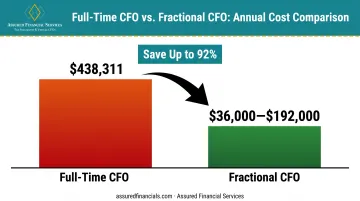
- Cost efficiency. You pay for the hours or scope you need, nothing more. The average U.S. CFO salary sits at $438,311, per Salary.com's 2026 benchmark data, before benefits, bonuses, or equity. A fractional retainer of a few thousand dollars a month is a far smaller commitment.
- Faster access to expertise. No executive search and no months-long onboarding. A fractional CFO can typically start within days of the first conversation, not after a quarter of recruiting.
- Scalable, flexible support. When complexity, funding stage, or compliance needs change, the engagement can expand or contract with them. A full-time employment contract rarely offers that flexibility.
When Should Your Business Consider a Fractional CFO?
A few situations tend to push businesses toward fractional support:
- Rapid growth outpacing current financial visibility
- An upcoming fundraising round, acquisition, or audit
- Unpredictable cash flow that's hard to explain, let alone fix
- A leadership gap between full-time CFO hires
Fractional support pays off most when financial complexity is real:
- Government contractors managing indirect rate reporting and DCAA compliance need more than general bookkeeping
- Cross-border companies handling multi-jurisdiction tax exposure, FBAR and FATCA filings, and foreign entity reporting face the same pressure
- Established SMBs crossing the $5 million-plus revenue mark need forward-looking data, not historical reporting alone
That complexity is what Assured Financial Services is built to handle. Many businesses in this position start with a low-stakes step: AFS offers a free 30-minute consultation with no minimum engagement requirement, so you can see whether strategic Fractional CFO support, operational Virtual CFO support, or a mix of both fits before committing.
How Much Does a Fractional CFO Cost?
Fractional CFO pricing usually follows one of three models. Ranges vary by provider and business size:
| Pricing Model | Typical Range | Best For |
|---|---|---|
| Hourly rate | $250–$500/hour | Ad-hoc or limited-scope needs |
| Monthly retainer | $3,000–$16,000/month | Ongoing strategic support |
| Project-based fee | Varies by scope | One-time deliverables (models, audits) |
Startup-focused firms report hourly rates around $250 to $350, with monthly costs between $8,000 and $16,000, according to industry pricing guides. Broader small-business benchmarks put the industry-wide average closer to $5,000 to $8,000 per month, with most small-to-midsize agreements landing in the $5,000 to $7,000 range.
What Drives the Price Up or Down
- Scope of work — pure strategy versus strategy plus ongoing operational oversight
- Business complexity — GovCon work (DCAA readiness, indirect rates) costs more than generalist accounting
- CFO experience level — deeper industry-specific expertise commands a higher rate
Those factors explain why quotes span such a wide band. Demand is rising at the same time: requests for interim and fractional-style finance talent rose 46% year over year, according to Business Talent Group's 2024 High-End Independent Talent Report.
Set that against the average full-time CFO salary of $438,311 mentioned earlier, and most growing businesses still come out ahead. Fractional support buys senior-level guidance without the full-time fixed cost.
Frequently Asked Questions
How much does a fractional CFO charge?
Pricing typically follows an hourly rate, a fixed monthly retainer, or a project-based fee. Costs vary based on scope of work, business complexity, and the CFO's experience level, ranging from $3,000 to $16,000 per month.
Is a fractional CFO worth it?
For businesses needing strategic financial guidance but not ready for full-time executive costs, yes. The value is clearest during growth, fundraising, or compliance-heavy periods, when you get senior expertise without the salary and equity commitment.
What's the difference between a fractional CFO and a controller or bookkeeper?
Controllers and bookkeepers focus on historical accuracy: accurate books, payroll, and compliance. A fractional CFO looks forward, building forecasts and strategy to guide decisions rather than just recording what already happened.
How many hours per week does a fractional CFO typically work with a company?
Engagement time is flexible, ranging from a few hours weekly to several days monthly depending on business needs. It usually scales with the company's stage, complexity, and current priorities.
Can a fractional CFO help with government contracting (GovCon) compliance?
Yes, specialized fractional CFOs can support DCAA audit readiness, indirect rate structures, and FAR-compliant accounting systems. This requires GovCon-specific expertise beyond general CFO knowledge, which not every provider offers.
How do I know if my business is ready for a fractional CFO?
Signs include financial complexity that has outgrown bookkeeping support, an approaching fundraising or compliance milestone, or a lack of forward-looking visibility into cash flow and performance. If decisions are being made without reliable data, it's time.