The United States taxes citizens, green card holders, resident aliens, and even certain businesses on worldwide income — regardless of where that income was earned or where the taxpayer currently lives. A paycheck from a Singapore employer, rental income from a flat in Lisbon, or profits from a subsidiary in Mexico City are all fair game for a U.S. tax return.
This assumption trips up more people than you'd think. U.S. expats, cross-border business owners, and government contractors working overseas frequently skip filings, miss disclosures, or file incorrectly — and the penalties for getting it wrong can be steep.
This article covers who has to report foreign income, how different income types land on your return, how much foreign earned income is actually tax-free, related disclosures like FBAR and FATCA, and the mistakes that cause the most trouble.
Key Takeaways
- U.S. persons must report worldwide income on a U.S. return, no matter where it was earned
- FEIE covers earned income only (wages and self-employment), not pensions or investment income
- FBAR and FATCA are separate account disclosures with their own thresholds—not part of Form 1040
- Foreign subsidiaries and overseas entities trigger entity-level filings beyond individual FEIE rules
Who Needs to Report Foreign Income to the IRS
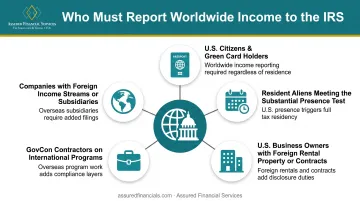
If you're a U.S. citizen or green card holder, the IRS taxes your worldwide income regardless of where you actually live. Moving abroad doesn't cancel your filing obligation. It just adds a few more forms to the pile. The IRS confirms this directly for citizens and resident aliens abroad, stating that these individuals report all taxable income under the same rules that apply domestically.
Resident aliens aren't off the hook either. Anyone meeting the substantial presence test — generally 31 days in the current year plus a weighted 183-day count across three years — is taxed on worldwide income, not just U.S.-source earnings.
This obligation extends well past individual expats:
- U.S. business owners with foreign rental property, overseas contracts, or income routed through a foreign subsidiary
- GovCon contractors on international programs who assume overseas work changes their tax picture (it usually doesn't)
- Companies with foreign income streams, including disregarded entities and foreign partnerships
One common trap: foreign earnings paid directly by the U.S. government generally don't qualify for the Foreign Earned Income Exclusion (FEIE).
The Filing Requirement Doesn't Disappear at Zero
Here's the part that catches people off guard: even when the Foreign Earned Income Exclusion or Foreign Tax Credit reduces your final tax bill to zero, you still have to file. The exclusion isn't automatic — you claim it on a return you're required to submit anyway.
Cross-border individuals also need to watch for treaty-based nuances. A tax treaty between the U.S. and your country of residence might change how certain income is sourced or taxed, but treaty provisions aren't a substitute for evaluating your specific facts.
When those facts stack up, generic filing advice falls short. Assured Financial Services works with cross-border individuals, U.S. expats, and government contractors on foreign income reporting, FBAR/FATCA issues, and the entity structures that sit underneath them.
Types of Foreign Income and Where They Go on Your Tax Return
Foreign income doesn't get its own separate form. It goes on the same lines as domestic income, sorted by type. The distinction between earned and unearned income matters more than almost anything else here, because it's the single factor determining FEIE eligibility.
| Income Type | Where It Goes |
|---|---|
| Foreign wages (W-2 equivalent) | Form 1040, line 1a |
| Foreign employer pay without a W-2 | Form 1040, line 1h ("Other earned income") |
| Self-employment income | Schedule C, flowing to Schedule 1, line 3 |
| Foreign interest | Schedule B, Form 1040 line 2b |
| Foreign dividends | Schedule B, Form 1040 line 3b |
| Foreign rental income | Schedule E, flowing to Schedule 1, line 5 |
| Foreign pension/annuity | Form 1040, lines 5a and 5b |
Foreign Social Security is trickier. Treatment depends on whether a specific tax treaty applies, and absent one, it's usually taxed like a foreign pension.
Currency Conversion Has No Official Answer
The IRS doesn't publish an official exchange rate. You're expected to use a reasonable, consistently applied rate (the spot rate on the transaction date is common) and document your method so you can defend it later if questioned.
The Business Owner Gap Most Guides Skip
If you own a foreign subsidiary, partnership, or disregarded entity, individual FEIE reporting is only part of the picture. You may also need:
- Form 5471: for U.S. shareholders owning 10% or more of a foreign corporation, or controlling more than 50%
- Form 8865: for interests in controlled foreign partnerships, with thresholds starting around 10% ownership
- Form 8858: for foreign disregarded entities or branches, filed separately for each one
One more detail that surprises FEIE-heavy filers: excluded foreign earned income doesn't count as compensation for IRA contribution purposes. If most of your income gets excluded under Section 911, you may have little or no eligible compensation left to fund an IRA.
Foreign Earned Income Exclusion: How Much of Your Foreign Income Is Tax-Free
The Foreign Earned Income Exclusion, claimed on Form 2555, lets qualifying taxpayers exclude a set amount of foreign earned income from U.S. tax. Note the word "earned." This exclusion has nothing to do with passive income of any kind.
For tax year 2026, the maximum exclusion is $132,900 per qualifying individual, set by Rev. Proc. 2025-32. Married couples who both qualify can potentially exclude up to double that amount, since the exclusion applies per person, not per return.
Two Ways to Qualify
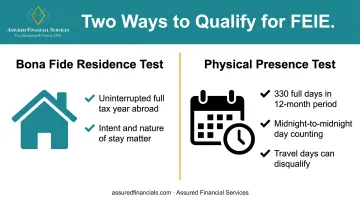
- Bona fide residence test — You've established genuine residence in a foreign country for an uninterrupted period covering a full tax year. Intent and the nature of your stay matter here, not just a passport stamp.
- Physical presence test — You were physically present in a foreign country for at least 330 full days within any consecutive 12-month period. A "full day" runs midnight to midnight; travel days and layovers trip people up constantly when counting.
What the FEIE Does NOT Cover
- Pensions and annuities
- Social Security benefits
- Interest, dividends, and capital gains
- Rental income
- Self-employment tax (the exclusion applies to income tax, not the SE tax itself)
The Stacking Rule Nobody Explains Well
Non-excluded income doesn't get taxed starting from the lowest bracket. Instead, the IRS calculates tax on your remaining income at the rate that would have applied without the exclusion, using the Foreign Earned Income Tax Worksheet. Practically, this often pushes your non-excluded income into a higher effective bracket than you'd expect.
Tools That Often Pair With the FEIE
- Foreign Housing Exclusion/Deduction — covers housing costs above a base amount, useful in high-cost foreign cities
- Foreign Tax Credit (Form 1116) — often better than the FEIE when foreign tax rates exceed U.S. rates
The credit can also preserve refundable credits like the Additional Child Tax Credit, which excluded income cannot generate.
Beyond the FEIE: FBAR, FATCA, and Other Foreign Asset Disclosures
Income tax reporting and account disclosure are two entirely separate systems. Claiming the FEIE has no effect on your foreign account reporting obligations.
FBAR (FinCEN Form 114) — Required if the aggregate value of your foreign financial accounts exceeded $10,000 at any point during the year. This isn't a per-account threshold; it's the combined total across every account. You file the FBAR separately through FinCEN's BSA E-Filing System. The deadline is April 15, with an automatic extension to October 15.
Form 8938 (FATCA) — A different filing with higher, residency-dependent thresholds:
| Filing Status | Living in U.S. | Living Abroad |
|---|---|---|
| Single/MFS | $50,000 (year-end) / $75,000 (any time) | $200,000 / $300,000 |
| Married filing jointly | $100,000 / $150,000 | $400,000 / $600,000 |
FATCA doesn't replace FBAR. If you meet both thresholds, you file both.
The Schedule B trap: Part III of Schedule B asks whether you had a foreign account at any point during the year. You must answer this even if the account earned zero interest or dividends — a detail that plenty of otherwise careful filers miss.
Common Foreign Income Reporting Mistakes and Penalties to Avoid
Most foreign income problems come from a short, predictable list of errors:
- Leaving foreign income off the return entirely, assuming it's invisible to the IRS
- Applying the FEIE to pensions, interest, or other passive income it was never meant to cover
- Skipping FBAR or Form 8938 because "I already reported the income on my 1040"
- Switching currency conversion methods year to year without documentation
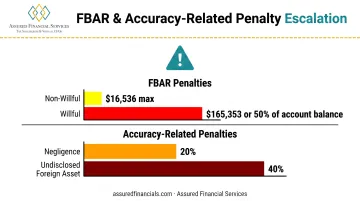
The penalty exposure is real. For FBAR violations assessed on or after January 17, 2025, the FinCEN inflation-adjusted maximums sit at $16,536 for non-willful violations and $165,353 for willful ones, with willful penalties potentially reaching 50% of the account balance instead.
Separately, an accuracy-related penalty of 20% applies to underpayments from negligence, jumping to 40% when tied to an undisclosed foreign financial asset.
If you've fallen behind, you have options. The IRS Streamlined Filing Compliance Procedures allow taxpayers to catch up on unfiled returns and delinquent FBARs by certifying non-willful conduct, without facing the full penalty stack.
This is where working with someone who holds real standing with the IRS matters. Assured Financial Services is led by an IRS Enrolled Agent, a federally licensed practitioner with unlimited rights to represent taxpayers before the IRS in all 50 states. That means catching up compliantly or resolving existing issues doesn't require bouncing between a preparer and a separate representative.
Frequently Asked Questions
Do I need to report foreign earned income to the IRS?
Yes. U.S. citizens, green card holders, and resident aliens must report all worldwide income, including foreign earned income, even if you later exclude part of it using the FEIE.
How do I report foreign earned income on my tax return?
Foreign wages or self-employment income goes on the applicable Form 1040 line or Schedule C, the same way you report domestic income. You attach Form 2555 separately to claim any eligible exclusion.
How much foreign earned income is tax-free in the USA?
For tax year 2026, up to $132,900 per qualifying individual is excludable under the FEIE, per Rev. Proc. 2025-32. This cap applies only to qualifying earned income, not pensions or investment income.
What happens if I don't report foreign income?
You risk penalties, accruing interest, and audit exposure, with accuracy-related penalties reaching up to 40% in some foreign-asset cases. Unfiled years can often be resolved through IRS compliance programs before things escalate.
Do I need to file an FBAR if I have foreign income?
Not automatically. FBAR is triggered by foreign account balances exceeding $10,000 in aggregate, not by having foreign income itself. Check both obligations independently — they don't overlap.
Can a business with foreign income exclude it the same way an individual can?
No. The FEIE applies only to individuals, not entities. Businesses with foreign income or foreign subsidiaries face separate reporting rules and forms, including controlled foreign corporation filings, GILTI, and related international information returns.