The numbers back this up. According to NSBA's 2024 Taxation Survey, 90% of small business owners say federal taxes affect their day-to-day operations, and one in three report a significant impact. SCORE has also found that small businesses routinely leave deductions and credits on the table simply because they only think about taxes at filing time.
This guide walks through entity structure, deductions and credits, timing strategies, and the mistakes that cost owners the most. Businesses with added layers—government contracts, multi-state operations, or cross-border income—need an even more proactive approach, since generalist tax prep often stops short of catching what matters most for them.
Key Takeaways
- Year-round tax planning compounds value; once-a-year filing leaves savings on the table
- Entity choice (LLC, S-corp, C-corp) directly shapes self-employment, corporate, and personal tax exposure
- Deductions lower taxable income; credits cut your tax bill dollar-for-dollar
- GovCon work, multi-state activity, or cross-border income add compliance layers generalist prep often misses
Understanding Your Small Business Tax Obligations
The IRS organizes federal business tax responsibilities into five categories: income tax, estimated taxes, self-employment tax, employment taxes, and excise tax. On top of that, most businesses also owe state and local income, sales, or property tax, depending on where they operate.
What you actually owe, and when, depends heavily on:
- Your entity structure (sole prop, LLC, S-corp, or C-corp)
- Where you operate (single state vs. multi-state)
- Whether you have employees (payroll tax obligations)
- Whether you hold foreign accounts or income (added reporting layers)
The IRS Small Business Tax Center is a solid baseline for federal requirements. But it won't tell you everything.
Where Standard Guidance Falls Short
Two groups routinely carry obligations that generic tax software never flags:
- Federal contractors: Indirect cost rates, job costing, and DCAA-compliant systems under FAR Part 31
- Foreign accounts or income: FBAR (FinCEN Form 114) once combined balances top $10,000; FATCA Form 8938 at $50,000–$600,000 thresholds by filing status and residency
Assured Financial Services built its practice around that gap. GovCon accounting compliance and cross-border reporting are core to how we work with clients.
Choose a Tax-Efficient Business Structure
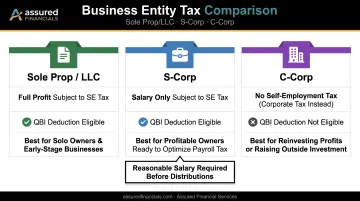
Entity choice is one of the biggest levers you have. A sole proprietor or single-member LLC pays self-employment tax on all Schedule C profit. An S-corp owner, by contrast, splits income between W-2 salary (subject to payroll tax) and distributions (not subject to payroll tax), which often lowers the total tax bill.
Here's how the main structures compare:
| Structure | Self-Employment Tax | QBI Eligible? | Best Fit |
|---|---|---|---|
| Sole Prop/LLC | Full net profit | Yes (subject to limits) | Simple, low-complexity operations |
| S-Corp | Only on salary portion | Yes (subject to limits) | Profitable owner-operators |
| C-Corp | None (flat corporate rate) | No | Businesses raising capital or planning an exit |
The Qualified Business Income (QBI) deduction lets pass-through owners deduct up to 20% of qualified business income, subject to taxable-income and wage limits. For 2026, the phase-in range runs from $201,750 to $276,750 for single filers and $403,500 to $553,500 for joint filers. Specified service businesses—law, medicine, accounting, consulting—get phased out entirely above the upper threshold.
C-corps aren't always the wrong answer. Following the 2025 One Big Beautiful Bill Act, Qualified Small Business Stock (QSBS) exclusions now offer 50% exclusion after 3 years, 75% after 4, and 100% after 5, with the per-issuer cap raised to $15 million. Businesses planning to raise outside capital or sell within a few years should run the numbers before defaulting to a pass-through structure.
One catch for S-corps: the IRS requires owners to pay themselves a reasonable salary before taking distributions. Pay too little, and you risk reclassification of distributions as wages—plus back payroll taxes and penalties.
When Structure Decisions Get More Complex
Multi-state operations, cross-border ownership, and federal contracts raise the stakes considerably. A structure that made sense at $500,000 in revenue often stops making sense at $5 million.
Many growing businesses never revisit that original entity choice and keep overpaying without realizing it. An IRS Enrolled Agent who also understands corporate finance, GovCon, and cross-border rules—such as the team at Assured Financial Services—can flag the right structure before those costs compound.
Maximize Deductions, Credits & Depreciation Strategies
Deductions and credits get confused constantly, but they work differently:
- Deductions reduce your taxable income (a $10,000 deduction saves you a percentage of $10,000, based on your tax bracket)
- Credits reduce your tax bill dollar-for-dollar (a $10,000 credit saves you the full $10,000)
Commonly Claimed Deductions
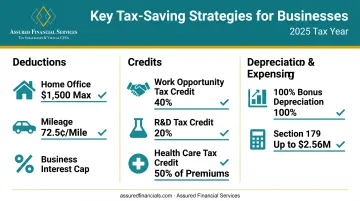
- Home office: simplified method allows $5 per square foot, up to 300 square feet, for a maximum $1,500 deduction
- Vehicle/mileage: the 2026 standard mileage rate is 72.5 cents per mile, or you can track actual expenses
- Business interest: generally capped at 30% of adjusted taxable income for larger businesses (most under the $32 million gross-receipts threshold are exempt)
- Office supplies & compensation: ordinary supplies, wages, and employee benefit costs are generally fully deductible when they are ordinary and necessary
High-Value Tax Credits
- Work Opportunity Tax Credit: up to 40% of the first $6,000 in wages for qualifying new hires
- R&D Tax Credit: 20% of qualifying research expenses; small businesses can apply up to $500,000 against payroll tax
- Small Business Health Care Tax Credit: up to 50% of premiums for employers with fewer than 25 full-time employees
- Disabled Access Credit: up to $5,000 annually for eligible access improvements
Beyond annual credits, timing tools—depreciation and expensing—often move the largest dollars.
Depreciation & Immediate Expensing
Recent tax legislation restored permanent 100% first-year bonus depreciation for qualifying property placed in service after January 19, 2025. Section 179 expensing for 2026 allows up to $2.56 million in immediate deductions, phasing out once purchases exceed $4.09 million.
Also commonly missed: deductible startup costs, pension plan startup costs, and bad debt write-offs for accrual-basis businesses.
Documentation is what separates a claimed deduction from a defensible one. For GovCon clients especially, that means job-costing records and labor-charging support that hold up under audit—not a spreadsheet built after the fact.
Time Your Income, Expenses & Contributions Strategically
Timing is one of the most underused tools in a business owner's tax kit, and it costs nothing to implement if you plan ahead.
For cash-basis businesses:
- Having a strong year? Accelerate deductible expenses and defer income into next year
- Expecting a down year? Do the reverse: accelerate income now, push expenses later
Retirement Contributions Do Double Duty
Contributing to a retirement plan reduces taxable income today while building savings for later:
| Plan | 2026 Limit |
|---|---|
| SEP-IRA | Lesser of 25% of compensation or $72,000 |
| Solo 401(k) | $24,500 deferral (+$8,000 catch-up at 50, $11,250 at 60-63) |
| SIMPLE IRA | $17,000 ($4,000-$5,250 catch-up, up to $18,100 for enhanced plans) |
Several other timing moves work the same way: they change when income or deductions hit your return.
Pass-Through Entity (PTE) tax election. If you're an S-corp, partnership, or LLC owner hit by the SALT deduction cap, entity-level state tax payments under IRS Notice 2020-75 bypass the individual SALT limitation entirely.
Quarterly estimated taxes. To avoid underpayment penalties, pay at least 90% of your current-year tax liability or 100% of last year's (110% if prior-year AGI exceeded $150,000).
HSA and FSA contributions. These trim taxable income while covering healthcare costs. 2026 HSA limits are $4,400 for self-only coverage and $8,750 for families.
Avoid These Common Tax Planning Mistakes
A few tax mistakes show up every year, and most are preventable with basic discipline.
- Missing deadlines or underpaying estimated taxes. Penalties and interest compound fast. A quarterly payment schedule avoids both.
- Misclassifying employees as independent contractors. A GAO estimate found roughly 15% of employers had misclassified workers—an issue that still triggers back taxes, penalties, and payroll tax exposure.
- Treating tax planning as a filing-season task. Waiting until filing season leaves deductions and timing strategies on the table. Quarterly reviews—such as those Assured Financial Services runs with clients—catch those opportunities while you can still act on them.
Frequently Asked Questions
What are the main types of tax planning for business owners?
The primary categories are entity structure planning, deduction and credit optimization, retirement and compensation planning, and timing strategies like income deferral or expense acceleration.
How much tax should I pay as a small business owner?
There's no fixed percentage since it depends on entity structure, income level, and state. As a general planning guideline, many owners set aside roughly 25-35% of net income for combined federal, state, and self-employment taxes.
When should small business owners start tax planning?
Tax planning works best as a year-round activity rather than a Q4 or filing-season scramble. Many strategies, like retirement plan setup or entity changes, need lead time to implement properly.
What's the difference between a CPA and an IRS Enrolled Agent for tax planning?
An Enrolled Agent is federally licensed specifically in taxation, with unlimited rights to represent taxpayers before the IRS in all 50 states. CPAs hold broader accounting credentials that may or may not include a tax specialization.
Can I handle small business tax planning myself without a professional?
Basic bookkeeping and simple filings may be manageable on your own. Multiple income streams, employees, multi-state activity, or cross-border reporting usually make professional guidance pay for itself.
What records should small businesses keep for tax purposes?
Keep receipts, invoices, mileage logs, payroll records, and bank statements organized throughout the year. Accounting software helps with consistent monthly reconciliation instead of a year-end scramble.