Introduction
Every startup founder hits the same wall eventually: the spreadsheet stops making sense, investors start asking harder questions, and cash flow feels like a guessing game. You need someone who can read the financial story behind the numbers. But a full-time CFO's salary, often north of $250,000 before bonus and equity, isn't realistic for most early-stage companies.
That gap widens faster when the work gets complex: government contractors managing DCAA compliance, or companies with international entities facing FBAR and FATCA obligations. You need more than a bookkeeper, but a full-time executive hire is overkill.
This guide breaks down what a fractional CFO actually does, what one costs, how to judge ROI, and how to evaluate scope, expertise, and fit before you hire.
Key Takeaways
- Fractional CFOs deliver forecasting, fundraising support, and KPI tracking without a full-time executive salary
- Pricing is typically hourly, monthly retainer, or project-based, based on scope and complexity
- Common triggers: unpredictable cash flow, an upcoming raise, rapid hiring, or investor reporting pressure
- GovCon and cross-border startups usually see the highest return from specialized fractional CFO support
What Is a Fractional CFO for Startups?
A fractional CFO is a senior finance executive who works with your company on a part-time, retainer, or project basis instead of joining as a full-time employee. Think of it as renting the expertise without buying the whole package: salary, benefits, equity, and all.
The role sits above bookkeeping and controllership:
- Bookkeeper: Records daily transactions, reconciles accounts, keeps the books current
- Controller: Manages accounting operations, internal reporting, and month-end close
- Fractional CFO: Owns strategy, forecasting, fundraising, and decision support
Engagement structures vary by firm and by need. Some startups want a fixed number of hours each month for ongoing oversight. Others need project-based support, such as building financial models for a fundraising round or preparing due diligence materials for an acquisition.
Assured Financial Services structures its fractional CFO work around part-time engagements for ongoing strategic leadership and project-based engagements for defined needs like long-range planning, KPI dashboard builds, or investor reporting packages. Each engagement is scoped to what the business actually needs.
Fractional CFO support spans the entire startup lifecycle, from pre-seed to growth stage. It also covers specialized niches, including GovCon startups managing DCAA-compliant accounting systems and cross-border companies navigating international tax exposure.
Fractional CFO vs. Full-Time CFO vs. Bookkeeper/Controller
Here's how the four roles compare on scope, cost, and commitment:
| Role | Primary Focus | Typical Cost | Commitment |
|---|---|---|---|
| Bookkeeper | Transaction recording, reconciliation | Lowest | Ongoing, hourly/monthly |
| Controller | Accounting operations, internal reporting | Moderate | Full-time or part-time |
| Fractional CFO | Strategy, forecasting, fundraising, KPIs | Moderate-to-high, scoped | Part-time, retainer, or project |
| Full-Time CFO | Full executive leadership, board relations | Highest (salary + equity + benefits) | Full-time, permanent |
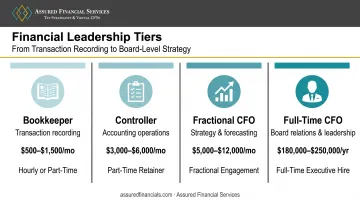
So when does a startup graduate to a full-time CFO? There's no universal revenue or funding-stage cutoff. It depends more on sustained workload than a magic number. That said, once a company is closing frequent financing rounds, managing board relationships continuously, and running CFO-level work daily rather than periodically, a full-time hire usually starts to pencil out.
Core Services and Responsibilities of a Fractional CFO
A fractional CFO's job isn't just "finance help." It's specific, strategic work that touches every major decision your startup makes.
Cash Flow and Fundraising Support
Cash flow forecasting and runway management sit at the center of the role. A fractional CFO models burn rate, tracks weekly or monthly cash position, and flags funding gaps months before they become emergencies, not after the bank account hits zero.
This matters more than most founders realize. CB Insights analyzed 431 VC-backed startups that shut down since 2023 and found 70% ran out of capital before closing.
Running out of cash was usually the final event, not always the root cause. Poor visibility into runway still made the outcome worse in nearly every case.
Fundraising support extends naturally from this work:
- Preparing investor-ready financial statements and projections
- Building due diligence packages for VCs or lenders
- Providing valuation input during term sheet negotiations
- Running best-case, expected, and worst-case scenarios for hiring and expansion
KPI Tracking and Financial Infrastructure
Every business model has different metrics that matter. A fractional CFO builds dashboards tracking MRR, CAC, LTV, gross margin, and burn multiple so leaders decide on data, not gut feel.
For startups with added complexity, the same role goes deeper:
- GovCon compliance and audit readiness, including indirect rates, FAR/DCAA requirements, and SF1408 pre-award standards
- Cross-border obligations such as FBAR and FATCA, not only domestic tax rules
Financial infrastructure is part of the job. Assured Financial Services (AFS) implements the stack that fits a startup's size and contract mix:
- QuickBooks Online for smaller contractors pursuing a first cost-type contract
- Unanet for mid-market teams managing multiple contract types
- Deltek Costpoint for complex GovCon portfolios that need deeper compliance functionality
Signs Your Startup Needs a Fractional CFO
A few signals show up again and again. Watch for these:
- Unpredictable cash flow: you're surprised by your bank balance more often than you'd like
- An approaching fundraising round: investors want models and materials you don't have time to build
- Accelerating headcount: payroll and burn rate are moving faster than your tracking system
- Investor pressure for detailed reporting: board decks now require metrics you're not currently tracking
There's also a time-cost problem most founders underestimate. An Intuit QuickBooks survey of business owners and executives found that companies spent an average of 25 hours per week reconciling data manually across systems. That time belongs on product, sales, or hiring instead.
Certain complexity spikes make the gap obvious even faster:
- Winning a first government contract and needing DCAA-compliant systems immediately
- Expanding into international markets and inheriting cross-border tax exposure
- Setting up multi-entity structures that generalist bookkeeping can't handle
Any of these means you've outgrown what a bookkeeper alone can manage.
How Much Does a Fractional CFO Cost for Startups?
Pricing generally follows three models:
- Hourly rates — best for occasional, ad hoc support
- Monthly retainers — best for ongoing, predictable strategic involvement
- Project-based fees — best for defined deliverables like a fundraising round or system implementation
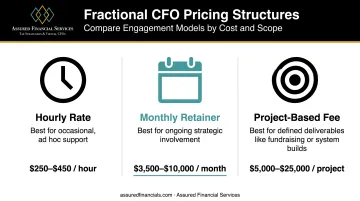
According to TGG Accounting, fractional CFO rates typically fall between $150 and $400 per hour, or $3,000 to $10,000 per month for retainer engagements. What drives the price within that range?
- Company stage — pre-seed needs differ hugely from Series A
- Operational complexity — GovCon compliance or cross-border tax exposure adds scope
- Deliverable scope — a fundraising model costs less than a full financial infrastructure rebuild
- Engagement frequency — weekly CFO calls cost more than monthly check-ins
Compare that to a full-time hire. A 2025 JM Search survey of over 300 sitting CFOs found that at companies with $49 million or less in revenue, the most common full-time CFO package included a $250,000 to $299,000 base salary, plus bonus and equity on top. A fractional arrangement delivers similar strategic input without that fixed overhead.
Firms without a minimum engagement requirement let early-stage startups begin with a lighter footprint. Assured Financial Services, for example, doesn't require a minimum commitment to begin a conversation. Engagement scope gets built during an initial consultation rather than forced into a preset package.
Is a Fractional CFO Worth It for Startups?
The ROI math is straightforward: a fractional arrangement typically costs a fraction of a full-time hire's fully loaded package. The real value shows up in what you avoid: missed fundraising deadlines, cash crunches, or compliance failures that cost far more to fix later than to prevent.
The return scales with complexity. A simple, low-overhead startup with steady revenue and no regulatory exposure might get modest value from a fractional CFO. A GovCon startup facing its first DCAA audit, or a company managing tax obligations across three countries, gets substantially more, because the cost of getting it wrong is so much higher.
How to Choose the Right Fractional CFO for Your Startup
Not all fractional CFOs are interchangeable. Before signing on with one, run through this checklist:
- Relevant industry experience — work with companies like yours, not just "startups" in general
- Credentials — CPA, Enrolled Agent, or equivalent tax and finance qualifications
- Tool fluency — comfort with QuickBooks Online, Deltek Costpoint, Unanet, or whatever platform fits your stage
- Communication cadence — clear expectations for calls, reporting, and availability
If your startup has specialized needs, vet specifically for that expertise. A generalist fractional CFO may not know FAR 31.203 indirect cost rules or how to structure a defensible overhead pool for a DCAA pre-award survey. Cross-border complexity is the same story: FBAR thresholds, Form 8938 filings, and foreign entity reporting require someone who has done that work before.
When those needs show up, look for a firm built around them—not a generalist who learns on your engagement. Assured Financial Services is a principal-led practice founded by an IRS Enrolled Agent with 15+ years across corporate finance and federal government contracting. Every engagement is led directly by the founder, not passed to a rotating account team.
Capabilities that matter for complex startups include:
- In-house, U.S.-based delivery — no offshore outsourcing, so sensitive financial data stays domestic
- Security-cleared staff — support for GovCon startups on classified or security-sensitive work, including DCAA floor checks
- Integrated tax and CFO strategy — one team on financial leadership and the tax positioning behind it

If you are heading into a first cost-type contract or international entity structure, weight technical depth and hands-on leadership as heavily as hourly rate.
Frequently Asked Questions
How much does a fractional CFO for startups charge?
Fractional CFOs typically charge $150-$400 per hour or $3,000-$10,000 per month for retainer work, with project-based fees for defined deliverables. Cost scales with company complexity, scope of work, and engagement frequency.
Is a fractional CFO worth it for startups?
Yes, for most startups facing real financial complexity. The cost is a fraction of a full-time hire. You get clearer decisions, stronger fundraising materials, and fewer costly compliance mistakes.
What's the difference between a fractional CFO and a full-time CFO?
A fractional CFO works part-time, on retainer, or per project, at a fraction of the cost. A full-time CFO is a permanent executive hire with full salary, benefits, and typically equity.
When should a startup hire a fractional CFO?
Common triggers include unpredictable cash flow, an approaching fundraising round, rapid hiring, or investors requesting detailed financial reporting. Compliance-heavy events, like winning a first government contract, also signal it's time.
Can a fractional CFO help my startup raise funding?
Yes. Fractional CFOs build investor-ready financial models, prepare due diligence materials, and provide valuation input during negotiations. That work is hard to produce quickly without dedicated financial expertise.
Do fractional CFOs support niche startups like government contractors or cross-border businesses?
Specialized providers do, but not all generalist fractional CFOs handle DCAA/FAR compliance or FBAR/FATCA obligations well. Firms like Assured Financial Services build their practice specifically around this complexity.