This applies to individuals and business owners who lived, worked, or earned income in more than one state during the year. A multi-state filing doesn't change your federal tax liability. Your federal return stays the same regardless of how many states are involved. What changes is your total state tax exposure, and how much paperwork lands on your desk.
This guide covers who needs to file in multiple states, the step-by-step process, reciprocity agreements that prevent double taxation, and the mistakes that trigger penalties and audits.
Key Takeaways
- Multiple state returns are often required after a move, cross-border work, out-of-state property or business interests, or remote work for an out-of-state employer
- Your residency status in each state (full-year, part-year, or nonresident) determines which forms you file and how income gets taxed
- Reciprocity agreements and credits for taxes paid to another state are the two tools that prevent double taxation
- Skipping a required nonresident filing can trigger penalties, interest, and audit exposure years later
- State rules vary widely—a credentialed tax professional can simplify multi-state compliance and limit unnecessary exposure
What Is Filing Multiple State Tax Returns?
Filing multiple state tax returns means preparing and submitting income tax returns to two or more state revenue departments, in addition to your single federal return. Which states require a return depends on residency, where you physically worked, and where your income was sourced.
Rules are designed so each state taxes only the income properly connected to it, rather than letting two states tax the same dollar twice. States accomplish this through resident credits, reciprocity agreements, or apportionment formulas that split income based on where it was earned.
Your federal tax liability and forms don't change no matter how many states are involved. Only the state-level paperwork multiplies, and so does the risk of getting the allocation wrong.
Residency Categories That Determine Your Filing Requirements
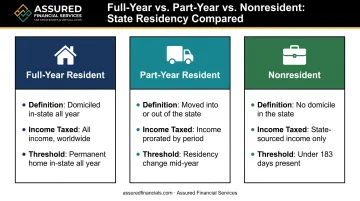
Every state sorts taxpayers into three residency buckets, and your bucket dictates which forms you file and how much income each state can tax.
Full-year resident. Most states use a statutory threshold, commonly 183 days, to establish residency, though the test is rarely just a day count. New York, for instance, requires 184 days or more plus maintaining a permanent place of abode before treating someone as a statutory resident. Full-year residents are typically taxed on worldwide income, regardless of where it was earned.
Part-year resident. If you moved states during the year, both your old and new state generally tax you as a part-year resident. States prorate the income: each state taxes the income you earned while living there, plus any state-sourced income earned during the nonresident portion of the year.
Nonresident. If you never lived in a state but earned money there through wages, rental property, or a business, that state taxes only the income sourced to it. A nonresident who worked ten days in another state, for example, generally owes tax there only on wages tied to those ten days.
Common Scenarios That Require Multiple State Tax Returns
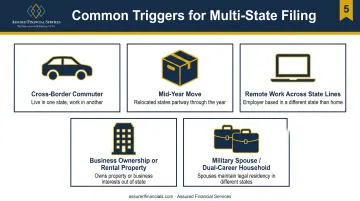
Several distinct life and work situations create multi-state filing obligations. Here's when each one applies.
Living in One State, Working in Another
This is the classic cross-border commuter scenario: you live in New Jersey but work in New York, or live in Virginia but commute into Washington, D.C.
Eight states (Alaska, Florida, Nevada, New Hampshire, South Dakota, Tennessee, Texas, and Wyoming) levy no personal income tax. Washington taxes capital gains but not wages. That simplifies things if you live or work in one of them.
Absent a reciprocity agreement, the general rule is straightforward: file a nonresident return in the state where you work, then a resident return in your home state, claiming a credit for taxes paid to the work state.
Moving to a New State Mid-Year
A mid-year move typically means part-year resident returns in both your former and new state. Each state taxes the income earned while you lived there, allocated based on your actual dates of residency, not an even 50/50 split. Keep your moving date, lease termination, and first paycheck stub from the new state; you'll need them to draw the line.
Remote Work Across State Lines
State tax generally follows where the work is physically performed, not where your employer is headquartered. If you work remotely from Maryland for a company based in California, Maryland, not California, generally has the first claim on those wages.
This trips up a lot of people. In an AICPA-sponsored Harris Poll, 55% of remote workers said they were unaware of the potential tax consequences of working across state lines, and 47% didn't realize states have different rules for remote work.
Those numbers are a few years old, but the underlying confusion hasn't gone away. Remote work has only become more common since.
Business Ownership, Rental Property, or Multi-State Income Sources
Owning a rental property in another state, holding a partnership interest, or being a shareholder in an S-corp that operates across state lines all create nonresident filing obligations in those states. The income is sourced to wherever the property sits or the business operates, regardless of where you personally live.
This is common territory for business owners with multiple ventures, and it's exactly the kind of layered filing situation where allocation errors get expensive.
Military Spouses and Dual-Career Households
The Military Spouse Residency Relief Act lets a civilian spouse elect the same state of residence as the active-duty servicemember. As of 2023, spouses and servicemembers can each choose the servicemember's domicile, the spouse's domicile, or the servicemember's duty station. They don't have to match.
Dual-career households without military status don't get that flexibility. If both spouses work in different states, each spouse's income typically gets sourced and taxed separately, which can mean two nonresident filings plus a joint resident return.
How to File Multiple State Tax Returns: Step-by-Step Process
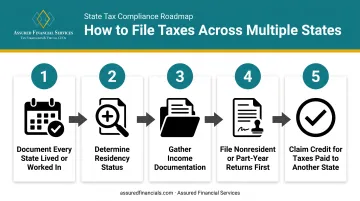
The process follows a clear order. Work through it this way:
- Establish residency status in each state
- Identify income sourced to each state
- File nonresident and part-year returns first
- Complete your resident return and claim any credits you qualify for
Step 1: Document Every State You Lived or Worked In
Track the details that drive allocation and audit defense:
- Move-in and move-out dates for each state
- When you started and stopped working in each location
- Where each income source originated (employer, client, or entity)
A simple spreadsheet with those dates, employer locations, and income by state supports accurate allocation and protects you if a state later challenges residency.
Step 2: Determine Your Residency Status in Each State
Residency tests vary by state, and some go well beyond counting days. New York and Virginia both weigh domicile (where you intend to permanently live) alongside statutory day counts.
California looks at your closest personal and economic connections, with no single factor controlling the outcome. Check each state's specific test rather than assuming a 183-day rule applies universally.
Step 3: Gather Income Documentation
Collect your W-2s, 1099s, K-1s, and expense records before you start filing. You'll need these to allocate income correctly by state and to support any deductions or credits you claim. Missing documentation is one of the most common reasons multi-state returns get delayed or flagged.
Step 4: File Nonresident or Part-Year Returns Before Your Resident Return
File your nonresident or part-year returns first. Most resident states need the tax figures from those returns—especially tax actually paid to the other state—to calculate the credit on your resident return. Filing out of order usually means amending later.
Step 5: Claim the Credit for Taxes Paid to Another State
Once your nonresident return is filed, your resident state generally lets you claim a credit for tax paid to that other state on the same income. The catch: the credit is usually capped at what your resident state would have charged on that income. If the nonresident state's rate is higher, you may still owe the difference. The credit reduces double taxation; it doesn't always eliminate it.
Reciprocity Agreements and Avoiding Double Taxation
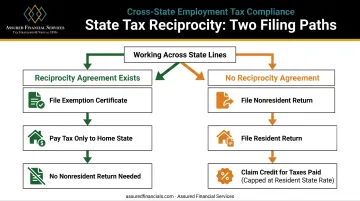
A reciprocity agreement is a deal between two neighboring states that lets residents who work across the border pay income tax only to their home state, skipping a nonresident filing in the work state entirely.
According to the Tax Foundation, there are 30 reciprocity agreements across 16 states and the District of Columbia, though only 17 of those are truly bilateral. States with agreements include:
- Arizona, Illinois, Indiana, Iowa
- Kentucky, Maryland, Michigan, Minnesota
- Montana, New Jersey, North Dakota, Ohio
- Pennsylvania, Virginia, West Virginia, Wisconsin
Reciprocity isn't automatic. To benefit, you typically need to file an exemption certificate with your employer, such as Virginia's Form VA-4 or Pennsylvania's Form REV-419, so your employer stops withholding for the work state and starts withholding for your home state instead. Without that paperwork, you may still need to file for a refund.
One important limit: reciprocity generally covers wages and salaries only. It usually doesn't extend to rental income, business income, or capital gains. Those still get sourced and taxed under standard rules.
When There's No Reciprocity Agreement
Most states without a reciprocity deal allow a credit for taxes paid to another jurisdiction instead. Your resident state calculates tax on all your income, then subtracts a credit for what you already paid the nonresident state on the same income. That credit is usually capped at what your resident state would have charged on that income.
Multi-state filing gets harder when foreign accounts, overseas income, or an international entity structure sit on top of it. Then FBAR, FATCA, and tax treaty rules apply too. Those federal requirements are separate from state residency, but they interact with it in practice.
Assured Financial Services works with clients who carry both multi-state exposure and cross-border reporting, handled by one in-house, U.S.-based team.
Common Mistakes and When to Get Professional Help
Mistake 1: Assuming remote work only owes tax to the employer's state. State tax liability generally follows where you physically perform the work, not where your employer is headquartered or incorporated. A New York company with a remote employee in Texas doesn't make that employee's wages New York income.
Mistake 2: Skipping a nonresident filing because no tax was withheld. If a state requires a return, you owe it, regardless of withholding. New York's late-filing penalty runs 5% per month, capped at 25% of the tax due, plus separate late-payment penalties and interest. Skipping the filing also starts the audit clock and can forfeit your right to a refund later.
Mistake 3: Assuming two-state filing means paying full tax twice. Reciprocity agreements and resident credits exist specifically to prevent that. You may owe some incremental amount if one state's rate is higher, but full double taxation on the same income is the exception, not the rule.
Avoiding these mistakes covers most filers. Professional help is still worth it when the facts get complex. Situations that usually call for an expert include:
- Business owners with income or nexus in multiple states
- Government contractors working across state lines
- Anyone with multi-state plus cross-border or international income
Allocation rules compound quickly once more than two states or an international component enters the picture.
Assured Financial Services is led by an IRS Enrolled Agent with unlimited practice rights before the IRS in all 50 states. The firm provides year-round multi-state tax planning and IRS representation when you need an advocate.
Frequently Asked Questions
How do I file multiple state tax returns if I live in one state and work in another?
File a nonresident return in the state where you work first, then a resident return in your home state claiming a credit for taxes paid to the work state. If the two states have a reciprocity agreement, you generally only file in your home state.
How can I avoid double taxation when filing multiple state tax returns?
Two mechanisms handle this: reciprocity agreements between neighboring states that exempt you from filing in the work state, and resident credits that offset tax already paid to another state on the same income.
Do I have to pay taxes in two states if I moved during the year?
Often yes—but as a part-year resident in each state, not a full-year resident in both. Income is generally prorated based on when you lived and earned money in each state.
What happens if I don't file a required nonresident state tax return?
You risk late-filing and late-payment penalties, daily-compounded interest, and increased audit exposure. Some states also impose a deadline for claiming a refund, so waiting too long can cost you money you're owed.
Which states have no state income tax?
Alaska, Florida, Nevada, South Dakota, Tennessee, Texas, and Wyoming levy no personal income tax. New Hampshire and Washington do not tax wage income (Washington taxes certain capital gains; New Hampshire’s interest and dividends tax is phasing out). Residents may still owe nonresident tax if they earn income in other states.
Can I get a credit for taxes paid to another state?
Most resident states offer this credit, but it's typically capped at what your resident state would have charged on that same income. If the other state's tax rate is higher, the credit may not fully offset the difference.