Introduction
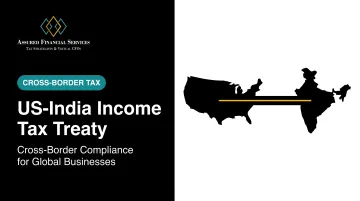
If you have financial ties to both the US and India, you've probably run into a frustrating reality: both countries want a piece of the same income. The US taxes citizens and green card holders on their worldwide income, no matter where they live. India taxes based on residency and source, which means the same paycheck, dividend, or capital gain can trigger claims from two governments at once. The US-India Income Tax Treaty, signed in 1989, exists to sort out that overlap. It determines which country gets primary taxing rights and prevents the same dollar from being taxed twice. This guide breaks down how the treaty works if you are:
- An NRI with US-linked income or accounts
- An Indian national on a US visa
- A US citizen or green card holder with India-sourced income
- A business operating across both countries Assured Financial Services helps clients on these treaty positions and the IRS reporting that comes with them.
Key Takeaways
- The treaty reduces double taxation but doesn't eliminate your US filing obligations
- Which treaty article applies depends on your income type and visa or residency status
- Claim treaty benefits on Form W-8BEN, 8233, or 8833 — skip them and face full withholding
- Foreign Tax Credit usually works alongside treaty provisions, not instead of them
Who the US-India Tax Treaty Applies To
The treaty's job is straightforward: allocate taxing rights between the US and India so both governments don't tax the same income. It was signed on September 12, 1989, and became effective for US purposes starting January 1, 1991.
Article 1 of the official treaty text covers anyone who is a resident of one or both countries under Article 4's definition.
Here's where it gets complicated. For US tax purposes, you're classified as a "US person" if you're a citizen, a green card holder, or you meet the Substantial Presence Test — generally 31 days in the US this year plus a weighted 183 days across the past three years.
That status triggers worldwide income reporting, regardless of where the money was actually earned.
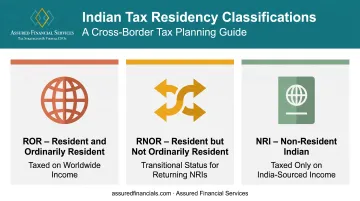
India works differently. Its system sorts individuals into:
- Resident and Ordinarily Resident (ROR) — taxed on worldwide income
- Resident but Not Ordinarily Resident (RNOR) — a transitional category, often for returning NRIs
- Non-Resident Indian (NRI) — taxed only on India-sourced income
That mismatch is exactly why the same person can owe tax on the same income in both countries in a single year. This isn't a fringe issue. Pew Research estimates that 5.2 million people identified as Indian in the United States in 2023, many with cross-border financial ties.
Who Should Pay Close Attention
The treaty matters most to:
- F-1, J-1, and H-1B visa holders with US wages or scholarship income
- US citizens and green card holders who own property, investments, or earn income in India
- Indian companies with US operations or employees
- US businesses with Indian subsidiaries, contractors, or vendors
One point that trips people up constantly: having treaty coverage doesn't remove your requirement to file Form 1040 and disclose foreign accounts and assets. Treaty relief and US filing obligations are two separate things.
Key Treaty Provisions and Benefits Worth Knowing
Not every treaty article applies to every taxpayer. The right one depends on your income type and how long you've been present in each country.
Personal Services and Employment Income
Under Article 15 (independent personal services), income is generally taxed only in your residence country unless you have a fixed base in the other country or stay there 90+ days in the tax year.
Article 16 (dependent personal services) exempts your employment income from US tax if all three conditions apply:
- You're present in the US 183 days or less during the tax year
- Your employer isn't a US resident
- The cost isn't borne by a US permanent establishment or fixed base
Students, Trainees, Teachers, and Researchers
Article 21(2) gives Indian students and business apprentices on F-1 or J-1 status an uncommon benefit: they can claim the standard deduction, something most nonresident aliens can't do.
For 2025, that's $15,750 for single filers, per the Form 1040 instructions. Always confirm the current-year figure before filing.
Article 22 exempts teachers and researchers on J-1 status from US tax for up to two years from their first visit. Watch the fine print here: if you overstay that two-year window, the exemption can be clawed back retroactively for the entire period, not just the excess time.
Withholding Rates on Investment Income
Without treaty protection, US-source dividends, interest, and royalties face a flat 30% withholding rate. The treaty lowers those rates as follows:
| Income Type | Standard Rate | Treaty Rate |
|---|---|---|
| Dividends (10%+ ownership) | 30% | 15% |
| Dividends (other) | 30% | 25% |
| Interest (bank loans) | 30% | 10% |
| Interest (other) | 30% | 15% |
| Royalties | 30% | 15% |
Capital Gains Get No Special Treatment
Here's a common misconception: the treaty does not carve out a capital gains exemption. Short-term gains are taxed as ordinary income. Long-term gains (assets held over a year) may qualify for the standard 0%, 15%, or 20% US rates depending on your income and filing status. Those preferential rates come from domestic law, not the treaty.
Treaty eligibility varies widely by visa category and residency status. Don't assume a benefit applies to you without checking the specific article.
Avoiding Double Taxation: Foreign Tax Credit and Treaty Interaction
If you're a US person earning India-source income, you can end up owing tax to both the IRS and Indian authorities on the same dollar without relief. Two tools address this, and they're often confused with each other.
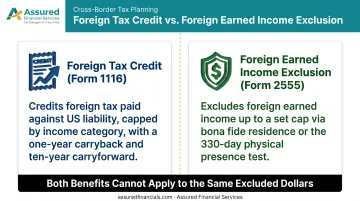
The Foreign Tax Credit (Form 1116) lets you credit foreign tax paid against your US tax liability. It's not a simple dollar-for-dollar swap — the credit is capped at the lesser of the foreign tax paid or the US tax attributable to that foreign income, calculated separately by income category. Unused credit generally carries back one year and forward up to 10 years, so a bad year doesn't necessarily waste the credit.
The Foreign Earned Income Exclusion (Form 2555) works differently. Instead of crediting foreign tax, it excludes foreign earned income from US taxation entirely, up to a set cap. You qualify through either bona fide residence abroad or 330 days of physical presence in 12 months. One catch: you can't use the FEIE and the FTC on the same excluded dollars.
Keep these interaction rules in mind:
- FTC is limited by category and by US tax on that foreign income
- Unused FTC generally carries back 1 year and forward up to 10 years
- FEIE and FTC cannot apply to the same excluded dollars
- Treaty residence tie-breakers and the FTC usually work together, not as substitutes
When Countries Both Claim You as a Resident
Sometimes the US and India both consider you a tax resident in the same year. The treaty's tie-breaker rule resolves this in order:
- Where your permanent home is located
- Where your center of vital interests lies (personal and economic ties)
- Where you have a habitual abode
- Your nationality
- Mutual agreement between tax authorities, if all else fails
Treaty relief and the FTC typically work together, not as substitutes. Pick the wrong combination and you risk overpaying or falling out of compliance.
Assured Financial Services helps clients match treaty positions to the right credits so nothing gets double-counted or missed.
Claiming Treaty Benefits: Forms and Compliance Requirements
Treaty benefits aren't automatic. You have to claim them with the right paperwork, submitted to the right party, at the right time.
- Form W-8BEN — Submit to the withholding agent or payer (not the IRS) to claim a treaty-reduced rate on US-source dividends, interest, or similar income. Skip it, and full 30% withholding typically applies.
- Form 8233 — File to claim a withholding exemption on personal-services compensation or certain scholarship and fellowship income. The withholding agent generally forwards it to the IRS within five days.
- Form 8833 — Attach this Treaty-Based Return Position Disclosure to your tax return when you formally claim a treaty position. Certain student, trainee, teacher, and dependent-services claims are waived.
Getting these forms right is critical. Missing one doesn't just create a paperwork problem. It can mean losing the benefit altogether.
Common Mistakes and Why Professional Guidance Matters
A few errors show up again and again with cross-border filers, and they're avoidable.
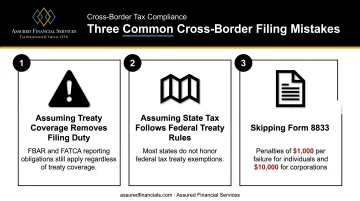
Mistake 1: Assuming treaty coverage means no US filing is required. It doesn't. FBAR (FinCEN Form 114) and FATCA (Form 8938) obligations exist independently of treaty status. If your foreign accounts exceeded $10,000 in aggregate at any point during the year, you likely have an FBAR obligation regardless of what the treaty says about your income.
Mistake 2: Assuming state tax follows federal treaty rules. It often doesn't. States generally don't honor federal treaty exemptions. Income that's treaty-exempt for federal purposes may still be fully taxable at the state level, depending on where you live or work.
Mistake 3: Skipping Form 8833 when it's required. Failing to file it, or misapplying a treaty position, can trigger penalties of $1,000 per failure for individuals and $10,000 per failure for C corporations, on top of potentially forfeiting the treaty benefit itself.
These aren't rare edge cases. They're the gaps that trip up otherwise careful filers—and where professional guidance pays for itself.
Assured Financial Services is led by a federally licensed IRS Enrolled Agent with unlimited practice rights before the IRS in all 50 states. The firm helps cross-border individuals and businesses apply treaty positions correctly, file required disclosures, and respond if the IRS challenges a claim.
All work stays in-house with a U.S.-based team, so sensitive account and compliance data never leaves domestic hands.
Frequently Asked Questions
Does India have a tax treaty with the US?
Yes. The US and India have had a comprehensive income tax treaty in force since 1990, effective for tax purposes starting in 1991, designed to prevent double taxation and allocate taxing rights between the two countries.
How much tax do Indians pay in the US?
There's no single flat rate. It depends on residency status, income type, and which treaty article applies. A student on F-1 status, for example, may claim the standard deduction under Article 21(2), while a resident alien is taxed on worldwide income at graduated rates.
Is income earned in the US taxable in India?
It depends on your Indian residency status. NRIs are generally taxed only on India-sourced income, so US earnings typically stay outside India's tax net. RORs (Resident and Ordinarily Resident) are taxed on worldwide income, including anything earned in the US.
Who pays the 42% tax rate in India?
This refers to India's peak effective rate for very high earners under the old regime — roughly 42.7%, once the top 30% slab is layered with a 37% surcharge and 4% cess. It primarily affects individuals with income above ₹5 crore.
How do I actually claim US-India tax treaty benefits on my return?
Identify the treaty article that applies to your income type, then submit the correct form — W-8BEN or 8233 — to the withholding agent. If required, disclose the position on Form 8833 when you file your return.
Can I claim both tax treaty benefits and the Foreign Tax Credit?
In many cases, yes, depending on the income type involved. The interaction is technical, and wrong sequencing can produce filing errors, so get a professional review before you file.